About Varanus komodoensis Ouwens, 1912
Taxon Introduction
Varanus komodoensis, the Komodo dragon, has the following physical description.
Wild Adult Weight
In the wild, adult Komodo dragons usually weigh around 70 kg (150 lb), while captive individuals often weigh more.
Average Adult Size
Per Guinness World Records, an average adult male weighs 79 to 91 kg (174 to 201 lb) and measures 2.59 m (8.5 ft), while an average female weighs 68 to 73 kg (150 to 161 lb) and measures 2.29 m (7.5 ft).
Largest Captive Specimen
The largest verified captive specimen reached 3.13 m (10 ft 3 in) in length and 166 kg (366 lb) in weight, including undigested food.
Largest Wild Specimens
The largest wild specimen measured 3.04 m (10 ft) in total length, with a 1.54 m (5 ft 1 in) snout-vent length (SVL), and weighed 81.5 kg (180 lb) excluding stomach contents; the heaviest recorded wild specimen reached 87.4 kg (193 lb).
Post-Meal Weight
Studies note that weights over 100 kg (220 lb) are only possible after the animal has eaten a large meal.
Tail, Teeth, and Saliva
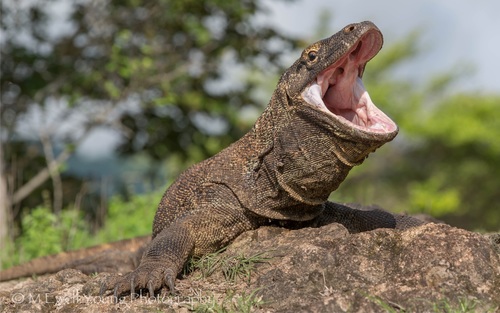
Komodo dragons have a tail equal in length to their body, around 60 frequently replaced serrated teeth that can grow up to 2.5 cm (1 in) long, and their saliva is often blood-tinged because gingival tissue almost completely covering the teeth is naturally lacerated during feeding.
Tongue Structure
They also have a long, yellow, deeply forked tongue.
Skin Armor
Komodo dragon skin is reinforced by armored scales that contain tiny bones called osteoderms, which act as a form of natural chain-mail.
Osteoderm Head Distribution
On the head of an adult Komodo dragon, osteoderms are only absent around the eyes, nostrils, mouth margins, and the parietal eye (a light-sensing organ on the top of the head).
Osteoderm Shape Types
While most lizards have only one or two osteoderm patterns or shapes, Komodo dragons have four types: rosette, platy, dendritic, and vermiform.
Hide Commercial Use
This thick, reinforced hide makes Komodo dragon skin a poor source of leather.
Osteoderm Age-Related Development
Osteoderms become more extensive and variable in shape as Komodo dragons age, and ossify more fully as the lizard grows.
Juvenile Osteoderm Absence
Osteoderms are completely absent in hatchlings and juveniles, which suggests this natural armor develops with age, likely as protection during intraspecific combat between adults over food and mates.
Habitat Preferences
In terms of behaviour and ecology, the Komodo dragon prefers hot, dry environments, and typically lives in dry open grassland, savanna, and low elevation tropical forest.
Activity Patterns
As an ectotherm, it is most active during the day, though it does have some limited nocturnal activity.
Social Behavior
Komodo dragons are solitary, only gathering to breed and feed, and they have individual personality differences, with some individuals (especially females) being shyer than others.
Locomotive Abilities
They can run quickly in short sprints up to 20 km/h (12 mph), dive up to 4.5 m (15 ft), and climb trees proficiently when young, using their strong claws.
Prey Access Adaptation
To reach prey that is out of normal range, Komodo dragons can stand on their hind legs and use their tail for support.
Adult Claw Function
As they mature, their great size makes climbing impractical, so their claws are used primarily as weapons.
Shelter Burrows
For shelter, Komodo dragons dig holes 1 to 3 m (3.3 to 9.8 ft) wide with their powerful forelimbs and claws.
Burrow Thermoregulation
Their large size and use of these burrows for sleeping lets them conserve body heat through the night and reduce how long they need to bask the next morning.
Daily Activity Schedule
Komodo dragons rest in shade during the hottest part of the day and hunt in the afternoon.
Ambush Resting Spots
Their preferred resting spots are usually on ridges with cool sea breezes; these spots are marked with droppings, cleared of vegetation, and also act as strategic positions to ambush deer.
Reproductive Timing
For reproduction, Komodo dragon mating takes place between May and August, and eggs are laid in September.
Male Mating Combat
During this period, males fight over females and territory by grappling with one another on their hind legs until the loser is pinned to the ground.
Pre-Fight Behavior
Males may vomit or defecate when preparing for a fight.
Post-Fight Courtship Check
After winning a fight, the male flicks his long tongue at the female to check if she is receptive.
Female Courtship Response
Females are antagonistic and resist with their claws and teeth in the early stages of courtship, so the male must fully restrain the female during copulation to avoid injury.
Additional Courtship Behaviors
Other courtship behaviours include males rubbing their chins on the female, scratching the female's back hard, and licking.
Copulation Process
Copulation occurs when the male inserts one of his hemipenes into the female's cloaca.
Mating System
Komodo dragons may be monogamous and form pair bonds, which is a rare behaviour for lizards.
Inbreeding Avoidance
To avoid inbreeding, females actively select sperm from distantly related males.
Nest Site Selection
Females lay eggs between August and September, and may use different types of nesting sites; one study found 60% of females laid eggs in the nests of orange-footed scrubfowl (a mound-building megapode), 20% laid on ground level, and 20% laid in hilly areas.
Nest Predation Avoidance
Females build many camouflaged nests or holes to stop other Komodo dragons from eating the eggs.
Nest Sharing
Nests usually only hold one female, though studies have found occasional cases of two females sharing the same den.
Clutch and Incubation
Clutches hold an average of 20 eggs, with an incubation period of 7 to 8 months.
Hatching Process
Hatching is exhausting for newborn Komodo dragons.
Egg Tooth Use
They break out of their eggshells using an egg tooth that falls off shortly after hatching.
Post-Hatching Nest Emergence
After cutting through the shell, hatchlings may stay in the eggshell for hours before digging out of the nest.
Hatchling Vulnerability
They are born defenseless and highly vulnerable to predation.
Hatchling Size
Sixteen hatchlings from one nest had an average length of 46.5 cm and an average weight of 105.1 grams.
Juvenile Habitat
Young Komodo dragons spend most of their first few years in trees, where they are relatively safe from predators (including cannibalistic adult Komodo dragons; juvenile Komodo dragons make up 10% of adult diets).
Cannibalism Function
Cannibalism may help adult Komodo dragons sustain their large body size, as medium-sized prey is rare on the islands they inhabit.
Juvenile Predation Avoidance
When young Komodo dragons approach an adult kill, they roll in faecal matter and rest in the intestines of eviscerated prey to deter hungry adults.
Maturity and Lifespan
Komodo dragons take approximately 8 to 9 years to reach sexual maturity, and can live for up to 30 years.