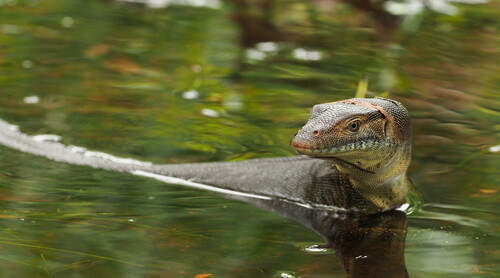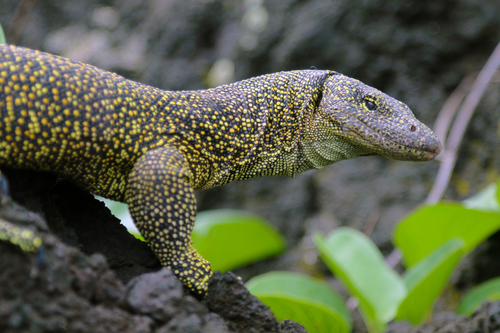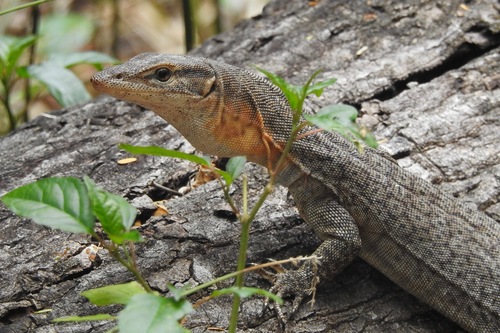
About Varanus tristis Schlegel, 1839
Subspecies Classification
Varanus tristis Schlegel, 1839 has two distinct subspecies.
Nominate Subspecies Size
The nominate subspecies V. t. tristis is the larger of the two, growing up to 80 cm in total length.
Nominate Subspecies Color Variation
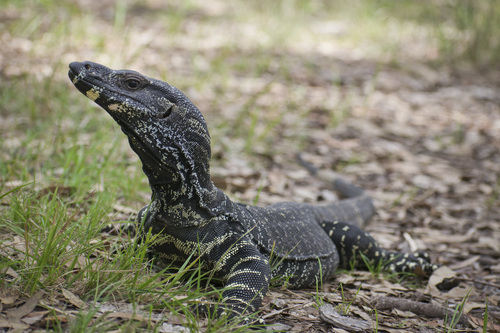
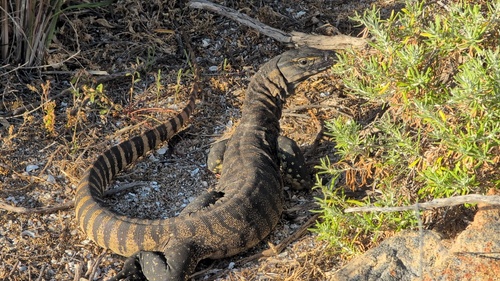
Populations of this subspecies around Perth are completely black, while populations further north in warmer regions show increasingly lighter coloration.
Eastern Subspecies Size
The smaller subspecies is V. t. orientalis, commonly called the freckled monitor, which reaches up to 60 cm long.
Eastern Subspecies Morphology
It has lighter, more distinct coloration than the nominate subspecies, and a less spiny tail.
Juvenile Coloration
Hatchlings of both subspecies are brightly colored, but only freckled monitors retain most of this coloration into adulthood.
Male Secondary Sexual Traits
After reaching sexual maturity, which usually occurs around two years of age, males can be identified by a large cluster of spiny scales on either side of the vent.
Female Secondary Sexual Traits
Females lack these obvious protrusions, and rarely have more than a small number of spines that are only slightly larger than the surrounding scales.
Sexual Maturity Size Threshold
Both sexes reach sexual maturity when they measure 20 cm from snout to vent.
Species Distribution Range
This is the most widespread monitor species in Australia. It occurs across the entire Australian mainland, and even lives on some northern islands including Magnetic Island. It is only absent from the southernmost and south-easternmost regions of the country.
Subspecies Geographic Separation
V. t. tristis occurs mainly in western Australia, while V. t. orientalis is mostly confined to eastern Australia.
Subspecies Sympatry
The two subspecies overlap in range (are sympatric) in some areas, including the east coast of Queensland.
Habitat Type
This is an arboreal monitor lizard. It is most commonly found near rivers in forests, scrublands, and woodlands, but it also inhabits deserts.
Shelter Sites
It takes shelter in tight spaces such as loose bark, tree hollows, and rocky crevices.
Breeding Season Timing
The breeding season occurs in November, when breeding pairs begin sharing the same tree.
Clutch Characteristics
Females lay a clutch of 6 to 11 eggs in December, though clutches can be as large as 17 eggs.
Egg Incubation Details
Eggs incubate at a temperature of 27 to 29°C, and hatch in February or March.