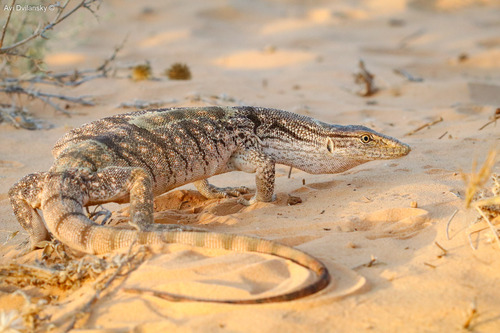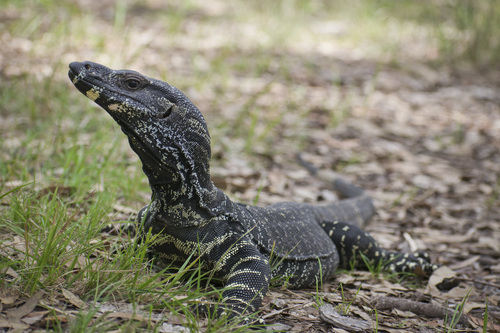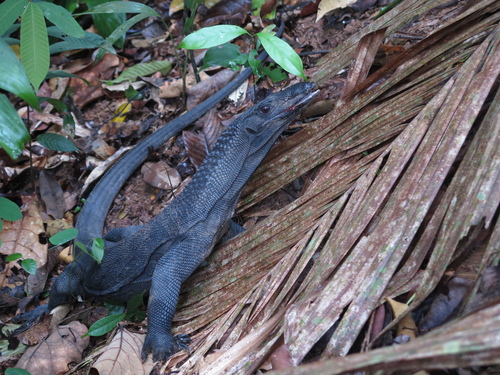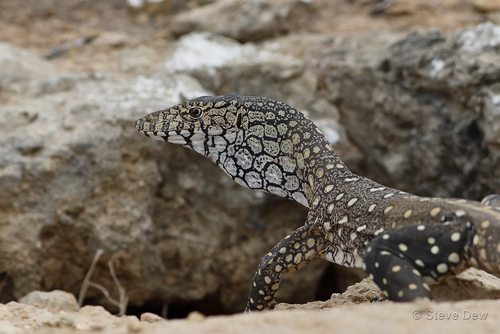
About Varanus salvator (Laurenti, 1768)
Scientific Name and Base Coloration
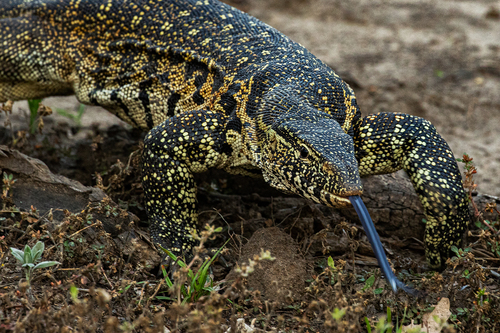
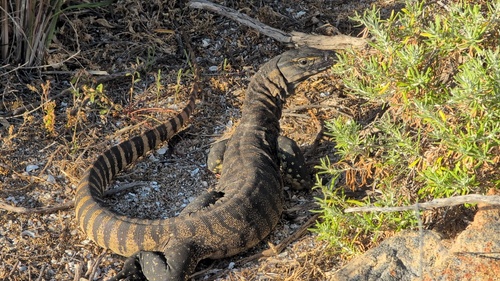
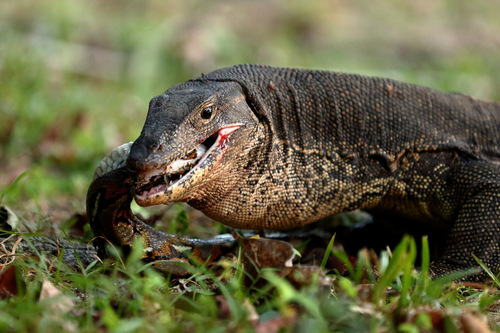
The Asian water monitor (scientific name Varanus salvator (Laurenti, 1768)) has a dark brown or blackish base color, with yellow spots on the underside that fade gradually as the lizard ages. It has blackish bands with yellow edges that extend backward from each eye.
Body and Tail Structure
Its body is muscular, with a long, powerful, laterally compressed tail. All its scales are keeled, and the scales on the top of its head are larger than those on its back.
Head and Limb Features
It has a long neck and an elongated snout, plus powerful jaws, serrated teeth and sharp claws.
Adult Total Length
Most adults do not exceed 1.5–2 m (4 ft 11 in – 6 ft 7 in) in total length; the largest confirmed specimen on record, from Sri Lanka, measured 3.21 m (10.5 ft).
Common Mature Weight
A common mature weight for the species is 19.5 kg (43 lb).
Sumatra Male Size Sample
However, a sample of 80 males killed for the leather trade in Sumatra had an average weight of only 3.42 kg (7.5 lb), average snout-to-vent length of 56.6 cm (22.3 in), and average total length of 142 cm (56 in).
Sumatra Female Size Sample
A sample of 42 females from the same source averaged 3.52 kg (7.8 lb), 59 cm (23 in) snout–vent length, and 149.6 cm (58.9 in) total length.
Sexual Dimorphism and Breeding Maturity Size
Males grow larger than females overall: males reach breeding maturity at 40 cm (16 in) in length and 1 kg (2.2 lb) in weight, while females reach breeding maturity at 50 cm (20 in) in length.
Additional Weight Range Data
One group of adult Asian water monitors had an average weight of 7.6 kg (17 lb), mature individuals in northern Sumatra had an estimated mean body mass of 20 kg (44 lb), and a sample of 55 individuals had weights ranging from 2–32 kg (4.4–70.5 lb).
Maximum Captive Weight
The maximum recorded weight for captive individuals is over 50 kg (110 lb).
Life Expectancy
Captive Asian water monitors have a recorded life expectancy of 11 to 25 years, varying by living conditions; wild individuals have considerably shorter lifespans.
Tooth Structure
Individual teeth are compressed, irregularly serrated, and recurved.
Tooth Replacement
Up to two replacement teeth sit behind each active tooth position at any time, and teeth are replaced every 59 days.
Native Distribution
The Asian water monitor has a wide native distribution ranging from India, Bangladesh, Sri Lanka, Myanmar (excluding northern and northeastern regions), Thailand, Cambodia, Laos, Vietnam, China's Guangxi and Hainan provinces, Malaysia, and Singapore, extending to the Sunda islands of Sumatra, Java, Bali, Borneo, and Sulawesi.
Introduced Population
An introduced invasive population has become established in the southeastern United States.
Elevation Range
It primarily inhabits lowland freshwater and brackish wetlands, and has been recorded at elevations up to 1,800 m (5,900 ft).
Natural Habitat Preferences
It is semiaquatic and opportunistic, and can live in a range of natural habitats, though it is found most often in primary forests and mangrove swamps.
Anthropogenic Habitat Adaptation
It is not deterred from living near human settlements, and has been recorded adapting and thriving in agricultural areas and cities with canal systems, such as parts of Sri Lanka where it is not hunted or persecuted.
Core Habitat Types
Its most important habitats include mangrove vegetation, swamps, wetlands, and areas at elevations below 1,000 m (3,300 ft).
Habitat Limitations
It cannot thrive in habitats that have experienced extensive loss of natural vegetation and aquatic resources, and it prefers cooler habitat areas compared to other large lizards.
Defense Mechanisms
Asian water monitors defend themselves using their tails, claws, and jaws.
Swimming Ability
They are excellent swimmers, using the fin-like ridge on their tails to steer through water.
Small Prey Hunting Behavior
When hunting smaller prey, the lizard subdues prey with its jaws, then violently thrashes its neck to destroy the prey's organs and spine, leaving the prey dead or incapacitated before swallowing it whole.
Ecological Adaptability Traits
In mostly aquatic habitats, its semiaquatic behavior provides protection from predators; this trait, combined with its versatile diet, supports its high ecological adaptability, or plasticity.
Predator Escape via Climbing
When hunted by predators such as the king cobra (Ophiophagus hannah), it climbs trees using its powerful legs and claws.
Predator Escape via Jumping to Water
If climbing does not allow it to escape danger, it has been recorded jumping from trees into streams to hide, a tactic similar to that used by the green iguana (Iguana iguana).
Range Overlap with Komodo Dragon
On the island of Flores, it shares its range with the Komodo dragon.
Carrion Feeding Habit
Like the Komodo dragon, the Asian water monitor often eats carrion, or decaying flesh.
Ecosystem Benefit of Carrion Feeding
By consuming this decaying flesh, it provides an ecosystem benefit by removing infectious material and cleaning the environment.
Age-related Habitat Use
Adult Asian water monitors are primarily terrestrial, while juveniles are primarily arboreal.
First English Literature Description
The first description of the Asian water monitor and its behavior in English literature was published in 1681 by Robert Knox, who observed the lizard during his long confinement in the Kingdom of Kandy.
Knox's Species Description
Knox's description notes: "There is a Creature here called Kobberaguion, resembling an Alligator. The biggest may be five or six feet long, speckled black and white. He lives most upon the Land, but will take the water and dive under it: hath a long blue forked tongue like a sting, which he puts forth and hisseth and gapeth, but doth not bite nor sting, tho the appearance of him would scare those that knew not what he was. He is not afraid of people, but will lie gaping and hissing at them in the way, and will scarce stir out of it. He will come and eat Carrion with the Dogs and Jackals, and will not be scared away by them, but if they come near to bark or snap at him, with his tail, which is long like a whip, he will so slash them, that they will run away and howl."
Breeding Season
The Asian water monitor breeds between April and October.
Egg Laying
Females lay eggs approximately one month after mating, depositing clutches in rotting logs or stumps.
Clutch Size and Incubation
A single clutch can contain 10 to 40 eggs, and eggs have an incubation period of 6 to 7 months.
Hatchling Traits
When they hatch, hatchlings are fully developed and independent.
Reproductive Maturity Length
Reproductive maturity is reached once both males and females reach approximately 150 cm (59 in) in length.