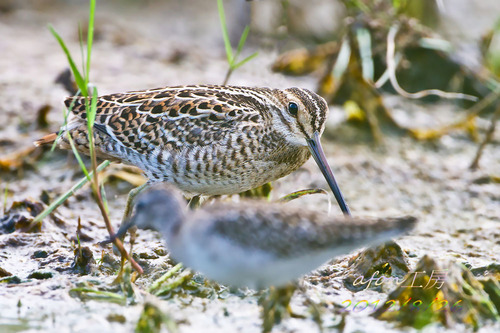
About Tringa totanus (Linnaeus, 1758)
Seasonal Plumage Variation
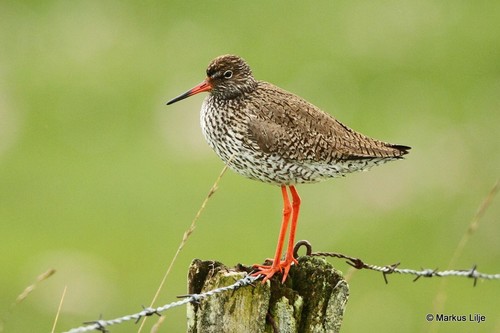
Common redshanks (Tringa totanus) display different plumage colors and patterns across seasons. In breeding plumage, they are marbled brown, with a slightly lighter color on their underside. In winter plumage, they become lighter-toned with less patterning: they are fairly plain greyish-brown on their upper side and whitish on their underside.
Distinctive Physical Markings
They have red legs and a red bill with a black tip, and visible white coloring on the upper back and wings when in flight.
Spotted Redshank Comparison
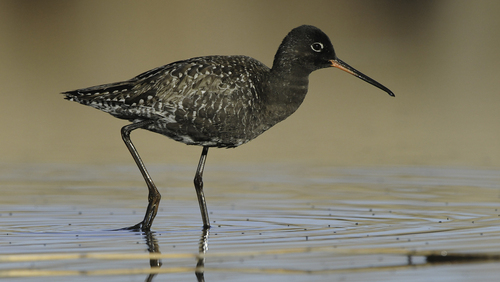
The spotted redshank (T. erythropus), which breeds in the Arctic, has a longer bill and longer legs than the common redshank; it is almost entirely black in breeding plumage and very pale in winter. It is not a particularly close relative of the common redshank, and instead belongs to a high-latitude lineage of larger shanks.
Closely Related Species
By contrast, T. totanus is closely related to the marsh sandpiper (T. stagnatilis), and even more closely related to the small wood sandpiper (T. glareola). The ancestors of the common redshank and the wood sandpiper appear to have diverged around the Miocene-Pliocene boundary, approximately 5–6 million years ago.
Small Shank Group Traits
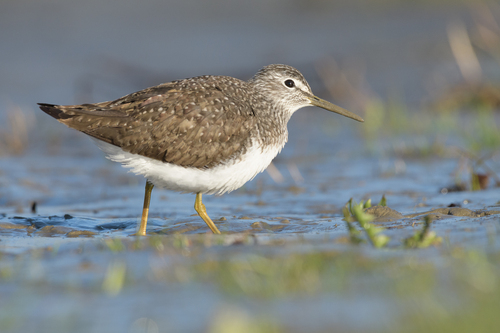
These three species, which occur from subarctic to temperate regions, form a group of smallish shanks that have red or yellowish legs. In breeding plumage, they are generally a subdued light brown on the upper side with some darker mottling, and have somewhat diffuse small brownish spots on the breast and neck.
Breeding Range
The common redshank is a widespread breeding bird across temperate Eurasia.
Wintering Range
It is a migratory species that winters on coasts around the Mediterranean, on the Atlantic coast of Europe from Ireland and Great Britain southwards, and in South Asia.
Vagrant Occurrence General
It is an uncommon vagrant outside these areas.
Micronesia Vagrant Records
For example, the species was recorded in Palau, Micronesia, in the mid-1970s and again in 2000.
India Tagged Sighting
A tagged common redshank was spotted at Manakudi Bird Sanctuary, Kanniyakumari District, Tamil Nadu, India, in April 2021.
North America Vagrant Status
It has been rarely observed in North America.
Caribbean Vagrant Record
In the Caribbean, there is one recorded sighting of a common redshank in Guadeloupe.
South America Vagrant Records
It has also been observed in South America, primarily in Brazil, with an additional recorded sighting in Colombia.
Behavior and Vocalization
Common redshanks are wary, noisy birds that alert other nearby animals with their loud piping call.
Diet
Like most waders, they feed on small invertebrates.