About Tringa melanoleuca (J.F.Gmelin, 1789)
Nomenclature
This species has the scientific name Tringa melanoleuca (J.F.Gmelin, 1789), and is commonly called the greater yellowlegs.
Similar Species
It is similar in appearance to the smaller lesser yellowlegs.
Taxonomic Relationships
Its closest relative is the greenshank; the greenshank, greater yellowlegs, and spotted redshank together form a close-knit group. These three species display all the basic leg and foot colors found in shanks, which demonstrates that this character is paraphyletic. They are also the largest shanks, excluding the more robustly built willet.
Shared Breeding Plumage Traits
In breeding plumage, the greater yellowlegs and greenshank share a coarse, dark, fairly crisp breast pattern, and have a large amount of black on the shoulders and back.
Adult Morphology
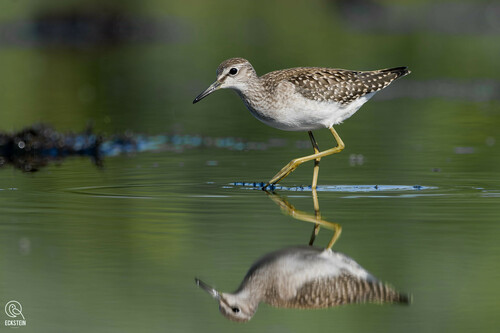
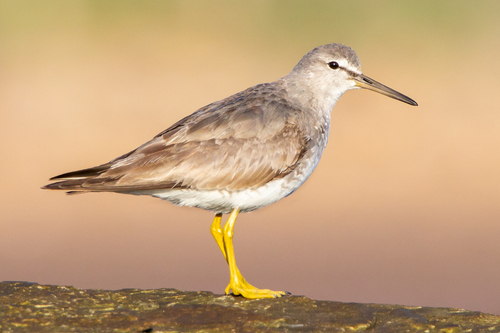
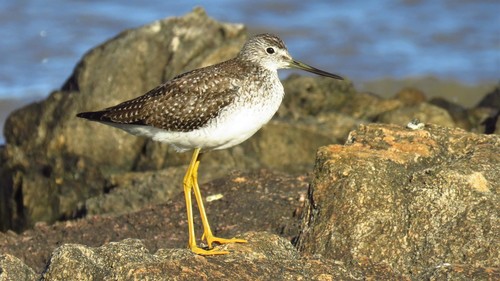
Adult greater yellowlegs have long yellow legs and a long, thin, dark bill that has a slight upward curve and is longer than the head. The upper body is grey-brown, and the underbody is white; the neck and breast are streaked with dark brown, and the rump is white.
Size Measurements
The species ranges in length from 29 to 40 cm (11 to 16 in), in weight from 111 to 250 g (3.9 to 8.8 oz), and has an average wingspan of 60 cm (23.6 in).
Vocalization Characteristics
Its call is harsher, louder, and clearer than the call of the lesser yellowlegs. When calling in flight, it produces a three-syllable whistle, with the third syllable at a lower pitch.
Breeding Habitat
Its breeding habitat is bogs and marshes in the boreal forest region of Canada and Alaska.
Migration Range
It migrates to the Atlantic and Pacific coasts of the United States, the Caribbean, and as far south as South America. It is a very rare vagrant to western Europe.
Foraging Behavior
Greater yellowlegs forage in shallow water, sometimes using their bills to stir up the water.
Diet
They mainly eat insects and small fish, and also consume crustaceans, marine worms, frogs, seeds, and berries.