About Arenaria interpres (Linnaeus, 1758)
Scientific Nomenclature
This bird, the ruddy turnstone, has the scientific name Arenaria interpres (Linnaeus, 1758).
Size Measurements
It is a fairly small, stocky wader, measuring 22–24 cm (8.7–9.4 in) in length, with a 50–57 cm (20–22 in) wingspan, and weighing 85–150 g (3.0–5.3 oz).
Bill and Leg Characteristics
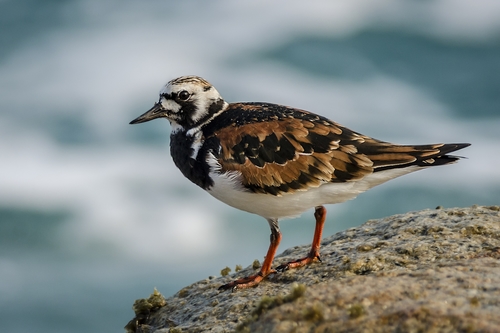
It has a dark, slightly upturned wedge-shaped bill 2–2.5 cm (0.79–0.98 in) long, and fairly short bright orange legs 3.5 cm (1.4 in) long.
General Plumage Pattern
Its plumage is dominated by a harlequin-like pattern of brown, black, and white in all seasons.
Breeding Adult Plumage
Breeding individuals have reddish-brown upperparts with black markings; the head is mostly white with black streaks on the crown and a black facial pattern. The breast is mostly black with a white patch on the sides, and the rest of the underparts are white.
Flight Plumage Features
In flight, it shows a white wingbar, a white patch near the wing base, and white lower back, rump, and tail, with dark bands on the uppertail-coverts and near the tail tip.
Female Plumage
Females are slightly duller than males, with a browner head that has more streaking.
Non-breeding Adult Plumage
Non-breeding adults are duller than breeding birds, with dark grey-brown upperparts with black mottling and a dark head with little white.
Juvenile Plumage
Juvenile birds have a pale brown head, and pale fringes on upperpart feathers that create a scaly appearance.
Subspecies Morphology
The subspecies A. i. morinella is marginally smaller, with darker upperparts and less streaking on the crown.
Vocalizations
The ruddy turnstone has a staccato, rattling call, and a chattering alarm call that is mainly given during the breeding season.
Breeding Range General
The ruddy turnstone breeds in northern latitudes, usually within a few kilometers of the sea.
A. i. morinella Breeding Range
Subspecies A. i. morinella occurs in northern Alaska and Arctic Canada as far east as Baffin Island.
A. i. interpres Breeding Range
Subspecies A. i. interpres breeds in western Alaska, Ellesmere Island, Greenland, Norway, Denmark, Sweden, Finland, Estonia, and northern Russia. It formerly bred on Germany’s Baltic coast, and may have bred in Scotland and the Faroe Islands.
Americas Winter Range
In the Americas, this species winters on coastlines from Washington and Massachusetts south to the southern tip of South America; it is scarce in southern Chile and Argentina, and is only an unconfirmed vagrant in the Falkland Islands.
Europe Winter Range
In Europe, it winters in western regions from Iceland, Norway, and Denmark southward, with only small numbers found on Mediterranean coasts.
Africa Winter Range
In Africa, it is common all the way south to South Africa, with large populations on many offshore islands.
Asia Winter Range
In Asia, it is widespread in the south, and wintering birds range as far north as southern China and Japan, mainly in the Ryukyu Islands.
Pacific Winter Range
It occurs south to Tasmania and New Zealand, and is present on many Pacific islands.
Non-breeding Residency
Some non-breeding birds stay year-round across many parts of the wintering range, and some of these birds still develop breeding plumage in spring and summer.
Habitat Tolerance
Ruddy turnstones can survive in a wide range of habitats and climatic conditions, from Arctic to tropical environments.
Breeding Habitat
Their typical breeding habitat is open tundra located near water.
Non-breeding Coastal Habitat
Outside the breeding season, they live along coasts, particularly on rocky or stony shores. They are often found on human-made structures such as breakwaters and jetties, and may venture onto open grassy areas near the coast.
Inland Occurrence
Small numbers sometimes appear on inland wetlands, especially during spring and autumn migration.
Winter Site Fidelity
Ruddy turnstones are particularly faithful to specific wintering sites. A 2009 study of turnstones wintering along a stretch of coastline in the Firth of Clyde found that 95% of birds resident to the area at the end of winter returned the following autumn.
Lifespan and Mortality
The same study also confirmed the ruddy turnstone is one of the longest-lived wader species, with annual adult mortality rates under 15%. Its average lifespan is 9 years, and the longest recorded lifespan is 20 years.
Mating System
The ruddy turnstone is a monogamous species, and pairs may stay together for more than one breeding season.
Nest Characteristics
The nest is a shallow scrape about 11 cm (4.3 in) across and 3 cm (1.2 in) deep, often lined with leaves. It may be built among vegetation or on bare stony or rocky ground, and multiple pairs may nest close together.
Clutch Details
A single clutch of two to five eggs is laid, with four being the most common. Eggs measure about 41 mm × 29 mm (1.6 in × 1.1 in) and weigh around 17.9 g (0.63 oz).
Egg Appearance
They are smooth, slightly glossy, and shaped oval to pear-shaped. Their colour varies, but they are commonly pale green-brown with dark brown markings that are densest at the larger end.
Incubation Period
Incubation starts when the first egg is laid and lasts 22–24 days. The female is mainly responsible for incubating eggs, but the male may help toward the end.
Hatchling Characteristics
Young birds are precocial and can leave the nest soon after hatching. They are buff above with dark grey markings and white below.
Chick Development
They can feed themselves, but are protected by their parents, particularly the male. They fledge after 19–21 days.