About Tringa glareola Linnaeus, 1758
Nomenclature
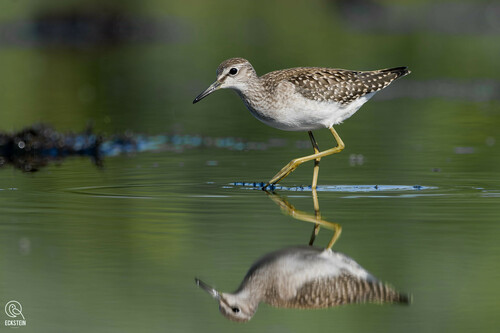
This species, scientifically named Tringa glareola Linnaeus, 1758, is commonly known as the wood sandpiper.
Overall Morphology Comparison
It resembles a longer-legged, more delicate version of the green sandpiper (T. ochropus) or the solitary sandpiper (T. solitaria), but has a shorter, finer bill, a brown back, and longer yellowish legs.
Rump Patch Differences
It differs from the green sandpiper by having a smaller, less contrasting white rump patch, while the solitary sandpiper has no rump patch at all.
Phylogenetic Relationship
Despite this similarity in appearance, the wood sandpiper is not closely related to these two species. Its closest relative is the common redshank (T. totanus), and the two share a sister relationship with the marsh sandpiper (T. stagnatilis).
Species Group Traits
These three species form a group of smallish shanks with red or yellowish legs.
Breeding Plumage
In breeding plumage, they have subdued light brown upperparts with some darker mottling, and a pattern of somewhat smaller diffuse brownish spots on the breast and neck.
Breeding Range
The wood sandpiper breeds in subarctic wetlands, stretching from the Scottish Highlands in the west, east across Eurasia and the Palearctic.
Core Migration Destinations
It migrates to Africa, South Asia (particularly India), and Australia.
Pacific Vagrant Records
Vagrant individuals have been observed as far into the Pacific as the Hawaiian Islands.
Micronesia Occurrence
In Micronesia, it is a regular visitor to Palau and the Mariana Islands, where flocks of up to 32 birds have been reported.
Marshall Islands Occurrence
It is observed and recorded on Kwajalein, Marshall Islands, approximately once each decade.
Western Pacific Occurrence Period
This species is also encountered in the Western Pacific region of East Asia and some Western Pacific islands between mid-October and mid-May.
Range Expansion
A slight westward expansion led to the establishment of a small resident breeding population in Scotland beginning in the 1950s.
Non-breeding Habitat
During migration and wintering, this species is usually found in and around freshwater habitats.
Adult Primary Moult
Mature wood sandpipers moult all of their primary feathers between August and December.
Juvenile Primary Moult
Juvenile birds shed a varying number of outer primaries between December and April, much closer to their departure from Africa.
Immature Moult Flexibility
Immature birds are also much more flexible than older birds regarding the timing and rate of their moult and refueling.
Non-stop Flight Capacity
Adults and immatures that accumulate fuel loads of around 50% of their lean body mass can potentially cross distances of 2397–4490 km in one non-stop flight.
Foraging Behavior
Wood sandpipers forage for invertebrates by probing their bills in shallow water or wet mud, such as along lakeshores or riverbanks.
Diet
They mainly eat aquatic insects, crustaceans, arthropods, various worms, and other small prey.