About Theristicus caudatus (Boddaert, 1783)
Size
The buff-necked ibis, Theristicus caudatus (Boddaert, 1783), has a total length of approximately 75 centimetres, which equals 30 inches.
Plumage Features
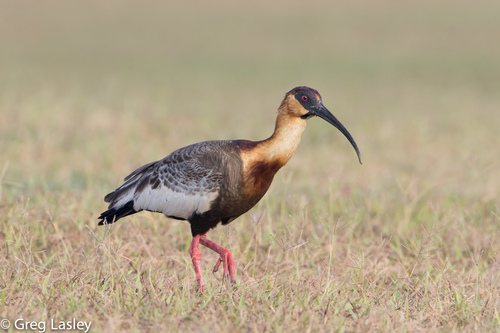
Its neck is buffish, upperparts are grey, belly and flight feathers are black, and it has a large white patch on the wings. Unlike ibises of genera such as Eudocimus and Plegadis, its relatively short legs do not extend beyond the tail when the bird is in flight.
Flight Appearance
In flight, this white patch forms a broad white band on the upperwing that separates the black remiges and the grey lesser wing-coverts.
Bare Part Coloration
The bill and bare skin around the eyes are blackish, and the legs are red.
Habitat Range
The buff-necked ibis inhabits a wide range of open habitats, including fields, marshes, savanna and grassland.
Subspecies Distribution
There are two primary populations: the nominate subspecies is found across northern and central South America in Colombia, Venezuela, the Guianas and Brazil, while the very similar subspecies hyperorius occurs in south-central South America in southern Brazil, eastern and northern Bolivia, Paraguay, Uruguay, and northern Argentina.
Elevation Limits
It is almost entirely restricted to tropical and warmer subtropical lowlands, but very locally it extends into highlands, though it never reaches as high as the Andean ibis.
Movement Patterns
It is almost entirely resident, although local movements may take place. It has been recorded as an accidental visitor to Panama.
Conservation Status
With a large range and an estimated total population of 25,000 to 100,000 mature individuals, the buff-necked ibis is evaluated as Least Concern on the IUCN Red List of Threatened Species.