About Pseudibis papillosa (Temminck, 1824)
Scientific Classification
The red-naped ibis (scientific name Pseudibis papillosa (Temminck, 1824)) is a large black bird with long legs and a long downcurved bill.
Plumage Characteristics
Its wing feathers and tail are black with a blue-green gloss, while the neck and body are brown and lack gloss. A distinct white patch stands out on the shoulders, and the top of its featherless head has a patch of bright red warty skin.
Head Caruncle Details
This warty patch, technically called a caruncle, is triangular: its apex sits at the crown, and its base lies behind the nape, and it only develops in adult birds.
Iris Coloration
The iris is orange-red.
Sexual and Juvenile Morphology
Both sexes look identical; young birds are browner, and start life without a bare head and red crown patch.
Bill and Leg Coloration
The bill and legs are grey, but turn reddish during the breeding season.
Foot Structure
The toes have a fringing membrane and are slightly webbed at the base.
Calling Timing
Red-naped ibises are usually silent, but call at dawn and dusk, and call more often when nesting.
Call Description
Their calls are a series of loud braying, squealing screams that decrease in loudness. Nocturnal calling is rare, and has only been observed in urban settings.
Similar Species Distinction
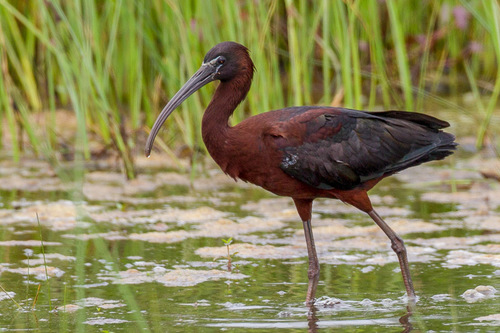
This species can be confused with the glossy ibis when seen at a distance, but the glossy ibis is smaller, more gregarious, tied to wetlands, lacks the white shoulder patch, and has a fully feathered head.
General Distribution Range
The red-naped ibis is widely distributed across the plains of the Indian subcontinent.
Rajasthan Habitat Use
In Rajasthan, it is common along the Aravalli mountains, but entirely avoids using trees on these mountains.
Habitat Types Used
Habitats used by the species include lakes, marshes, riverbeds, irrigated farmlands, dry fallow fields, villages, towns and cities.
Foraging Habitat Seasonality
Landscapes with more wetlands attract larger numbers of red-naped ibises, but the birds forage mostly in dry fields, increasing their use of wetlands for foraging during summer.
Flock Size
In semi-arid areas, it is commonly seen in small flocks of 2 to 4 individuals, which may be family groups, and larger groups are relatively rare.
Abundance and Seasonality
Fewer ibises are counted in wetter locations and during wet seasons.
Breeding Range in Northern India
It is a common breeding resident in Haryana, Punjab, Rajasthan and the Gangetic plains.
Southern Range Limits
Its range extends into southern India, but it is not found in the forested regions, the arid zone of the peninsula's extreme southeast, or in Sri Lanka.
Nepal Habitat Partitioning
In lowland Nepal, most foraging red-naped ibises are seen in agricultural fields, but most nests are found in forests.
Human Settlement Use
Red-naped ibises commonly use villages, towns and mega-cities to seek food, nest and roost.
Activity Rhythm
The species is largely diurnal for foraging and all other activities, and roosts communally at night on trees or islands. Nocturnal activities such as loud calling are rare.
Interspecific Competition Avoidance
In semi-arid areas, it avoids potential competitive interactions with other sympatric ibis species by foraging mostly in upland habitats.
Initial Diet Observations
Early observations and stomach content analyses showed the red-naped ibis's diet includes crustaceans (prawns, crabs), insects (beetles, grasshoppers, crickets), scorpions, carrion and frogs.
Omnivorous Diet Confirmation
Later additional observations confirm the species is omnivorous, feeding on carrion, insects, frogs, other small vertebrates, and grain.
Foraging Associations
It forages mainly in dry open land and stubbly fields, and sometimes joins egrets and other birds on tilled land to feed on exposed earthworms and disturbed insects, as well as dig for beetle grubs.
Foraging Behavior
It walks, and like other tactile-feeding ibises, probes in soft ground. It rarely wades in water, but has been observed seeking frogs hiding in crab holes.
Garbage Foraging
It commonly feeds at garbage dumps, eating mammal and bird carcasses.
Urban Prey Sources
In small towns, red-naped ibises hunt adult Rock Pigeons and prey on their eggs from building nests.
Roadkill Foraging
Near towns, ibises eat road kills, and pull marrow from the bones of cattle killed in traffic collisions.
Drought Foraging Adaptations
During droughts, they have been seen feeding on carrion and insect larvae that develop on carrion.
Crop Consumption
They also feed on groundnut and other crops.
Historical Agricultural Role
In British India, indigo planters considered them useful because they seemed to consume large numbers of crickets in fields, earning the species the nickname "planter's friend".
Nectar Feeding Observations
Both adult and juvenile red-naped ibises in Delhi have been observed digging into the flowers of Bombax ceiba, apparently to drink nectar.
Rare Fishing Behavior
Fishing by red-naped ibises is rare, and has only been observed in reservoirs.
Roosting and Flight Behavior
Ibises roost in groups, and fly to and from regularly used roost sites in a "V" formation.