About Nipponia nippon (Temminck, 1835)
Scientific Name and Length
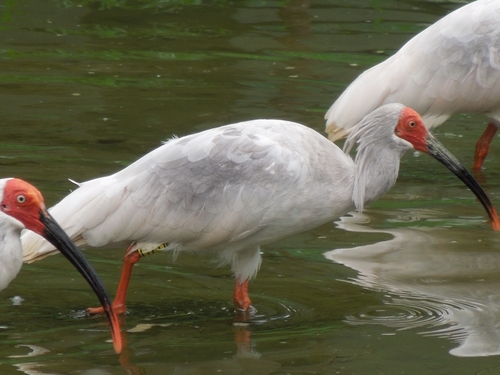
This species, the crested ibis (Nipponia nippon (Temminck, 1835)), is a medium-sized to large ibis that measures 55–78.5 cm (21.7–30.9 in) in length. It has a bare red face and a dense crest of plumes on the nape.
Seasonal Plumage
Its plumage changes with the seasons: in winter, it is mostly white, with salmon-pink tones on the wings and tail; in summer, its upper body and breast are pale grey, with a darker grey shawl across its back, and its underparts are white with a faint salmon-pink tinge. When in flight, the upper sides of the wings and tail are white, while the undersides of the flight feathers on the wings and tail have a strong pink flush.
Bill and Limb Coloration
The crested ibis has a long, strongly downcurved bill that is black with a red tip; its legs and feet are red.
Juvenile Facial Features
Juveniles have downy feathers on their cheeks, with the remaining facial skin bare and orange-yellow.
Juvenile Plumage and Soft Parts
Juvenile plumage has a smoky grey tinge and a rosy sheen; juvenile legs are pale brown, and the iris is light yellowish-brown.
Habitat
The crested ibis lives in temperate mountain forests and hilly regions, and is often active near rice paddies, riverbanks, ponds, marshes, and mountain streams. It usually builds its nests in tall trees located near wetlands.
Former Distribution in China
The crested ibis was once widespread across China, occurring in the Ussuri River basin and Lake Xingkai in Heilongjiang Province (northeastern China); eastern, central, and western Jilin Province; Dalian, Jin County, and Yingkou on the Liaodong Peninsula in Liaoning Province; Hebei Province; western Henan Province; Shandong Province; southeastern Shaanxi Province; Mount Taibai and Yangxian County in southern Shaanxi Province; Lanzhou and southeastern Huixian in Gansu; Anhui; Qu County in Zhejiang; and Fuzhou and Hainan Island.
Former International Distribution
It also nested in the Russian Far East and Japan, and was a non-breeding visitor to the Korean Peninsula and Taiwan.
Current Distribution
Currently, it is only found in Yangxian County, Shaanxi.