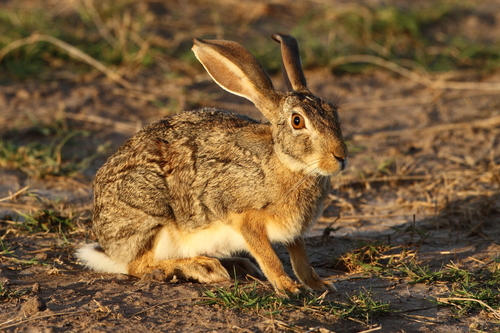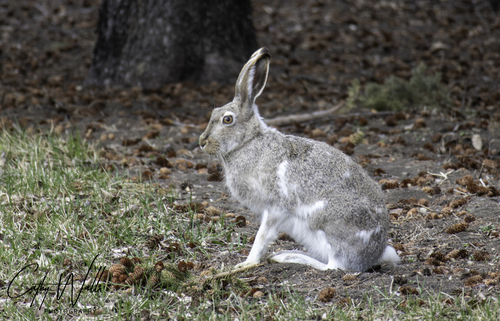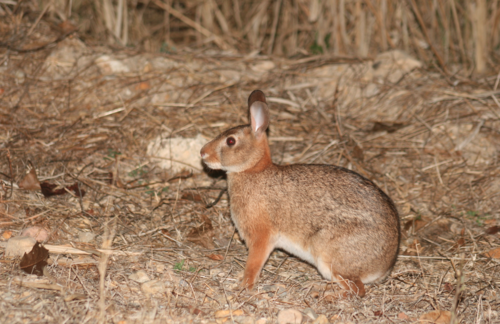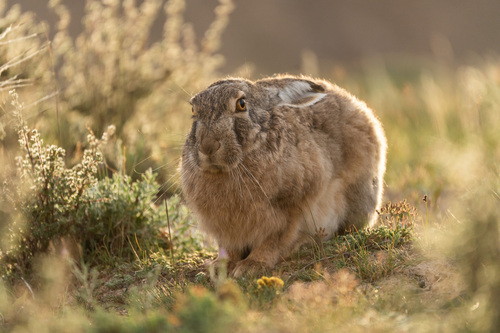
About Sylvilagus aquaticus (Bachman, 1837)
Common Name and Classification
Sylvilagus aquaticus, commonly called the swamp rabbit, is the largest species of cottontail rabbit.
Ear Size Relative to Other Cottontails
Its ears are smaller relative to its body than the ears of other cottontail species.
Coloration
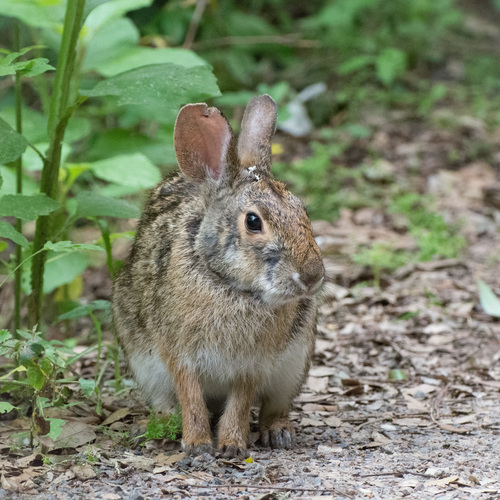
The head and back are typically dark brown, rusty brown, or black, while the throat, ventral surface, and tail are white, and a cinnamon-colored ring surrounds each eye.
Morphological Comparison to Eastern Cottontail
Though the swamp rabbit is largely similar in appearance to the eastern cottontail (Sylvilagus floridanus), it differs in ear and skull size: the swamp rabbit has much smaller ears and a larger skull. Additionally, the back portions of the swamp rabbit's hind legs are orange, which contrasts with the tan or white feet of the eastern cottontail.
Dental Formula
Like other leporids, the swamp rabbit has a dental formula of 2.0.3.3/1.0.2.3 × 2 = 28 total teeth: two pairs of upper incisors, one pair of lower incisors, no canines, three upper premolars and two lower premolars on each side, and three upper and three lower molars on each side of the jaw.
Male Weight
Male S. aquaticus weigh approximately 4 to 5.6 pounds (1.8 to 2.5 kg), with an average weight of about 5 pounds (2.3 kg).
Female Weight
Females weigh approximately 3.6 to 5.9 pounds (1.6 to 2.7 kg), with an average weight of about 4.8 pounds (2.2 kg).
Body Length
The total body length of S. aquaticus ranges from approximately 17.8 inches (45 cm) to 21.7 inches (55 cm), with an average length of about 19.7 inches (50 cm).
Sexual Dimorphism
Males and females of this species show very little sexual dimorphism in size.
Subspecies Distinction
The subspecies S. a. littoralis is distinguished from the nominate subspecies by its darker, redder fur, and is geographically restricted to the Gulf coast.
Physiology Research Status
Very little is known about the swamp rabbit's physiology.
Overall Distribution
The swamp rabbit is found across much of the south-central United States and along the Gulf coast.
Range of Inhabited States
It is most abundant in Alabama, Mississippi, and Louisiana, and also inhabits South Carolina, Arkansas, Tennessee, Texas, Oklahoma, Missouri, Kentucky, Illinois, Indiana, and Georgia.
Local Extirpation Status
It is possibly extirpated, or locally extinct, from Kansas.
Habitat Preferences
Swamp rabbits mainly live close to lowland water, most often in cypress swamps, marshland, floodplains, and river tributaries. They spend much of their time in depressions they dig in tall grass or leaves, which provides cover while they wait until night to forage.
Indicator Species Potential
The swamp rabbit has been suggested for use as an indicator species, because its preferred habitat is shared by many other species, it uses different aspects of its habitat, and it is easy to monitor.
Overlapping Ranges with Similar Species
The ranges of both the marsh rabbit and eastern cottontail overlap with that of the swamp rabbit.
Population Threats
Habitat loss and fragmentation have caused declines in swamp rabbit populations.
Vulnerability During Snowy Periods
In the northernmost regions of its range, the swamp rabbit is particularly vulnerable during snowy periods. Its dark coat makes it highly visible against a white background, which increases its vulnerability to predators. Snow cover also limits both its ability to hide and the availability of food resources.
Territoriality and Home Ranges
Swamp rabbits are territorial, though they will tolerate some overlap between individual home ranges depending on the season. These home ranges can vary in size from 1 to 12 hectares (2.5 to 29.7 acres).
Territory Marking Behavior
They mark their territory through a behavior called "chinning", which involves marking objects with pheromones produced by glands near the chin; this behavior is also observed in the European rabbit.
Male Territorial Fighting
Males competing for territory or social status may fight, and battles can sometimes result in an individual's death. Competing males stand up on their hind legs, lash out with their teeth and claws, and even use the claws on their hind feet during jumping attacks. However, fighting is rare compared to nonviolent displays of dominance and submission.
Social Order and Communication
Swamp rabbits maintain social order through dominance displays, and communicate directly through vocalizations including squeaks, chirps, squeals, and alert calls.
Dominance Hierarchy Dynamics
Higher-ranking males display dominance over lower-ranking males more frequently, and move through female home ranges more frequently. The alpha male typically copulates most often in a given breeding season. This male dominance system prevents injury to subordinate breeding males below the alpha, as lower-ranking individuals avoid higher-ranking males to prevent conflict.
Predator Evasion Maneuvers
When escaping predators, swamp rabbits use confusing maneuvers to evade pursuers, such as jumping onto a log, running to its end, backtracking, and jumping off the opposite side.
Swimming Capabilities for Escape
They are excellent swimmers, and may also dive into water to escape, sometimes keeping only their nose and eyes above the water surface.
Breeding Synchrony
Swamp rabbits are synchronous breeders, meaning individuals within a population tend to breed at the same time.
Birthing Nest Construction
Females line a ground depression with fur and grass to build a birthing nest. These nests, which are also used for thermoregulation, are called forms, and are common among non-burrowing rabbit species.
Offspring Development
Females give birth to altricial young: the newborns are immobile, and only open their eyes and begin walking after three days. Weaning is complete at 15 days, after which the young leave the nest. Juveniles become sexually mature at seven months old and reach adult weight at 10 months old.
Juvenile Social Integration Research Status
Very little is known about how juvenile rabbits join larger social groups.
Breeding Season Variation
The swamp rabbit's breeding season varies across its range. It occurs year-round in Texas, while elsewhere it falls between February and August.
Male Reproductive Timing
A study in Missouri found that spermatogenesis occurs in October and November, and in Mississippi, recorded males had descended testes more often in December and February than in any other months.
Estrus and Gestation
Estrus lasts one hour following induced ovulation. The average gestation period is 37 days.
Litter Production
A female can produce up to three litters annually, and each litter contains one to six young.
Embryo Resorption
Embryo resorption can occur in S. aquaticus in response to stress, which can lead to loss of an entire litter. This stress response is most often attributed to flooding, which causes overcrowding and directly triggers the release of stress hormones.