About Lepus oiostolus Hodgson, 1840
Taxonomic Identification
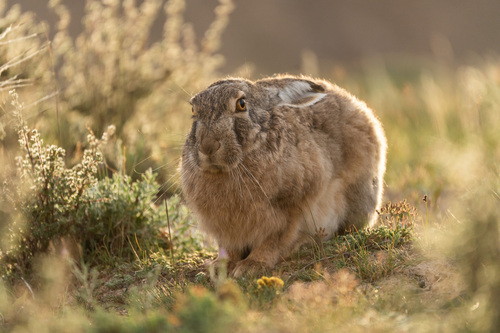
The woolly hare (scientific name Lepus oiostolus Hodgson, 1840) is a medium- to large-sized hare.
Body Measurements
It has a head-body length of 40 to 58 centimetres (16 to 23 inches), an average weight of 2.4 to 3 kilograms (5.3 to 6.6 pounds), ears that measure from 11 to 16 cm (4.3 to 6.3 in), and hind feet roughly 10 to 14 cm (3.9 to 5.5 in) long.
Facial Markings
It has whitish rings around the eyes.
Sexual Size Dimorphism
Males are slightly smaller than females.
Ear Characteristics
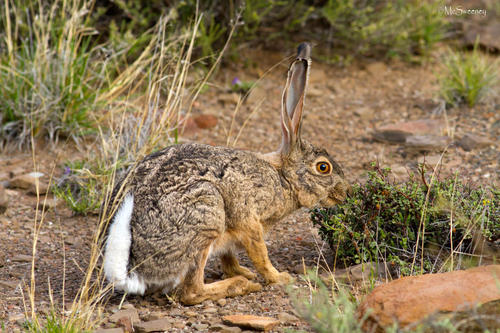
Among Chinese hares, the woolly hare has the largest ears, which are darker at the tip than at the base.
Auditory Bullae Structure
The auditory bullae, the bone structures that enclose the inner ear, are small.
Dental Formula
Like other leporids, it has a dental formula of 2.0.3.3 / 1.0.2.3 × 2 = 28 total teeth: two pairs of upper incisors, one pair of lower incisors, no canines, three upper and two lower premolars on each side, and three upper and lower molars on either side of the jaw.
Pelage Color Variation
Its thick, soft fur varies widely in colour across the species' distribution, ranging from sandy yellow to light brown.
Pelage Texture
Its fur is especially long and curly, giving it a woolly appearance that gives the hare its common name.
Dorsal and Ventral Pelage Contrast
The fur on its underside and near the hips is lighter in colour than the fur on its back and rump.
Abdominal Pelage
Its abdominal fur is mostly white, and may have a light brown line along the mid-ventral line.
Tail Characteristics
The hare's tail is white above and below, except for a narrow brown-gray stripe on its dorsal surface, and measures roughly 6.5 to 12.5 cm (2.6 to 4.9 in) in length.
Muzzle and Moulting
Its muzzle is elongated and narrow, and it moults its fur coat just once a year.
General Distribution Range
The woolly hare is native to Central Asia, and is found throughout most of the Tibetan Plateau.
Country and Regional Distribution
Its range extends from the border regions of northern Nepal and India (including Sikkim and Ladakh) to western and central China, where it occurs in Gansu, Qinghai, Sichuan, the Tibet Autonomous Region and Xinjiang.
Primary Habitat Type
The woolly hare mainly inhabits high altitude grasslands.
Secondary Habitat Types
It lives in alpine meadows, shrubby meadows, and upland cold deserts, but also occurs in coniferous or mixed montane woodland.
Habitat Shelter Requirements
In grassland habitats, the hare requires a certain amount of low-lying vegetation, such as shrubs, to use as shelter.
Altitudinal Range
It has been found at altitudes ranging from 2,500 to 5,400 metres (8,200 to 17,700 feet) above sea level.
Temperament and Activity Pattern
The woolly hare is a shy, usually solitary animal, and is mostly nocturnal, though it has been recorded active during the daytime.
Feeding Habits
It feeds on grasses and herbs, and individual hares regularly return to the same foraging areas at night.
Diurnal Resting Behaviour
During the day, it sometimes rests in the sun in a sheltered position.
Reproductive Traits
The breeding season starts in April, and each female produces an average of three young per year across two litters.
Population Demographics
Woolly hare populations generally have equal numbers of males and females, and young individuals may make up as much as half of a population's total size.
Population Density
A study conducted in Tibet reported population densities ranging from 13 to up to 27 hares per square kilometre.
Predators and Parasites Overview
Woolly hares are targeted by several predators and parasites; the species' main predators are birds of prey.
Known Predators
Golden eagles and Eurasian eagle-owls regularly prey on woolly hares, as do Siberian weasels.
Parasite Host Role
One tapeworm species, Echinococcus multilocularis, is thought to use the woolly hare as an intermediate host.