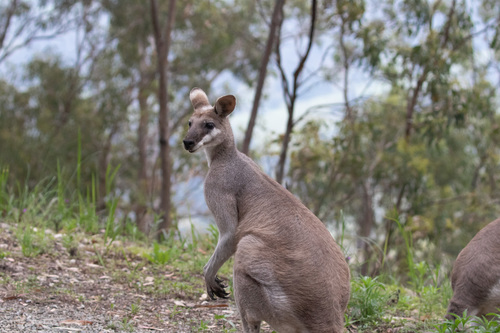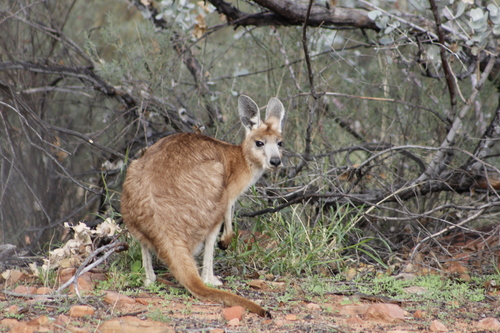
About Macropus robustus Gould, 1840
Common Names and Taxonomic Classification
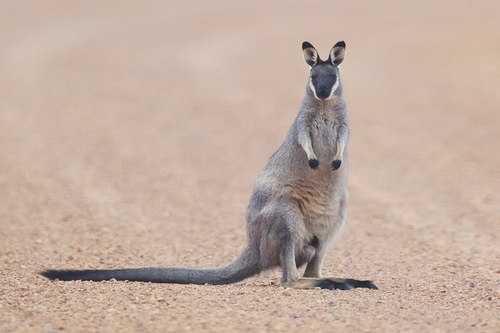
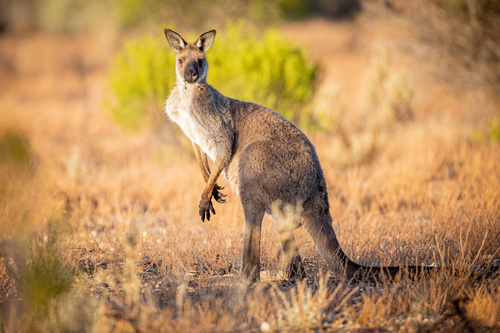
The common wallaroo, also known as the euro, hill wallaroo, or simply wallaroo, is a species of macropod, a marsupial family that also includes kangaroos and wallabies. This species currently has the scientific name Osphranter robustus, originally published as Macropus robustus Gould, 1840.
Subspecies Naming
The term 'euro' is specifically used for one of its subspecies, O. r. erubescens.
General Behavior and Abundance
The eastern wallaroo subspecies is mostly nocturnal and solitary, and the species is one of the more common macropods. Common wallaroos produce a loud hissing noise.
Sexual Dimorphism
Like most wallaroos, some of this species' other subspecies show sexual dimorphism.
Breeding Period
Female common wallaroos can give birth at any time of year.
Embryonic Diapause
They use a process called embryonic diapause, which allows them to become pregnant any time after giving birth, but the new embryo does not begin developing until the previous joey is ready to leave the mother's pouch.
Mating System
Common wallaroos are polygynous, meaning males may have multiple female mating partners.
Mating Competition
Males engage in non-lethal physical combat to compete for mating access to females.
Gestation Period
The gestation period lasts around 30 to 38 days.
Post-Gestation Joey Development
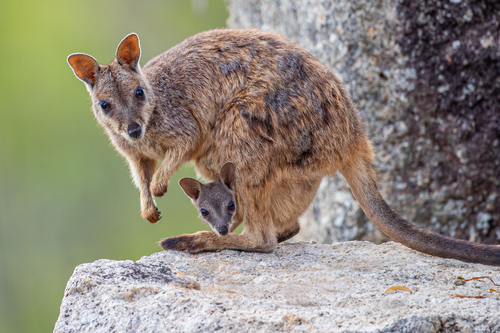
After gestation, the newborn joey moves into the mother's pouch to suckle and complete its development.
Pouch Departure Timeline
Young joeys begin leaving the pouch at around six months old, and by nine months they no longer spend most of their time in the pouch.
Sexual Maturity Timing
Males reach full development at around 18 to 20 months old, while females reach full development between 14 and 24 months old.
Parent-Joey Relationship Dynamics
The parent-joey relationship changes as the joey ages.
Paternal Protection During Pouch Development
While the joey is developing in the pouch, the father stays nearby to protect the joey and mother from predators.
Post-Protection Paternal Relationship
Once this protection is no longer needed, the father's relationship with the group weakens.
Post-Weaning Maternal Relationship
Even after the joey no longer depends on its mother for food, it remains in a close relationship with her.