About Scorpaenopsis diabolus (Cuvier, 1829)
Taxonomy
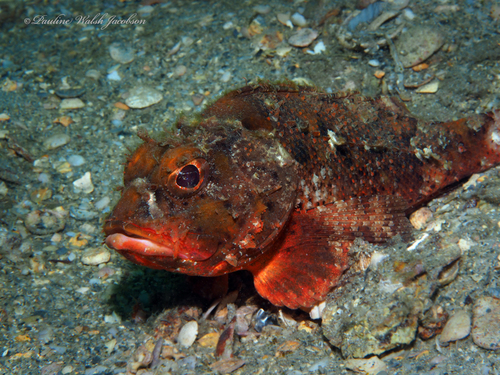
Scorpaenopsis diabolus, first described by Cuvier in 1829, has a broad head with a wide mouth, a humped back, and a tapering body.
Size
This species can grow up to 30 cm (12 in) in length.
Fin Structure
Its dorsal fin has 12 venomous spines and 8 to 10 soft rays, while its anal fin has three spines and 5 to 6 soft rays.
Skin Texture
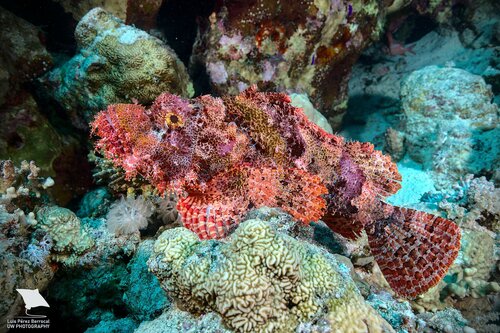
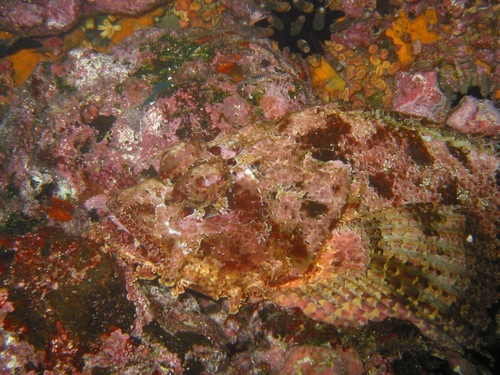
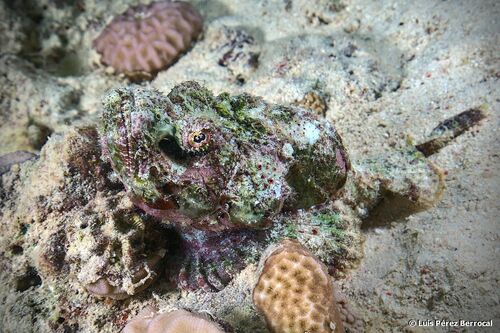
Its skin is rough, covered with low conical projections, spines, and tassels.
Base Coloration
Its base coloration is a mottled mix of grey and white, patterned with reddish-brown blotches, which provides effective camouflage among stones and corals.
Pectoral Fin Markings
The inner surfaces of its broad pectoral fins bear orange, black, and white blotches, and the fish can spread these fins as a warning display.
Similar Species
Scorpaenopsis diabolus closely resembles the reef stonefish, Synanceia verrucosa.
Biofluorescence
This species is biofluorescent: when illuminated by blue or ultraviolet light, it re-emits the light as red, giving it a different appearance than it has under white light.
Biofluorescence Function
This biofluorescence is thought to potentially aid in intraspecific communication and camouflage.
Distribution Range
Scorpaenopsis diabolus occurs in the Indian and Pacific Oceans, at depths down to around 70 m (230 ft).
Geographic Extent
Its range extends from South and East Africa and the Red Sea eastward to Japan, Hawaii, French Polynesia, Australia, and New Caledonia.
Habitat
It lives on the seabed, found among rubble, on seaweed-covered rocks, or on rocks covered in coralline algae; its habitats include reef flats, lagoons, and the seaward sides of reefs.