About Scorpaena mystes Jordan & Starks, 1895
Common Name & Head Spines
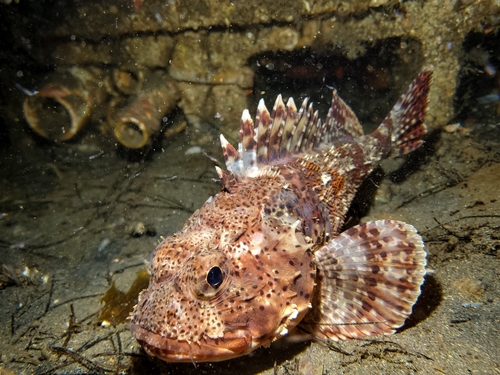
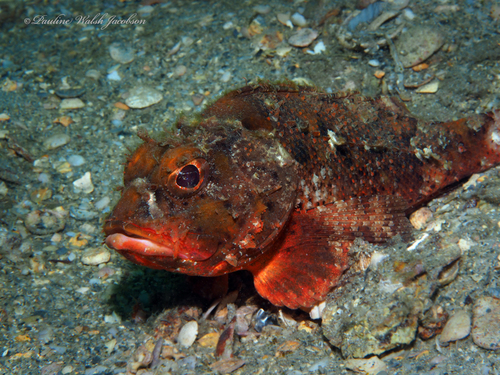
This species, commonly called the Pacific spotted scorpionfish, has a very bony head armed with numerous spines, plus a deep occipital pit and a smaller pit positioned in front of the eyes.
Head Proportions & Mouth
The depth of its head matches its width, and it has an extremely large mouth.
Suborbital Ridge & Palate Teeth
The suborbital ridge bears 3 or 4 spines, and teeth are present on the sides of the roof of the mouth.
Cutaneous Appendages
Both the head and body have a number of skin flaps.
Dorsal & Anal Fin Structure
The dorsal fin contains 12 spines and 9 or 10 soft rays, while the anal fin has 3 spines and 5 or 6 soft rays.
Pectoral Fin Structure
Pectoral fins have 18 to 21 fin rays, with the lower rays being simple and thickened.
Scales & Lateral Line
It has relatively large, smooth scales across the body, and a complete lateral line formed from tubed scales.
Size
This species reaches a maximum total length of 45.7 cm (18.0 in), making it the largest species in the genus Scorpaena; a more typical total length is 30.4 cm (12.0 in).
Coloration Variability
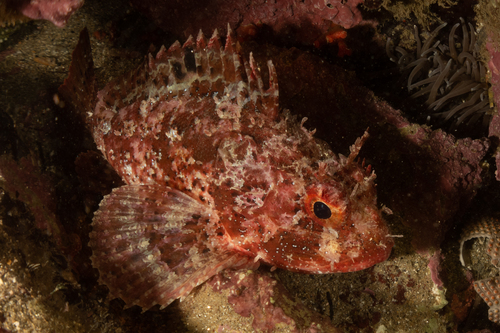
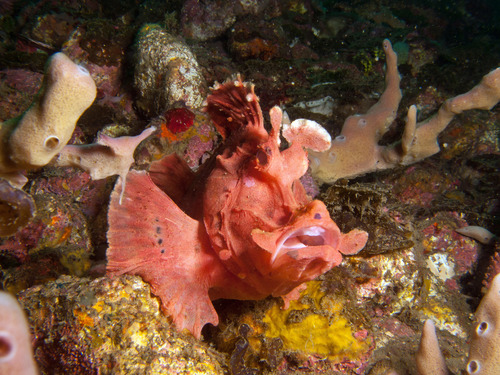
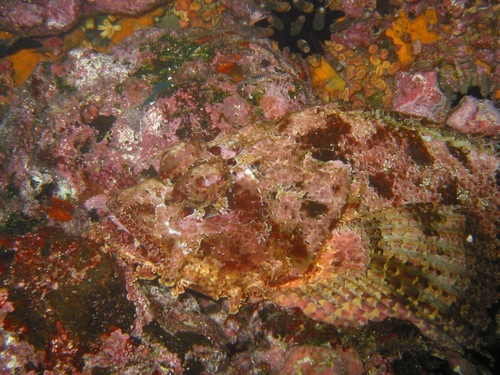
Its colouration is highly variable.
Body & Caudal Fin Pattern
Most individuals have a sombre mottled pattern in grey, brown, red, green and black, with dark bars on the caudal fin.
Pectoral Fin Axil Markings
The axil of the pectoral fin typically has white spots, which are often arranged in lines.
Dorsal Fin Spots
The dorsal fin usually has one obvious black spot, though up to four spots may be present.
Juvenile Coloration
Juveniles have a distinct dark bar on the posterior body, underneath the soft-rayed portion of the dorsal fin.
Native Range
The Pacific spotted scorpionfish is native to the eastern Pacific Ocean.
Coastal Distribution
It occurs along the western coasts of the Americas, ranging from southern California and the Gulf of California south to Chile.
Island Distribution
It can also be found off the Galápagos, Revillagigedos, Cocos, and Malpelo islands.
Depth & Habitat
This species lives from the intertidal zone down to depths of 100 m (330 ft), where it inhabits seaweed-covered reefs and open areas with sand and rubble substrates.