About Scorpaena brasiliensis Cuvier, 1829
Body Shape
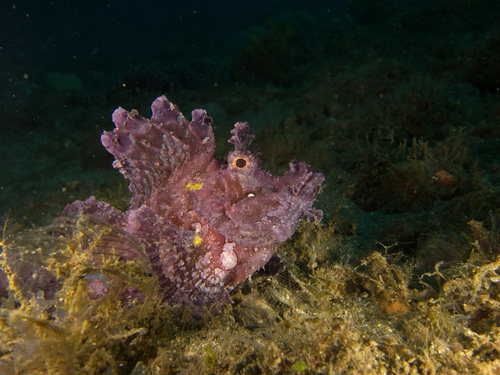
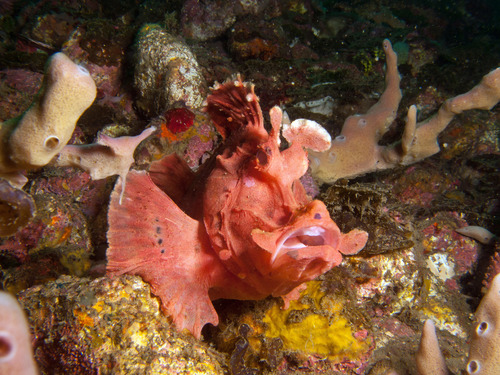
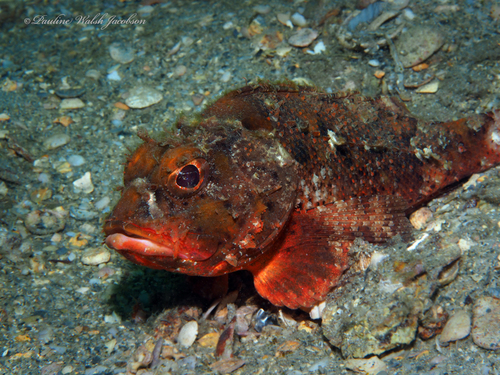
Scorpaena brasiliensis Cuvier, 1829 has a many-spined, compressed oblong body that tapers toward the tail.
Head and Snout Features
It has a rather short head and snout, with a distinct occipital pit, and a small or entirely absent posttemporal spine.
Preorbital and Suborbital Spines
The preorbital bone above the mouth bears two spiny points, while the suborbital ridge holds three spiny points, with the two anterior points being blunt.
Preoperculum Spines
There are five spines on the preoperculum: the uppermost spine has a supplementary spine, the second spine is almost the same size as the third spine, and the fourth and fifth spines range from medium to small in size.
Dentition
The mouth holds thin bands of small teeth on the jaws, palatine, and vomer.
Ocular Tentacles
Well-developed tentacles sit above the eyes.
Fin Ray Counts
The dorsal fin has 12 spines and 9 soft rays, the anal fin has 3 spines and 5 soft rays, and the pectoral fin has 16 to 20 fin rays.
Scales and Lateral Line
The body is covered in large, smooth scales, and the lateral line is complete.
Caudal Fin Shape
The caudal fin is rounded.
Body Background Color
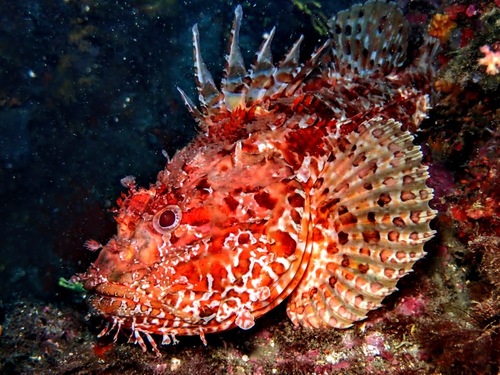
The body background color can be red, brown, greenish-brown, yellow, or white.
Pale Lower Body Markings
Lower portions of the body are paler than upper portions; the lower parts of the head and body, and the inner surface at the base of the pectoral fins, are marked with small, round dark spots.
Pectoral Fin Color
The center of the pectoral fins may be either green-brown or yellow.
Flank and Dorsal Fin Markings
Three or four brown blotches run along the flank below the lateral line, and there is no large blotch at the front of the dorsal fin.
Caudal Fin Markings
The caudal fin has two faint dark bars: one crosses the center of the fin, and the other runs along its rear margin.
Size
This species has a maximum published total length of 38 cm (15 in), with 20 cm (7.9 in) being a more typical adult size.
Geographic Range
This species is found in the Americas, in the Atlantic Ocean ranging from Virginia, United States, north of the Gulf of Mexico (including the Greater and Lesser Antilles), south to Brazil.
Bermuda Occurrence
It has been reported from Bermuda, but no individuals have been recorded there since 1927.
Habitat and Depth
It primarily inhabits soft bottoms and coral reefs, ranging from the coastline down to depths of 100 meters, and can be found in bays, ports, and on continental shelves.