About Pterois miles (Bennett, 1828)
Maximum Length
Pterois miles, commonly known as the common lionfish, can grow up to 35 cm (14 in) in length.
Fin Structure
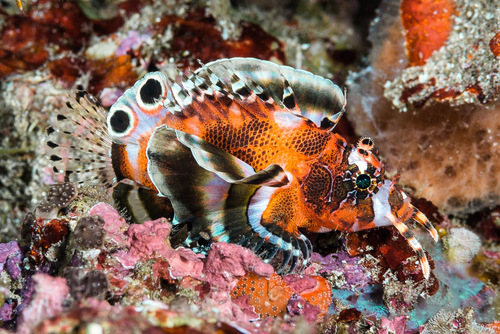
Its dorsal fin has 13 long, strong spines and 9 to 11 soft rays, while its anal fin has three long spines and six or seven soft rays.
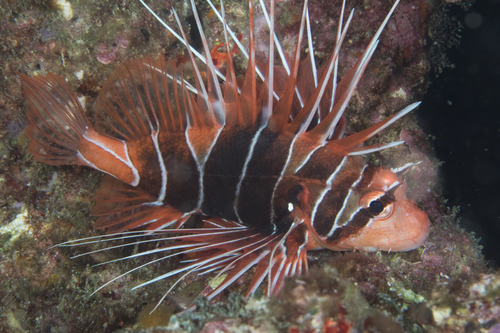
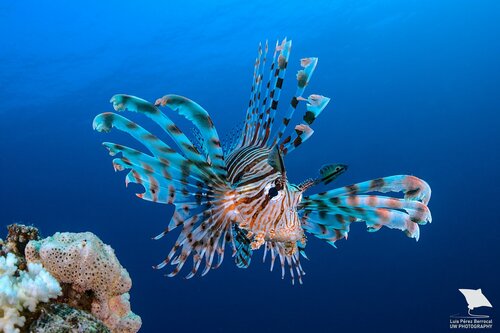
The dorsal fin has a feathery appearance; the pectoral fins are wing-like, with separate broad, smooth rays.
Coloration and Markings
These fish range in color from reddish to tan or grey, and have numerous thin, dark vertical bars on their heads and bodies.
Head Morphology
Its head is less angular than the head of P. volitans.
Native Range
P. miles is native to the Indian Ocean, spanning from the Red Sea to South Africa, and to Indonesia.
Mediterranean Introduction
It was first recorded in the Mediterranean Sea off Israel in 1991, after entering via the Suez Canal.
Current Mediterranean Distribution
It is now common in the eastern Mediterranean Basin, with recent observations made in the Sicily channel.
Invasive Range
This species is also currently present off the east coast of the United States and in the Caribbean Sea, where it is classified as an invasive species.
Similar Species Distinction
P. miles is very similar in appearance to P. volitans, a species that does not occur in the Red Sea.
Habitat
P. miles is typically found in areas that contain crevices, or in lagoons, and often lives on the outer slopes of coral reefs.
Native Predators
Moray eels have recently been identified as natural predators of P. miles in the species' native Red Sea habitat.
Some species of grouper and reef sharks are also predators of this lionfish.