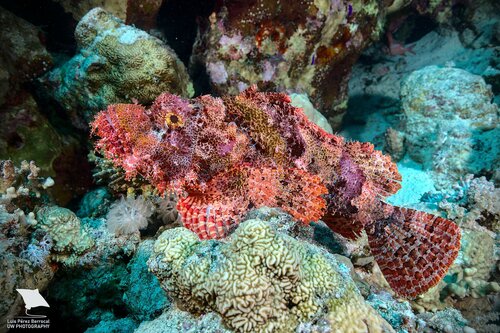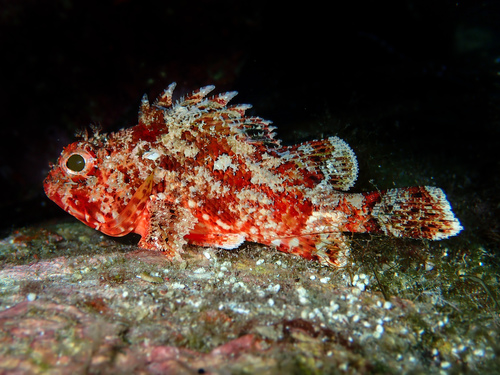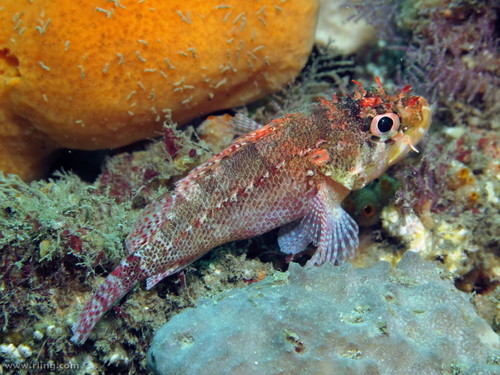
About Scorpaenodes evides (Jordan & Thompson, 1914)
Fin Morphology
Scorpaenodes evides has 13 spines and 9 soft rays in its dorsal fin, and 3 spines and 5 soft rays in its anal fin.
Body Shape
The anterior portion of its body is not strongly compressed, with compression increasing toward the caudal fin. The body is moderately deep, with its body depth smaller than the length of the head.
Facial Appendages
A tentacle is present on the species' front nostril.
Coloration
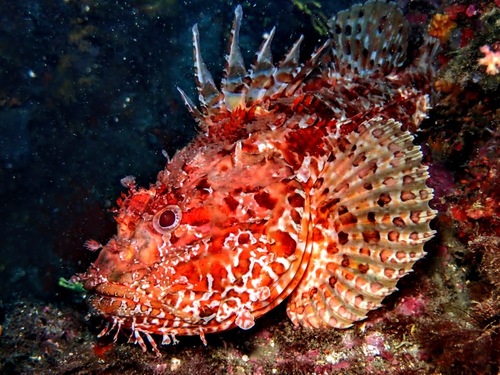
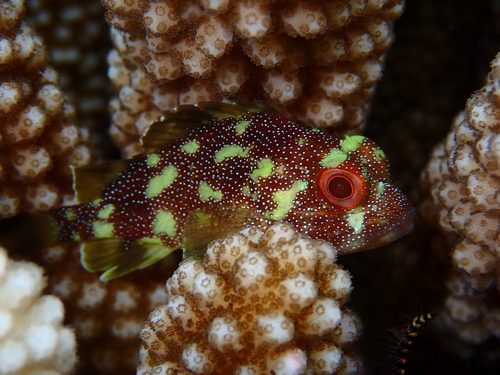
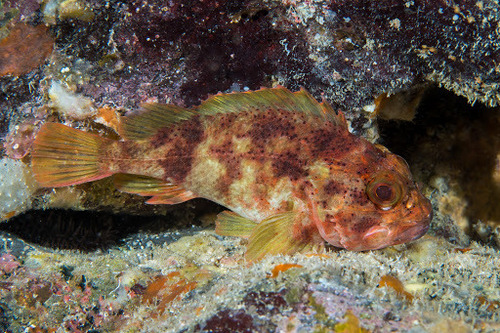
This species ranges in color from brownish to pink or reddish, with a dark blotch on the ventral section of the operculum; its fins bear red spots, and leaf-like skin flaps are located on the head.
Maximum Size
Scorpaenodes evides reaches a maximum total length of 11 cm (4.3 in).
General Distribution
This species has a wide distribution across the Indo-Pacific region.
African Distribution
In Africa, it occurs along the eastern coast of South Africa and in the Red Sea.
Indo-Pacific Range Extent
It ranges through the Indian and Pacific Oceans as far east as Easter Island and Hawaii, and extends as far north as southern Japan and as far south as Australia.
Australian Distribution
In Australia, it is found from the Houtman Abrolhos in Western Australia, along the country's northern coasts to Jervis Bay in New South Wales, and also occurs at Lord Howe Island, and Elizabeth and Middleton Reefs.
Habitat and Depth Range
Scorpaenodes evides is a demersal fish that mainly inhabits shallow tropical marine waters at depths between 1 and 40 m, on rocky and coral reefs.
Observed Behavior
It is frequently observed upside down on the roofs of caves.