About Scolopax minor J.F.Gmelin, 1789
Nomenclature
This species has the scientific name Scolopax minor J.F.Gmelin, 1789, and is commonly called the American woodcock.
General Body Morphology
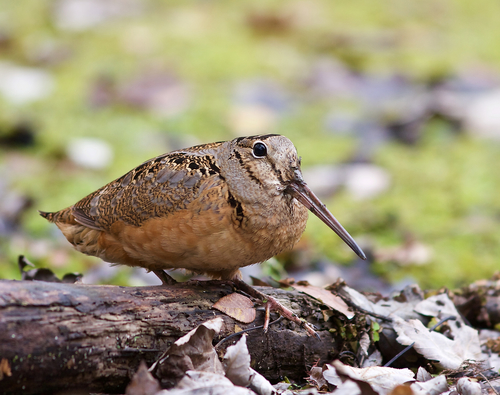
The American woodcock has a plump body, short legs, a large rounded head, and a long straight prehensile bill.
Adult Body Size
Adult individuals measure 10 to 12 inches, or 25 to 30 cm, in length, and weigh 5 to 8 ounces, or 140 to 230 g. Females are considerably larger than males.
Bill Length
The bill measures 2.5 to 2.8 inches, or 6.4 to 7.1 cm, in length.
Wingspan
Wingspans range from 16.5 to 18.9 inches, or 42 to 48 cm.
Plumage Coloration
The plumage forms a cryptic mix of different shades of brown, gray, and black. The chest and sides range from yellowish-white to rich tan. The nape of the head is black, with three or four crossbars of deep buff or rufous.
Feet Coloration
The small, weak feet and toes range from brownish gray to reddish brown.
Visual System
American woodcocks have large eyes set high on their heads, and their visual field is likely the largest of any bird, covering 360° in the horizontal plane and 180° in the vertical plane.
Feeding Apparatus Function
The American woodcock uses its long prehensile bill to probe soil for food, mainly invertebrates and especially earthworms. A unique arrangement of bone and muscle allows the bird to open and close the tip of its upper bill, or mandible, while the bill is sunk underground. Both the underside of the upper mandible and the long tongue have rough surfaces to help grasp slippery prey.
Overall Distribution Range
In terms of distribution and habitat, American woodcocks live in forested areas and mixed forest-agricultural-urban areas east of the 98th meridian. They have been observed as far north as York Factory, Manitoba, and as far east as Labrador and Newfoundland.
Migratory Range Limits
In winter, they migrate as far south as the Gulf Coast of the United States and Mexico.
Primary Breeding Range
The primary breeding range extends from Atlantic Canada, covering Nova Scotia, Prince Edward Island, and New Brunswick, west to southeastern Manitoba, and south to northern Virginia, western North Carolina, Kentucky, northern Tennessee, northern Illinois, Missouri, and eastern Kansas. A limited number of individuals breed as far south as Florida and Texas.
Range Expansion
The species may be expanding its distribution northward and westward.
Wintering Range Extent
After migrating south in autumn, most American woodcocks spend the winter in Gulf Coast and southeastern Atlantic Coast states. Some may remain as far north as southern Maryland, eastern Virginia, and southern New Jersey.
Wintering Range Core
The core of the wintering range is centered on Louisiana, Mississippi, Alabama, and Georgia. Based on Christmas Bird Count results, winter concentrations are highest in the northern half of Alabama.
General Habitat Types
American woodcocks live in wet thickets, moist woods, and brushy swamps. Ideal habitats combine early successional habitat, abandoned farmland, and forest.
Late Summer Roosting Habitat
In late summer, some American woodcocks roost on the ground at night in large openings among sparse, patchy vegetation.
Courtship and Breeding Habitat
Courtship and breeding habitats include forest openings, roadsides, pastures, and old fields, where males call and perform courtship flights in spring.
Nesting Habitat
Nesting habitats include thickets, shrubland, and young to middle-aged forest interspersed with openings.
Feeding Habitat
Feeding habitats have moist soil, and feature dense young trees including aspen (Populus spp.), birch (Betula spp.), and mixed hardwoods less than 20 years old, along with shrubs, particularly alder (Alnus spp.).
Roosting Habitat Characteristics
Roosting habitats are semiopen sites with short, sparse plant cover, such as blueberry barrens, pastures, and recently heavily logged forest stands.
Primary Diet
For food and feeding, American woodcocks eat mainly invertebrates, particularly earthworms (Oligochaeta), and they have been recorded using worm charming methods to bring worms to the surface. They do most of their feeding in areas with moist soil. They forage by probing soft soil in thickets, where they usually stay well hidden.
Other Food Items
Other food items include insect larvae, snails, centipedes, millipedes, spiders, snipe flies, beetles, and ants. They eat a small amount of plant food, mainly seeds.
Activity Pattern
American woodcocks are crepuscular, and are most active at dawn and dusk.