About Saucerottia cyanura (Gould, 1859)
Scientific Name and Length
The blue-tailed hummingbird, scientifically named Saucerottia cyanura (Gould, 1859), measures 9 to 10 cm (3.5 to 3.9 in) in length.
Weight
One recorded male specimen weighed 3.9 g (0.14 oz), while females typically weigh about 4.5 g (0.16 oz).
Bill Morphology
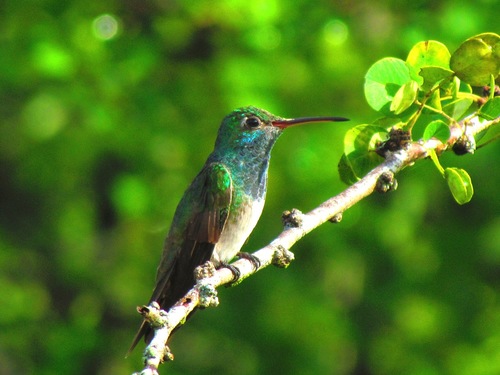
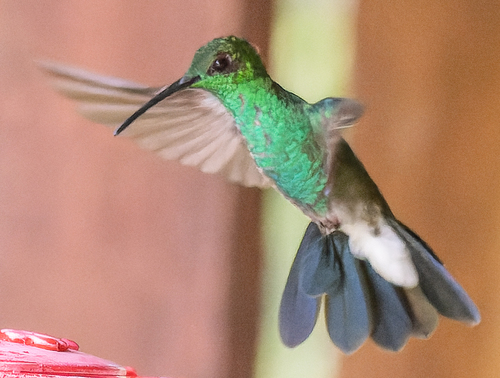
For all subspecies, both sexes have a black bill with a reddish base on the lower mandible.
Nominate Male Plumage (Upperparts)
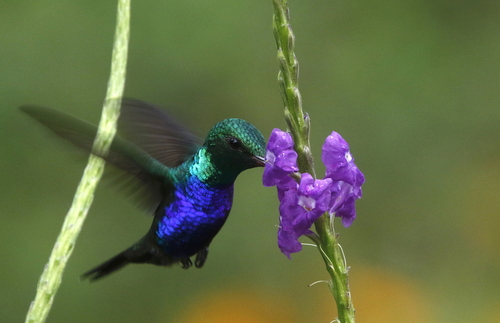
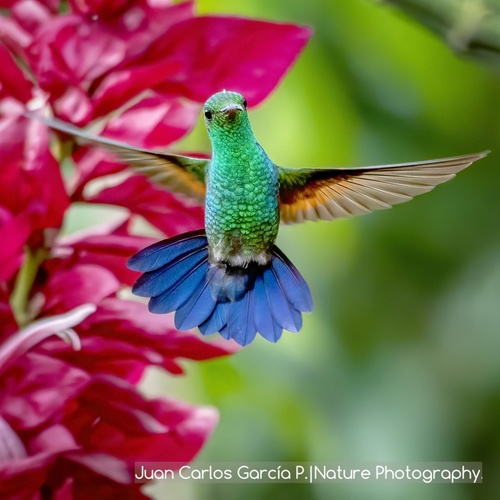
Males of the nominate subspecies have a deep metallic green crown and back, a dull purplish bronze rump, and dark metallic bluish uppertail coverts.
Nominate Male Plumage (Wings, Tail, Underparts)
Their primaries and secondaries are chestnut, forming a visible patch on the closed wing, their tail is dark metallic violet blue, and most of their underparts are bright metallic green with dull steel blue undertail coverts.
Nominate Female Plumage
Females are similar to males but have duller coloration: their rump is less purplish, underpart feathers usually have narrow whitish margins, their belly contains a mix of dull buffy whitish coloring, and their undertail coverts are grayish.
Subspecies S. c. guatemalae Morphology
Subspecies S. c. guatemalae is much darker than the nominate, with darker chestnut wing coloring, a tail that is more violaceous to metallic purple rather than blue, and undertail coverts that are dark steel blue to blue-black.
Subspecies S. c. impatiens Morphology
Subspecies S. c. impatiens is somewhat larger than the nominate, with darker green on the head and back, a larger rufous or cinnamon wing patch, and dull steel blue undertail coverts with rich ferruginous edges.
Subspecies Distribution
Each subspecies has a distinct range: S. c. guatemalae occurs on the Pacific slope from southeastern Chiapas in Mexico to southern Guatemala; the nominate S. c. cyanura occurs in southern Honduras, eastern El Salvador, and northwestern Nicaragua; S. c. impatiens occurs in northwestern and central Costa Rica (the published range map omits the range of this last subspecies).
Habitat
The species inhabits a variety of semi-open landscapes, including edges and clearings of humid and dry oak and pine forest, secondary forest, scrublands, and shade coffee plantations.
Elevation Range
Its elevation range is between 100 and 1,800 m (330 and 5,900 ft) in Mexico and Guatemala, and from near sea level to 1,200 m (3,900 ft) in El Salvador, Honduras, and Nicaragua.