About Lesbia victoriae (Bourcier & Mulsant, 1846)
Nomenclature
This species, commonly known as the black-tailed trainbearer, has the scientific name Lesbia victoriae (Bourcier & Mulsant, 1846).
Male Size
Males measure 21 to 24 centimeters in total length when including their long tail.
Male Coloration
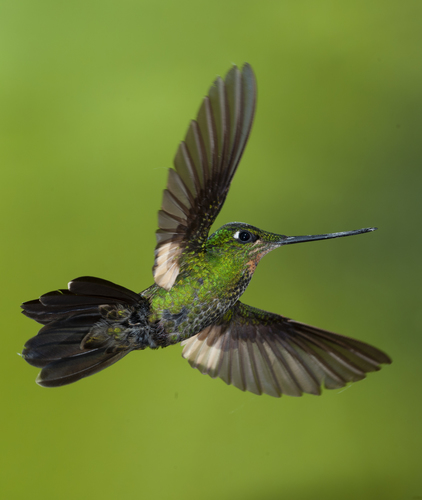
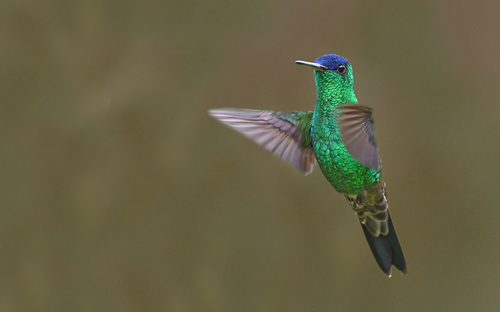
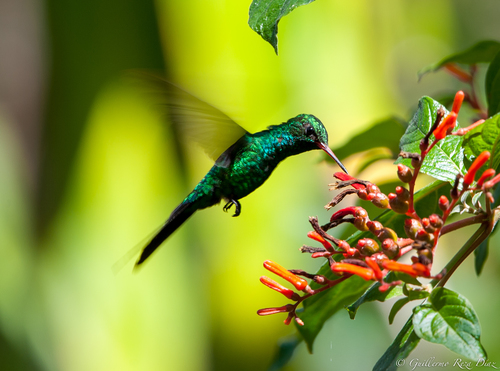
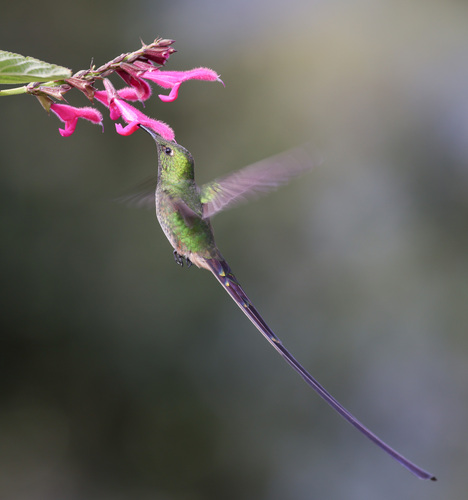
They are mostly green, with long black tail feathers and an iridescent green patch covering the chest and throat.
Female Traits
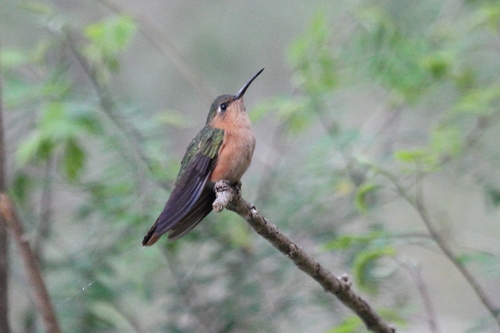
Females are 13.5 to 14.5 centimeters long, and differ from males by having a shorter tail and white underparts marked with green spots.
Species Comparison
Compared to the green-tailed trainbearer, the black-tailed trainbearer has a longer, more decurved bill; males also have a longer, more curved tail, and the species overall tends to be a duller shade of green.
Nominate Subspecies Size
The nominate subspecies Lesbia victoriae victoriae has a wing length of 59.9mm, and is the largest subspecies in the genus Lesbia.
Overall Distribution
The black-tailed trainbearer is widely distributed across the central and northern Andes, ranging from Colombia through Ecuador to Peru, at altitudes between 2500 and 3800 meters.
Subspecies Count
Three subspecies are currently recognized.
Northern Subspecies Range
The northernmost subspecies is L. v. victoriae, which occurs from the central Andes of Colombia to southern Ecuador.
Central Subspecies Range
L. v. juliae occupies the central portion of the species' distribution, found from southern Ecuador to northern Peru.
Southern Subspecies Range
The southernmost subspecies is L. v. berlepschi, which occurs from Huánuco to Cuzco in Peru.
Former Subspecies Classification
In the past, Ecuadorian populations of L. v. victoriae were sometimes treated as a fourth separate subspecies, L. v. aequatorialis, but these populations are not distinct enough from Colombian birds to justify classification as a separate subspecies.
Habitat Preference
Lesbia victoriae prefers semi-open areas over closed forest, which means it can adapt well to human-made urban ecosystems such as parks and gardens.
Male Courtship Behavior
During reproduction, male courtship behavior involves flying high while displaying the tail, then diving and producing a clicking noise using the tail.
Nest Construction
After courtship concludes, the mated pair builds a nest in a bush. When available, the pair tends to use synthetic fibers from human activity for nest construction.
Parental and Anti-predator Behavior
Both males and females care for the nest, and both tend to retreat and hide when danger is nearby.