About Amazilia luciae (Lawrence, 1868)
Common Name and Size
Amazilia luciae, commonly called the Honduran emerald, is 9 to 10 cm (3.5 to 3.9 in) long.
Bill Morphology
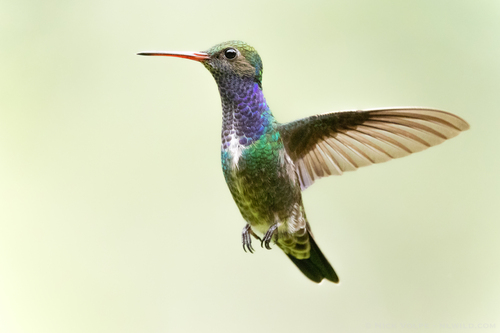
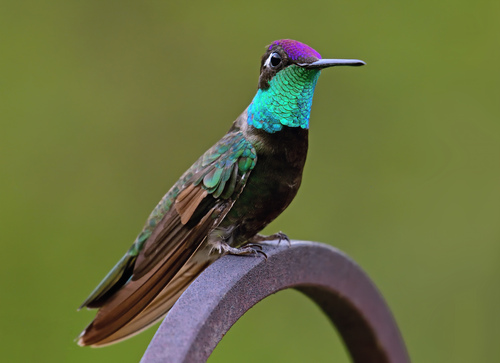
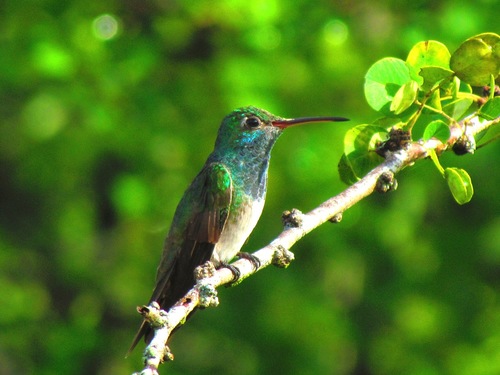
Both sexes have a medium-length, slightly decurved bill; the maxilla is black, and the red mandible has a black tip.
Adult Male Crown and Upperparts
Adult males have a dark green crown and dark green upperparts that turn bronzy on the lower back and uppertail coverts.
Adult Male Tail Feathers
Their central tail feathers are dark green, while the remaining tail feathers are dark green with a bronzy tint near the end; all tail feathers have a purplish band near the tip.
Adult Male Gorget and Breast
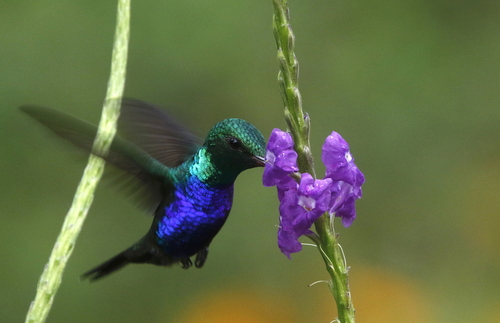
The male's gorget and upper breast are medium blue, which can appear greenish or grayish under different lighting conditions. Its lower breast is grayish white, with green sides and duller bronze-green flanks.
Adult Male Undertail Coverts
Its undertail coverts are dark green with white edges.
Adult Female Plumage
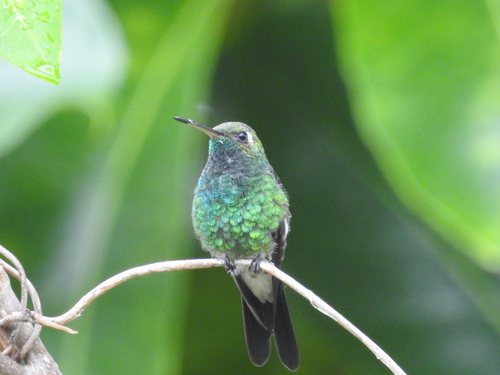
Adult females have similar plumage overall, but all coloration is duller than males. Females have a smaller, greener gorget than males, and their outer tail feathers have gray tips.
Immature Plumage
Immature Honduran emeralds resemble adult females.
Vocalizations
The species' vocalizations include a hard, slightly metallic ticking call often steadily repeated as "chik, chik-chik, chik chik...", a hard, slightly buzzy chattering given in flight as "zzchi ---" and "chik chi zzhi ---", a dry, quiet gruff warbling that may be the species' song, a hard buzzy chatter "chirr-rr-irr-rr-rr", and a high sharp "siik" given during pursuit.
Endemic Range
The Honduran emerald is endemic to northern Honduras, where it occurs in three widely separated areas spanning the departments of Santa Bárbara, Cortés, Yoro, and Olancho.
Pre-1950s Records
Until the 1950s, the species was only known from a small number of specimens collected in Yoro and Olancho.
Rediscovery and Range Expansion
It was not observed again until 1988, when it was rediscovered in Yoro, and was first documented in Santa Bárbara and Cortés in 2007. Since 2007, the species has been observed across a somewhat wider range within each of the three general areas than previously recorded.
Movement Patterns
The Honduran emerald's movement patterns are not fully understood. In the eastern part of its range, it is "one of the most conspicuous bird species" in its habitat during some seasons, and nearly absent at other times. Short-distance seasonal migration has been proposed as a possible explanation for this pattern.
Primary Habitat Type
The Honduran emerald inhabits tropical dry forests, most commonly in intermontane valleys. These forests are generally low to medium in height, with an open to partially closed canopy.
Western Department Habitat
Forests in the western departments of Santa Bárbara and Cortés are taller and denser, and are classified as semi-deciduous. In these western departments, the emerald has also been observed in thorn forest, pine-oak forest, and along pasture edges.
Western Elevation Range
In western areas, it generally occurs on valley slopes at elevations between 200 and 500 m (660 and 1,600 ft).
Eastern Department Habitat
Forests in the eastern departments of Yoro and Olancho are classified as dry tropical forest, thorn forest, or xeric woodland, and their trees are deciduous or semi-deciduous.
Eastern Elevation Range
In eastern areas, the species inhabits valley floors, and occurs at the same 200 to 500 m (660 and 1,600 ft) elevation range as in the west.
Habitat Preference Complexity
Across both eastern and western parts of its range, local topography, soil type, precipitation, and microhabitat vary considerably over small areas, which makes it difficult to determine the Honduran emerald's exact habitat preferences and requirements.