About Pampa curvipennis (Deppe, 1830)
Species Classification
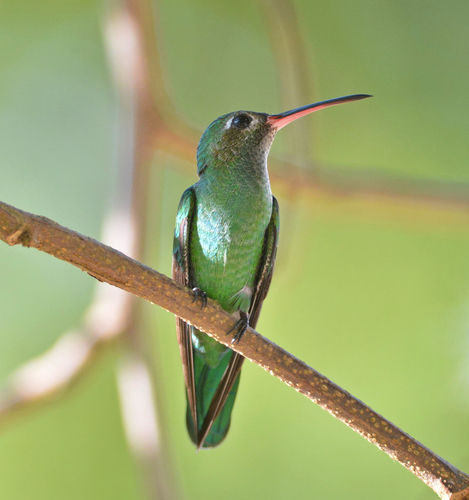
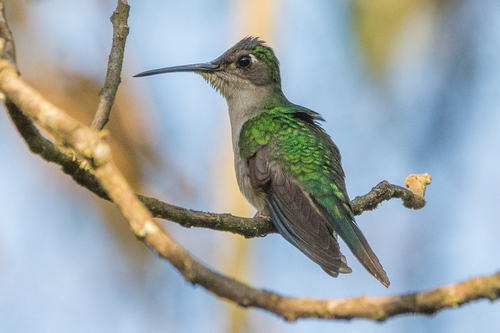
The curve-winged sabrewing (Pampa curvipennis) is a large species of hummingbird with a long, wedge-shaped tail. There are two recognized subspecies, which differ slightly in size and plumage.
Nominate Subspecies Length
The nominate subspecies P. c. curvipennis measures 11.5 to 13.5 cm (4.5 to 5.3 in) in total length. For this subspecies, the average male tail is about 5.2 cm (2.0 in) long, while the average female tail is about 4.7 cm (1.9 in) long.
Nominate Male Upperparts
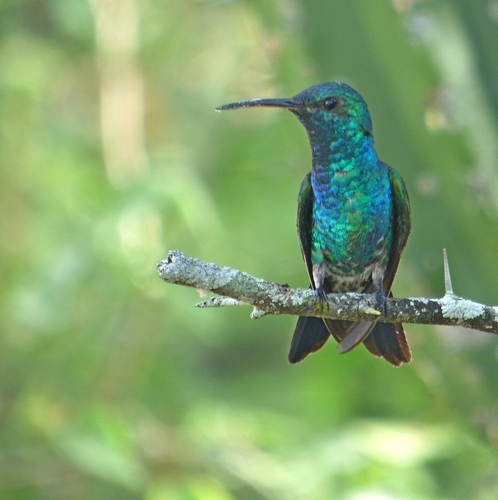
Adult male nominate P. c. curvipennis have a dull metallic violet blue to greenish blue crown, metallic green to bronze green upperparts, and bluish green uppertail coverts. Most of their tail feathers are dull metallic bluish green, turning purplish black at the tips.
Nominate Male Face & Underparts
The outermost pair of tail feathers have dusky to brownish gray outer webs. Much of their face is dull grayish white to gray, with a distinct white spot behind the eye. Their underparts are dull grayish white.
Nominate Female Appearance
Adult females of the nominate subspecies are very similar in appearance to adult males, but differ in a few key traits: their crown is dull blue rather than violet- to greenish blue, their two outermost pairs of tail feathers have wide dull gray or whitish tips, and much of the outer web of the outermost tail feather pair is brownish gray.
Immature Appearance
Immature curve-winged sabrewings are similar in appearance to adult females, with a duller crown whose individual feathers have buff tips, a pale cinnamon wash across the underparts, and a buff wash on the outer tail feathers.
P. c. excellens Length & Weight
The second subspecies, P. c. excellens, measures 12 to 14 cm (4.7 to 5.5 in) in total length. Males of this subspecies weigh an average of 11 g (0.39 oz), while females average 6.8 g (0.24 oz).
P. c. excellens Tail & Bill
For P. c. excellens, the male's tail is about 6.1 cm (2.4 in) long, and the female's tail is about 5.0 cm (2.0 in) long. Both sexes of P. c. excellens have a slightly decurved black bill.
P. c. excellens Male Plumage
Male P. c. excellens have a bright metallic violet crown, and the rest of their upperparts are deep metallic green. Much of their face is brownish gray, with a white spot behind the eye.
P. c. excellens Male Underparts & Tail
Their underparts are grayish white, darkening to dull grayish undertail coverts. Their tail is dull metallic green, with blackish violet tips on the feathers.
P. c. excellens Female Plumage
Female P. c. excellens have a duller crown than males, and their tail feathers have white tips rather than dark violet tips.
Overall Species Range
Both subspecies of curve-winged sabrewing are found exclusively in southeastern Mexico. The nominate subspecies ranges from southern San Luis Potosí south to Veracruz and Oaxaca.
P. c. excellens Range
Subspecies P. c. excellens is only found in a small area of southeastern Mexico around the Sierra de los Tuxtlas, spanning the states of Veracruz, Tabasco, and Chiapas. Note that range maps for this species often include the separate range of Pampa pampa in the Yucatán Peninsula.
Habitat
Curve-winged sabrewings inhabit the interior and edges of semi-arid to humid evergreen forest.
Elevation Range
Their elevation range extends from sea level to approximately 1,300 or 1,400 m (4,300 or 4,600 ft), and they are more common at lower elevations within this range.