About Chlorestes julie (Bourcier, 1843)
Common Name and Male Key Trait
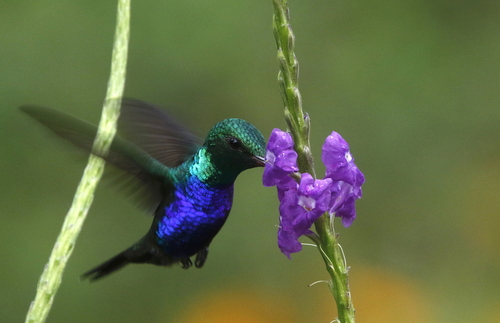
Chlorestes julie, commonly called the violet-bellied hummingbird, is characterized by the shimmering violet belly found on males.
Male Dorsal Coloration
A male's back and crown are a brilliant metallic green, matching the bright coloration of the rest of its body.
Sexual Dimorphism
This species exhibits sexual dimorphism, meaning females do not share the distinctive violet belly seen in males.
Shared Morphological Traits
Both sexes share several common traits: long, rounded tails, straight short bills, and pink lower mandibles.
Geographic Range
Violet-bellied hummingbirds range from central Panama, through Colombia, extending to southwestern Ecuador and the extreme northwestern point of Peru.
Subspecies Range and Movement
Different subspecies occupy different habitats within this overall range, and none of the subspecies perform seasonal migration.
Habitat Preferences
This species occurs in the understory of humid deciduous forests, along forest edges, and in regrowth forests.
Feeding Classification
Violet-bellied hummingbirds are primarily classified as nectarivorous, but they are more accurately described as omnivorous.
Nectar Diet Sources
They feed on nectar from plants in the Rubiaceae, Ericaceae, Gesneriaceae (genus Besleria), and Fabaceae (genus Inga) families.
Arthropod Consumption
Like many other hummingbird species, they also eat small arthropods.
Feeding Territory Defense
Males may defend their feeding territories from other males and large insects.
Social Feeding Behavior
While this species does not form flocks, individual violet-bellied hummingbirds may congregate to feed at fruit trees and feeding stations.
Predator Knowledge
The predators of the violet-bellied hummingbird are not currently known.