About Rynchops flavirostris Vieillot, 1816
Scientific Name and Plumage
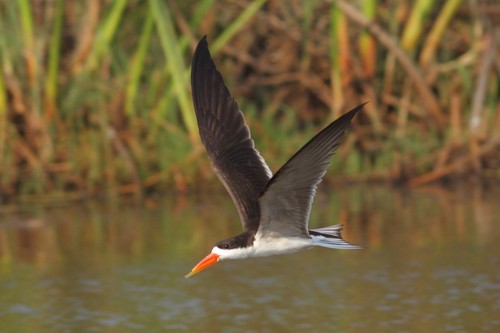
African skimmers (scientific name Rynchops flavirostris Vieillot, 1816) have long wings, with black coloring on the back, hindneck, and crown. The forehead and the rest of the body are white.
Beak Characteristics
They have a bright, long orange beak that ends in a yellow tip; immature individuals have a black beak tip instead. This yellow beak tip gives the species its specific name flavirostris, meaning "yellow-beak".
Tail, Legs, and Size
They have a short, forked white tail and bright red legs. On average, they are around 38 cm (15 in) long.
Vocalization
Their call is a sharp "kip-kip".
Bill Structure
Their bill has a unique structure: the lower mandible is much longer than the upper mandible, and it is flattened sideways like scissor blades.
Distribution Range
African skimmers are distributed across an extended range: from Senegal to the northern Congo River and the southern Nile Valley, from southern Tanzania to the Zambezi Valley, and extending south to KwaZulu-Natal Province, South Africa, and west to Angola.
Habitat
They inhabit large tropical rivers with sandbanks for nesting and roosting, as well as lake shores and coastal lagoons.
Population Estimate
The species is generally uncommon, with a total estimated population of 15,000 to 25,000 individuals.
Nesting Colony Basics
For reproduction, African skimmers nest in loose colonies on large sandbanks. Most colonies hold fewer than 50 breeding pairs.
Egg Laying
Each pair lays 2 to 3 eggs, rarely 4, in a shallow scrape dug into the sand.
Mixed Species Colonies
Occasionally, African skimmer colonies mix with colonies of other sandbank-nesting bird species including the collared pratincole, pied avocet, and white-fronted plover.