About Sterna paradisaea Pontoppidan, 1763
Description and taxonomy
Physical Measurements
The Arctic tern (Sterna paradisaea Pontoppidan, 1763) is a medium-sized bird, measuring 33–36 cm (13–14 in) from the tip of its beak to the tip of its tail. It has a wingspan of 76–85 cm (30–33 in) and weighs between 86–127 g (3.0–4.5 oz). Its beak, short legs, and webbed feet are all dark red.
Adult Plumage
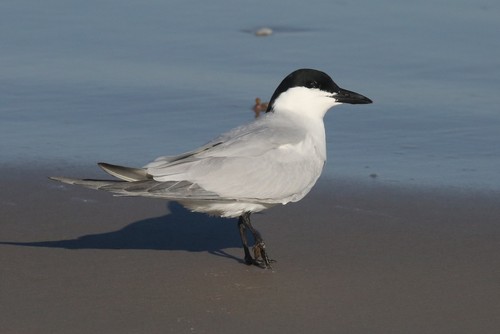
Like most terns, the Arctic tern has high-aspect-ratio wings and a deeply forked tail. Adult breeding plumage is grey on the upper body, with a black nape and crown, white cheeks, pale grey upperwings with a translucent area near the wingtip, a white tail, and pale grey underparts. Both sexes look nearly identical. Winter plumage is similar to breeding plumage, but the crown is whiter and the beak is darker.
Juvenile Features
Juveniles differ from adults with black bills and legs, scaly-looking wings, a mantle with dark feather tips, a dark carpal wing bar, and short tail streamers; during their first summer, juvenile Arctic terns also have a whiter forecrown.
Species Vocalizations
The Arctic tern has a range of calls, the most common of which are the alarm call, given when potential predators such as humans or other mammals enter its colony, and the advertising call. While it is similar to the common tern and roseate tern, it differs slightly in coloration, profile, and call.
Similar Species Distinctions
Compared to the common tern, it has a longer tail and a solid-colored bill; its main differences from the roseate tern are its slightly darker coloration and longer wings. The Arctic tern's call is more nasal and rasping than the common tern's, and is easily distinguished from the roseate tern's.
Taxonomic Relationships
This species' closest relatives are a group of South Polar species: the South American tern (Sterna hirundinacea), Kerguelen tern (S. virgata), and Antarctic tern (S. vittata). Immature Arctic terns were originally described as separate species, Sterna portlandica and Sterna pikei.
Distribution and migration
Breeding Range
The Arctic tern has a continuous circumpolar breeding distribution across the globe, and no subspecies are currently accepted. During the northern summer, it occurs in coastal regions of cooler temperate parts of North America and Eurasia. During the southern summer, it lives at sea, reaching the northern edge of the Antarctic ice.
General Migration Pattern
The Arctic tern is well-known for its long-distance migration: it flies from its Arctic breeding grounds to the Antarctic and back each year. The shortest distance between these two areas is 19,000 km (12,000 mi). This long journey means the species experiences two summers each year, and receives more daylight than any other creature on Earth.
Early Migration Records
Recorded examples of its remarkable long-distance flying ability include an Arctic tern ringed as an unfledged chick on the Farne Islands, Northumberland, UK, in the northern summer of 1982 that reached Melbourne, Australia in October, just three months after fledging, covering a journey of more than 22,000 km (14,000 mi). Another example is a chick ringed in Labrador, Canada, on 23 July 1928 that was found in South Africa four months later.
2010 Tracking Study Findings
A 2010 study using tracking devices attached to the birds confirmed that these examples are not unusual for the species, and showed that earlier research had seriously underestimated the annual distance travelled by Arctic terns. On average, eleven birds that bred in Greenland or Iceland covered 70,900 km (38,300 nmi) per year, with a maximum distance of 81,600 km (44,100 nmi). The difference from previous estimates comes from the birds following meandering courses rather than the straight route previously assumed; they take this convoluted path to take advantage of prevailing winds.
Lifetime Travel Estimate
The average Arctic tern lives around 30 years, and based on this research, will travel approximately 2.4 million km (1.5 million mi) over its lifetime — the equivalent of more than three round trips between Earth and the Moon.
2013 Netherlands Study
A 2013 tracking study of six Arctic terns breeding in the Netherlands found an average annual migration of around 48,700 km (26,300 nmi); on their southward journey, these birds roughly followed the coastlines of Europe and Africa.
Record Migration Individual
In a 2015–2017 study of Arctic terns on the Farne Islands in Northumberland, an individual tagged with a light-level geolocator labelled 'G82' covered 96,000 km (52,000 nmi) in just 10 months between the end of one breeding season and the start of the next, setting a new global migration record: the bird travelled the length of the Atlantic Ocean, crossed the width of the Indian Ocean, went halfway across the South Pacific to the boundary between the Ross and Amundsen Seas, then returned west along the Antarctic coast and back north up the Atlantic.
Offshore Migration Habit
Outside the breeding season, Arctic terns usually migrate far enough offshore that they are rarely seen from land.
Reproduction
Breeding Age and Monogamy
Breeding typically begins when Arctic terns are three or four years old. They are generally monogamous and mate for life, and in most cases return to the same colony each year.
Courtship Rituals
Courtship is elaborate, especially for birds nesting for the first time. Courtship starts with a 'high flight', where a female chases a male to a high altitude before the pair descend slowly. This display is followed by 'fish flights', where the male offers fish to the female. Ground courtship involves strutting with a raised tail and lowered wings, after which both birds usually fly and circle each other.
Nest Site Selection
Both sexes select a nest site together, and both defend the site. During this period, the male continues to feed the female, and mating occurs shortly after site selection.
Clutch Details
Breeding occurs in colonies on coasts and islands, and occasionally inland on tundra near water. The species often forms mixed flocks with the common tern. It lays one to three eggs per clutch, most often two.
Nest Defense Behaviour
The Arctic tern is one of the most aggressive tern species, and fiercely defends its nest and young. It will attack humans and large predators, usually striking the top or back of the head. Although it is too small to cause serious injury to an animal the size of a human, it is still capable of drawing blood, and can repel many raptorial birds, polar bears, and smaller mammalian predators such as foxes and cats.
Nest and Egg Traits
The nest is usually a depression in the ground, which may or may not be lined with bits of grass or similar materials. The eggs are mottled for camouflage. Both sexes share incubation duties.
Incubation and Fledging Periods
Chicks hatch after 22–27 days and fledge after 21–24 days. If parents are frequently disturbed and forced to leave the nest, the incubation period can extend to as long as 34 days.
Chick Development
When hatched, chicks are covered in down. They are precocial, so they begin to move around and explore their surroundings within one to three days after hatching, and usually do not stray far from the nest.
Chick Rearing
Adults brood chicks for the first ten days after hatching, and both parents care for hatchlings. Chick diets always include fish, and parents selectively bring larger prey items to chicks than they eat themselves. Males bring more food than females. Parental feeding continues for roughly a month before chicks are slowly weaned.
Post-Fledging Behaviour
After fledging, juveniles learn to feed themselves, including the specialized method of plunge-diving. They travel south to winter with the assistance of their parents.
Survival and Life History
Arctic terns are long-lived birds that spend substantial time raising only a small number of young, so they are classified as K-selected. A 1957 study on the Farne Islands estimated an annual survival rate of 82% for the species.
Ecology and behaviour
Diet Composition
The diet of the Arctic tern varies by location and time of year, but it is usually carnivorous. In most cases, it eats small fish or marine crustaceans. Fish make up the most important part of the diet, and account for more of the consumed biomass than any other food source.
Common Prey Species
Prey are typically immature (1–2-year-old) shoaling species such as herring, cod, sandlances, and capelin. Marine crustaceans eaten by Arctic terns include amphipods, crabs, and krill. Occasionally, the birds also eat molluscs, marine worms, or berries, and on their northern breeding grounds, they eat insects.
Feeding Methods
Arctic terns sometimes dip down to the water surface to catch prey near the surface, and may also chase insects in the air during the breeding season. It is thought that despite their small size, Arctic terns may occasionally practice kleptoparasitism, swooping at other birds to startle them into dropping their catches.
Kleptoparasitism Targets
Targeted species include other Arctic terns, other terns such as the common tern, and some auk and grebe species.
Nesting Predators
While nesting, Arctic terns are vulnerable to predation by cats and other animals. The larger herring gull is both a competitor for nesting sites and a predator that steals eggs and hatchlings.
Predation Mitigation
Camouflaged eggs and isolated nesting sites help reduce this predation. Scientists have tested using bamboo canes erected around tern nests to reduce predation: while they recorded fewer predation attempts in areas with canes compared to control areas, canes did not reduce the probability of successful predation per attempt.
Feeding Harassment
While feeding, skuas, gulls, and other tern species often harass Arctic terns and steal their food.