About Pagophila eburnea (Phipps, 1774)
Taxonomy and Length
The ivory gull, Pagophila eburnea (Phipps, 1774), measures 40–43 cm (16–17 in) in length, with a wingspan of 108–120 cm (43–47 in).
Weight
Males weigh 500–687 g (17.6–24.2 oz), while females weigh 448–583 g (15.8–20.6 oz).
Body Shape
This species is easily distinguishable from other gulls, with a more pigeon-like shape that is further emphasized by its short legs.
Adult Plumage
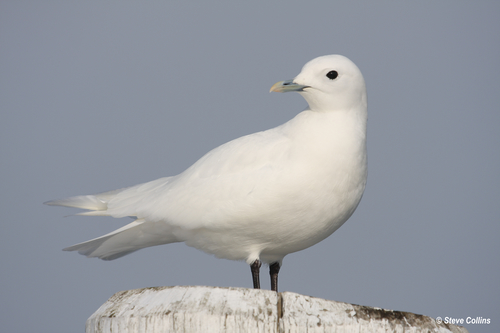
Adult ivory gulls have completely pure white plumage, unlike other gulls which have grey backs.
Adult Facial and Limb Features
The species has a thick blue bill with a yellow tip, which is occasionally reddish, solid black legs, dark eyes, and a narrow dark red orbital ring around the eyes.
Juvenile Plumage
Juvenile and first-winter ivory gulls have a dusky face and variable amounts of black flecking across their wings and tail.
Plumage Maturation
Ivory gulls take two years to develop full adult plumage; second-winter yearlings have intermediate plumage with smaller dark spots and a less dusky face, though some second-winter individuals closely resemble adults.
Flight Characteristics
In flight, this species has long wings that are broad at the base, with a strong wingbeat that is similar to that of skuas.
Primary Call
Its primary flight call is a harsh, tern-like keeeer.
Vocalization Repertoire
It makes a range of other calls: a warbling "fox-call" that warns when potential predators including arctic foxes, polar bears, glaucous gulls, or humans are near a nest; a "long-call" performed with extended wrists, a stretched neck, and a downward-pointed bill, given during elaborate courtship displays to other ivory gulls in the breeding season; and a plaintive begging call used by females during courtship when soliciting males, which is paired with head-tossing.
Geographic Variation
There are no consistent differences in appearance across the species' entire geographic range.
Eurasian Breeding Range
For breeding distribution and habitat, in Europe and Asia, the ivory gull breeds on Svalbard and the island archipelagos north of Russia.
North American Breeding Range
In North America, the species only breeds in the Canadian Arctic.
Known Canadian Breeding Colonies
The largest known breeding colony is located on Seymour Island, Nunavut, and established breeding colonies are also found on Ellesmere, Devon, Cornwallis, and northern Baffin islands.
Undiscovered Breeding Colonies
Researchers believe that additional small breeding colonies holding fewer than six birds have not yet been discovered.
Alaskan Breeding Status
There are no confirmed records of ivory gulls breeding in Alaska.
General Winter Habitat
During winter, ivory gulls live near polynyas, which are large areas of open water surrounded by sea ice.
Atlantic Winter Range
North American ivory gulls, plus some individuals from Greenland and Europe, winter along a 2000 km stretch of ice edge between 50° and 64° N, running from the Labrador Sea to Davis Strait and bordered by Labrador and southwestern Greenland.
Eastern Canada Winter Sightings
Wintering ivory gulls are frequently seen on the eastern coasts of Newfoundland and Labrador, and occasionally appear on the north shore of the Gulf of St. Lawrence and the interior of Labrador.
Pacific Winter Range
The species also winters in the Bering Sea and Chukchi Seas from October through June, and it is most widely distributed across the polynyas and pack ice of the Bering Sea.
Vagrant Range
Ivory gulls are vagrants across coastal Canada and the northeastern United States; records exist of individual vagrants as far south as California and Georgia, and vagrants have also been recorded in the British Isles.
Vagrant Timing
Most vagrant records occur from late November through early March.
Vagrant Age Disparity
Juvenile ivory gulls tend to wander further from the Arctic than adult individuals.
Migration Pattern
In terms of ecology and behaviour, ivory gulls only migrate short distances south in autumn.
Wintering Latitude
Most of the population winters in northern latitudes at the edge of pack ice, though some individuals reach more temperate areas.
Winter Ice Avoidance Behavior
During the Arctic winter, ivory gulls are often unwilling to land on water, because water droplets could freeze onto their plumage.
Breeding Habitat
For reproduction, the ivory gull breeds on Arctic coasts and cliffs.
Nesting and Egg Laying
It builds its ground nest lined with moss, lichens, or seaweed, and lays one to three olive eggs.
Breeding Timeline
Breeding occurs in summer: eggs are laid in late June or early July, and chicks fledge in August.
Breeding Colony Size
Most breeding colonies are small, holding between 5 and 60 breeding pairs, and colonies rarely have more than 100 pairs.
Ice Floe Breeding Colonies
Some breeding colonies have even been recorded on gravel-covered floating ice floes off the coast of Greenland.