About Romerolagus diazi (Ferrari-Pérez, 1893)
Size
Characteristics. The volcano rabbit, Romerolagus diazi, is one of the smallest rabbit species in the world. Adult individuals weigh between 386 and 602 g (0.851 to 1.327 lb), with a total body length of 23.4 to 31.1 centimeters (9.2 to 12.2 in).
External Appendages
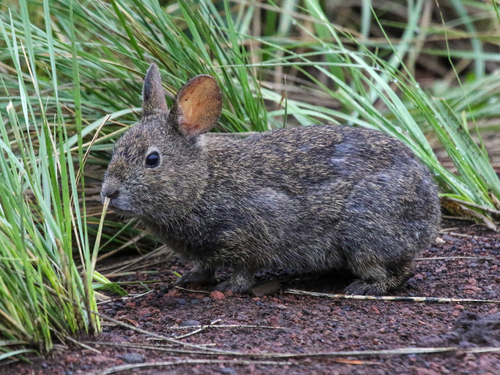
Their ears are small and rounded, measuring less than 4 centimeters (1.6 in) long, and their hind feet are short, ranging from 4.2 to 5.5 centimeters (1.7 to 2.2 in) in length. This species has a vestigial tail that is only visible in young rabbits, and becomes hidden under the skin when individuals reach adulthood.
Mammary Glands
Female volcano rabbits have three pairs of mammary glands.
Fur Coloration
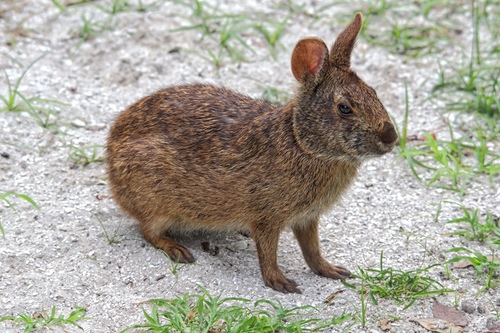
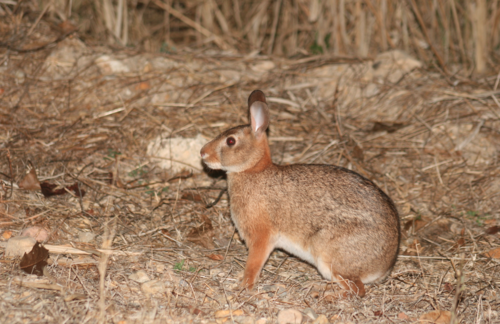
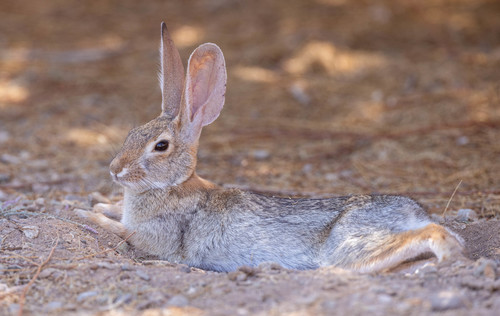
The volcano rabbit has short, dense fur that is yellowish brown across its entire body, and is softer on the underside. Each individual hair is black at the base and tip, and antimony yellow in the middle. This fur color shifts to a more buff shade only near the nose, eyes, and the base of the ears.
Fur Adaptation & Molting
The dark fur coloration blends in with the volcanic soils of the species' habitat, an adaptation that may help volcano rabbits evade predators. The coat does not change color between seasons, but the species does molt in four stages over the course of a year: first hair is lost, then melanin disappears, then melanin is deposited at the site of hair loss, and finally hair regrows.
Morphological Similarities
The volcano rabbit strongly resembles pikas, which are closely related mountain-dwelling lagomorphs. However, naturalist Marcus Ward Lyon Jr. — who completed the full classification of rabbit and hare genera — notes that the species is closest in appearance to the Amami rabbit.
Skull Structure
The skull of the volcano rabbit has small, triangle-shaped projections that extend from the brow ridge toward the back of the head. It has a long palate and a distinctly separated interparietal bone.
Dental Formula & Cheekbones
Like other leporids, it has a dental formula of 2.0.3.3/1.0.2.3 × 2 = 28, meaning it has two pairs of upper incisors, one pair of lower incisors, no canines, three upper premolars and two lower premolars on each side, and three upper and three lower molars on either side of the jaw. The cheekbones are wide, and grow larger toward the back of the head.
Auditory Bullae & Clavicle
The auditory bullae, the bony structures that enclose the external ear structure, are large compared to those of other leporids, and are larger than the foramen magnum, the opening at the base of the skull through which the spinal cord passes. The clavicle is complete and connects directly to the sternum, which is on average smaller than the sternum of other rabbits and hares.
Sternum & Navicular Bone
The central part of the sternum is segmented into three parts, which articulate with six pairs of ribs. The volcano rabbit's navicular bone is short and does not extend below the metatarsal bones.
Pelvis & Extinct Relatives
It has a strongly curved pelvis. The species' morphological features, specifically the arrangement of its teeth, resembles that of several extinct leporids from the Tertiary period, including †Nekrolagus, which lived during the Pliocene.
Hip Bone Features
The volcano rabbit's hip bones are more similar to another extinct species, †Limnolagus, and are also thinner and more pronounced toward the front and bottom of the spine.
Geographic Range
Distribution and habitat. Volcano rabbits are endemic to a 386 square kilometer (149 sq mi) area just southeast of Mexico City, where they live in alpine scrublands surrounding four volcanoes: Cerro Tláloc, Popocatépetl, Iztaccíhuatl, and El Pelado. The largest of these volcanic regions is within Iztaccíhuatl–Popocatépetl National Park; other occupied areas include the Chichinautzin and Pelado volcanoes.
Population Density & Historical Range
The highly vegetated Altzomoni peak within the park is recorded to support a notably large volcano rabbit population compared to other regions. Historically, the species likely occupied larger areas within the Trans-Mexican Volcanic Belt and the Sierra Chichinautzin mountain range.
Range Fragmentation
Human disturbance has since fragmented the volcano rabbit's range into 16, later 19, separate patches across these volcanoes.
Altitude & Habitat Climate
Volcano rabbits are most commonly found at altitudes between 3,150 and 3,400 meters (10,330 and 11,150 ft), but can occur anywhere from 2,800 to 4,250 meters (9,190 to 13,940 ft). The climate in the species' habitat is temperate and subhumid, with a mean annual temperature of 9.6 °C (49.3 °F) and an average annual rainfall of about 1,500 millimeters (59 in).
Soil & Vegetation Types
The soil is mostly made up of andosols and lithosols. Habitat vegetation includes species from both the Nearctic and Neotropical realms, drawn from both coniferous forest and tropical communities.
Dominant Habitat Plants
This vegetation diversity comes from the Trans-Mexican Volcanic Belt acting as a barrier between these two realms. Festuca tolucensis and Pinus hartwegii are abundant in volcano rabbit habitats.
Preferred Habitat Features
The species prefers habitats with tall, dense vegetation formed by a group of bunch grasses called zacatón, such as Muhlenbergia macroura and Festuca amplissima. Volcano rabbits also show strong preferences for thickly vegetated pine, alder, and mixed pine-alder forest habitats.
Habitat Threats
Human activity has heavily impacted the species' habitat, which has been fragmented by highways, farming, afforestation, and unsound fire and grazing practices. A study on the effects of climate change on volcano rabbit populations concluded that climate fluctuations affect rabbits more strongly at the edge of their habitable range.
Nevado de Toluca Extirpation
The volcano rabbit was once thought to live on the volcano Nevado de Toluca, and a specimen was collected there in 1975 by mammalogist Ticul Álvarez. Research conducted by Jurgen Hoth and colleagues in 1987 found no verified records of the species in this area, and local accounts noted the species had not been seen there for at least 15 years. A single rabbit was sighted in the region in August 2003, but the species was declared extinct in this portion of its range in 2018.
Current Population Status
Populations still exist elsewhere within the Trans-Mexican Volcanic Belt and in captivity. By 2019, the International Union for Conservation of Nature no longer listed Nevado de Toluca as a current or potential distribution site for this species.
Social Group Size
Behavior and ecology. Volcano rabbit social groups contain between two and five members. The species creates runways similar to those made by microtine rodents to move through its habitat.
Burrow Structure
Its burrows are tunnels with entrances located beneath dense grass clumps or in soil cracks, and can reach up to 5 meters (16 ft) in length and 40 centimeters (16 in) in depth below the soil surface. These burrows may have extra entrances to allow escape, and tunnels often weave around rocks and roots or split into multiple paths. Like some other rabbit species, volcano rabbits may opportunistically use burrows abandoned by other mammals, such as gophers and badgers.
Cover Seeking Behavior
The species is particularly reliant on dense grasses as cover to build its nests. Because it moves slower than other rabbits, it is more inclined to seek cover in higher, less open areas, a behavior also observed in the pygmy rabbit (S. idahoensis).
Alarm Vocalizations
The volcano rabbit produces high-pitched vocalizations to warn other group members of danger; this is a behavior shared with pikas that is unique among rabbits.
Lifespan & Activity Pattern
Little is known about the species' longevity, and it is expected to have an average wild lifespan of less than a year, similar to other rabbits and hares. It has been described as a diurnal animal, and is most active in the evening and early morning.
Reproductive Observation Source
However, large groups of volcano rabbits have been observed outside their burrows around noon. The reproductive behavior of volcano rabbits has rarely been observed, with most records coming from captive individuals.
Mating Behavior
Males often select a single female from a group to mate with, and will choose another female if their original mate is removed. The mating process begins when the male follows closely behind the female until she turns around, after which the two circle each other.
Gestation Period
After a few turns, the male mounts the female and copulation begins. The species has a very narrow gestational period.
Litter Size & Frequency
In a 1985 study, all females gave birth between 39 and 41 days after mating; later studies report a gestational period of 39 days. Each litter produces up to three young, and females can have four to five litters per year.
Development & Breeding Season
Young are weaned at roughly 28 days old, and reach sexual maturity after 185 days. The species is sexually active year-round, with the greatest reproductive activity occurring during the summer.
Nest Structure
Nests, which are shallow depressions dug into the ground lined with shredded grasses, plant fragments, and fur, are only built between April and September. On average, these nests are 11 centimeters (4 in) deep and 15 cm (6 in) wide. This nesting behavior is similar to that of female cottontail rabbits.
Captive Breeding Challenges
Young are born in these nests, similar to burrowing rabbits, which give birth in a nesting chamber. The volcano rabbit has difficulty breeding in captivity when there is little undergrowth, which has been linked to the species' dependence on areas of dense cover.
Dominance & Aggression
Female volcano rabbits are more dominant than males, and aggression between females is more violent and more frequent than aggression between males and females. In groups, only females are dominant, and males are never aggressive toward females. Males may chase each other, but are not known to fight.
Captive Interaction Observation
One observation of captive rabbits noted that the first confrontation between a male and female volcano rabbit resulted in the female attacking the male, and later conflicts were less violent.