About Sylvilagus audubonii (Baird, 1858)
General Appearance
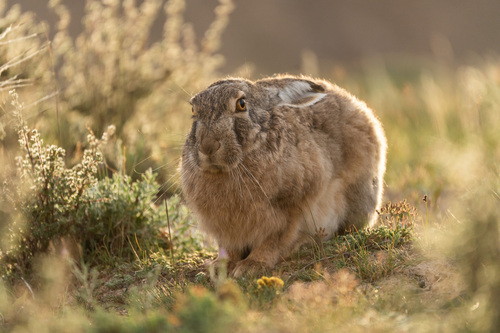
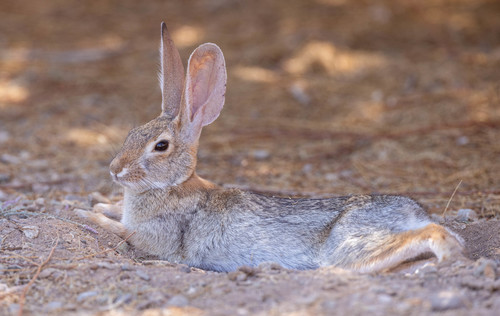
The desert cottontail (Sylvilagus audubonii) is similar in overall appearance to the European rabbit, but it has larger ears that are more often held erect.
Social Behavior
This species is social, and individuals frequently gather in small groups to feed.
Tail Characteristics
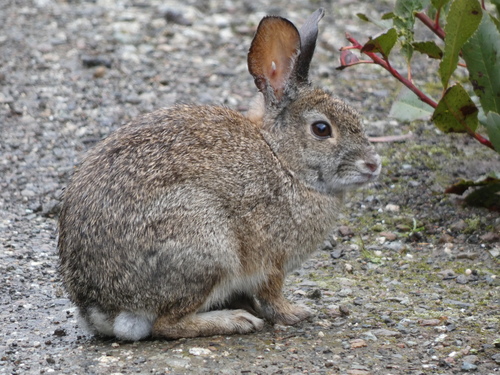
Like all cottontail rabbits, it has a greyish-brown, rounded tail with a broad white edge and white underside that is visible when the rabbit runs away.
Underside Fur Color
It also has white fur on its belly.
Adult Body Size
Adult desert cottontails measure 36 to 42 cm (14 to 17 in) in total length, and weigh between 700 and 1,200 g (1.5 to 2.6 lb).
Appendage Measurements
Their tails are 3.0 to 6.0 cm (1.2 to 2.4 in) long, their ears measure 6 to 9 cm (2.4 to 3.5 in) long, and they have large hindfeet that are about 7 to 9 cm (2.8 to 3.5 in) in length.
Sexual Dimorphism
There is very little sexual dimorphism in this species, but females are typically larger than males.
Home Range Differences
Females also have much smaller home ranges: around 4,000 m² (1 acre), compared to around 61,000 m² (15 acres) for males.
Geographic Distribution
This species is found throughout the Western United States, ranging from eastern Montana to western Texas, and also occurs in Northern and Central Mexico.
Eastern Range Limit
Its eastern range extends just barely into the Great Plains.
Western Range Limit
To the west, its range reaches central Nevada, central and southern California, and Baja California, reaching the Pacific Ocean.
Elevation Range
Desert cottontails live at elevations of up to 1,830 m (6,000 ft).
Habitat Preferences
They are particularly associated with the dry near-desert grasslands of the American southwest, though they can also be found in less arid habitats such as pinyon-juniper forest.
Riparian Habitat Use
They are also frequently found in riparian zones within arid regions.
Wet Winter Population Effect
An extremely wet winter leads to increased plant growth in the following spring, which causes desert cottontail populations to increase.
Dry Summer Post-Wet Winter Conditions
However, if a wet winter is followed by an especially dry summer, existing plant life dries out quickly due to the extreme high temperatures of a desert summer.
Dry Summer Population Effect
This has the opposite effect on populations, and can lead to hunger for the larger-than-usual desert cottontail population.