About Rhinopithecus roxellana (A.Milne-Edwards, 1870)
Sexual Dimorphism Overview
Rhinopithecus roxellana, the golden snub-nosed monkey, exhibits clear sexual dimorphism in adults and subadults.
Adult Male Age Criterion
Mature adult males are estimated to be over 7 years old.
Adult Male Body & Guard Hair Features
They have large bodies, with very long golden guard hairs covering their backs and cape regions.
Adult Male Crest & Limb Coloration
Their crest is medium brown with physically upright hairs that can be used to identify individual monkeys, while their back (from crown to nape), arms, and outer thighs are deep brown.
Adult Male Canine Feature
When their mouths are open, long canines are visible to researchers.
Adult Male Size & Weight
Adult males typically measure between 58 cm and 68 cm in length, and weigh around 16.4 kg.
Subadult Male Age & Build
Subadult males, estimated at 5–7 years of age, have a similar overall body size to fully developed adult males, but their build is more slender.
Subadult Male Hair & Crest Features
The golden guard hairs on their cape are short and sparse; their medium brown crests show microbanding, and are in the process of changing from brown.
Adult Female Age & Size
Adult females are estimated to be over 5 years old, and are about half the size of adult males.
Adult Female Dorsum & Limb Coloration
Their dorsum (from crown to nape), cape, arms, and outer thighs are brown to deep brown, particularly in older females.
Adult Female Guard Hair Features
Golden guard hairs are present on their back and cape, but these hairs are shorter than those found on males.
Adult Female Crest Feature
Their brown crests show microbanding.
Adult Female Identifying Physiological Features
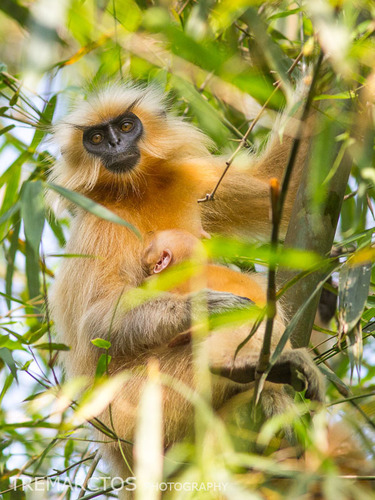
Large, easily visible breasts and nipples allow easy identification of adult females.
Adult Female Post-Pregnancy Behavior
After pregnancy, females are commonly seen with infants and newborns hanging beneath their abdomens while climbing or walking.
Adult Female Size & Weight
Adult females typically measure between 47 cm and 52 cm in length, and weigh around 9.4 kg.
Subadult Female Age & Size
Subadult females are estimated at 3–4 years old, and are about two-thirds the size of adult females, smaller than full mature females.
Subadult Female Body Hair Features
Their body hair is brown, and is gradually turning golden, but they do not yet have distinct golden guard hairs.
Subadult Female Crest & Breast Features
Their medium brown crests also show microbanding, and their breasts and nipples are not as large as those of adult females.
Juvenile Age & Size
Juveniles range from at least 1 year old to 3 years old, and are less than two-thirds the size of adult females, making them quite small.
Juvenile Body Hair Coloration
Their body hair is light brown, and gradually turns reddish gold.
Juvenile Dorsum & Limb Hair Coloration
Hair on the rest of their body (dorsum from crown to nape, cape, arms, and outer thighs) is brown.
Juvenile Distinguishing Hair Features
They do not have recognizable golden hairs on the dorsum or cape area, nor do they have the distinct medium brown crest seen in subadult and adult monkeys of both sexes.
Juvenile Sexual Identification Difficulty
Sexual identification is difficult for juveniles, as their external genital organs are still underdeveloped.
Infant Age Range
Infants are estimated to be between 3 months and 1 year old.
Infant Fur Coloration
Their fur is light brownish gray or light brown, and appears white when in sunlight.
Infant Social Behavior
While they often play with juveniles or other infants, infants spend most of their time near their mothers or nursing.
Infant Positioning on Mothers
They cling to the front of their mothers, primarily the lower abdomen, for protection, feeding, and nurturing.
Infant Sexual Identification Difficulty
An individual infant’s sex cannot be distinguished at this age, just like in newborns.
Newborn Age Criterion
Newborn babies are estimated to be less than 3 months old.
Newborn Fur Color Change
Their fur is dark to light gray, and turns light brownish gray after about 2 months.
Newborn Care Behavior
Newborns rarely leave their mothers or other females that carry them, a behavior called alloparenting.
Newborn Sexual Identification Difficulty
Sex is also indistinguishable at this newborn stage.
Species Geographic Distribution
Golden snub-nosed monkeys are only found in temperate mountain forests across four provinces in China: Sichuan, Gansu, Shaanxi, and Hubei.
Inhabited Elevation Range
They inhabit elevations between 1,500 and 3,400 m.
Elevation Vegetation Zonation
Within this range, vegetation changes with altitude: low elevations hold deciduous broadleaf forests, elevations above 2,200 m hold mixed coniferous-broadleaf forests, and elevations above 2,600 m hold coniferous forests.
Habitat Temperature Range
The average annual temperature in their habitat is 6.4 °C (43.5 °F), with a minimum of −8.3 °C (17.1 °F) in January and a maximum of 21.7 °C (71.1 °F) in July.
Home Range Drivers
Home range size varies seasonally, and changes in home range size and location depend on the availability and distribution of food.
Home Range Size
The total area covered by seasonal home ranges is surprisingly large for this species; one of the largest recorded home ranges covered 40 square kilometres (15 sq mi).
Sexual Maturity Age
Females reach sexual maturity at around 5 years old, while males reach sexual maturity at around 5–7 years old.
Mating Period
Mating can occur throughout the year, but peaks in October.
Gestation & Birth Period
Gestation lasts approximately 6–7 months, and births occur between March and June.
Primate Sexual Selection Drivers
While male–male competition for mates and female mate choice are common drivers of sexual selection in primates, female–female competition over males is especially important in polygynous species.
Species Taxonomy & Social System
The golden snub-nosed monkey (also called the Sichuan snub-nosed monkey) is a seasonal breeding colobine species endemic to China, and lives in a multi-level social system.
Basic Social Unit Structure
The basic social and reproductive unit is the harem, also called the one male unit (OMU), which consists of a single resident male, multiple adult females, subadult females, juveniles, and infants.
Within-Group Sexual Competition Dynamics
In this polygynous species, sexual competition is skewed: females face multiple competitors and display high levels of sexual competition, while the single resident male does not experience within-group sexual competition.
Female Reproductive Output
Females can have up to 3 babies.