About Trachypithecus geei Khajuria, 1956
Etymology and Facial Feature
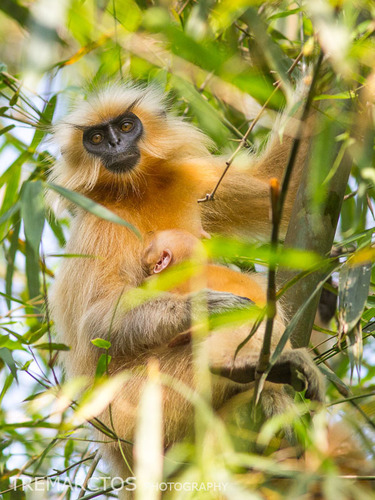
Gee's golden langur (Trachypithecus geei), commonly called the golden langur, is known for an uncanny, human-like gaze in widely shared online imagery, a trait caused by its light-colored eye sclera – a feature also seen in humans and some other great apes.
Coat Coloration
Adult golden langurs have coats that range from cream to golden; their flank and chest hairs are darker and often rust-colored, while juveniles and females have lighter coats, ranging from silvery white to light buff.
Seasonal Coat Variation
This species' coat changes color seasonally: it is white or cream in summer, and shifts to dark golden or chestnut in winter.
Facial and Crown Features
The langur's long whiskers protect its eyes from rain during the monsoon season. It has a black face and a large whorl of hair on its crown.
Sexual Dimorphism
Gee's golden langur displays sexual dimorphism: males are larger and more robust than females.
Weight Measurements
On average, adult males weigh 10.8 kg (24 lb), and adult females weigh 9.5 kg (21 lb).
Body and Tail Length
The combined head and body length ranges from 50–75 cm (20–30 in), and its relatively long tail measures between 70–100 cm (28–39 in).
Total Range Size
Gee's golden langur has a natural range covering around 30,000 square kilometers (12,000 square miles), much of which is unsuitable habitat.
Range Boundaries
Its natural range is bounded by the Brahmaputra River to the south, the Manas River to the east, the Sankosh River in Assam, India to the west, and the Black Mountains of Bhutan to the north.
Speciation Origin
Researchers believe these biogeographical barriers led to the speciation of Gee's golden langur from the closely related capped langur (Trachypithecus pileatus) via radiation.
Population Fragmentation
The species is split into two main fragmented sub-populations by National Highway 27.
Northern Sub-population Range
The northern sub-population lives in the western part of Manas National Park, spanning from the Sankosh River to the Manas River along the north side of National Highway 27 and State Highway 2, all the way to the India-Bhutan border.
Southern Sub-population Range
The southern sub-population is located on the southern side of NH27, extending to the Brahmaputra River.
Northern Sub-population Count
2020–21 population survey data shows the northern sub-population is larger, with a total of 5,566 individuals divided into 534 groups plus 23 lone males.
Southern Sub-population Count
The smaller, fragmented southern sub-population has around 1,830 individuals, organized into 173 groups plus eight lone males.
Northern Range Population Hotspot
Within the northern sub-population, Ripu Reserve Forest holds the highest number of individuals at 2,847.
Southern Range Population Hotspot
Within the fragmented southern range, Chakrashila Wildlife Sanctuary in Kokrajhar district hosts the largest number of individuals at 838.
Captive Release Event
In 1988, two captive groups of Gee's golden langur were released into the wild in Tripura, a state in northeast India outside of the species' natural range.
Released Population Status
One of these groups, released into Sepahijala Wildlife Sanctuary, still survives and has adapted to living wild there.
Canopy Locomotion
Most of the time, Gee's golden langur stays in the upper tree canopy, where its long tail acts as a balance when it leaps between branches.
Water Acquisition
During the rainy season, it gets water from dew and rain-soaked leaves.
Diet Composition
It is herbivorous, and its diet includes ripe and unripe fruits, mature and young leaves, seeds, buds, and flowers.
Typical Troop Structure
It typically lives in troops of around 8 individuals, with multiple females for every adult male.
Troop Size Range
Troop size ranges from 4 individuals (the smallest recorded) to 22 individuals (the largest recorded), for an average of 8.2 individuals per troop.
Adult Sex Ratio
The overall adult sex ratio is 2.3 females for every one male, and most troops contain only a single adult male.