About Macaca fuscata (Blyth, 1875)
Taxonomy and Sexual Dimorphism
The Japanese macaque, scientifically named Macaca fuscata (Blyth, 1875), is sexually dimorphic.
Weight
Males have an average weight of 11.3 kg (25 lb), while females average 8.4 kg (19 lb). Individuals from colder regions tend to weigh more than those from warmer areas.
Height
Average height is 57.0 cm (22.4 in) for males and 52.3 cm (20.6 in) for females.
Brain Weight
Their brain weighs approximately 95 g (3.4 oz).
Tail Length
Japanese macaques have short, stump-like tails, which average 92.5 mm (3.64 in) in males and 79.1 mm (3.11 in) in females.
External Appearance
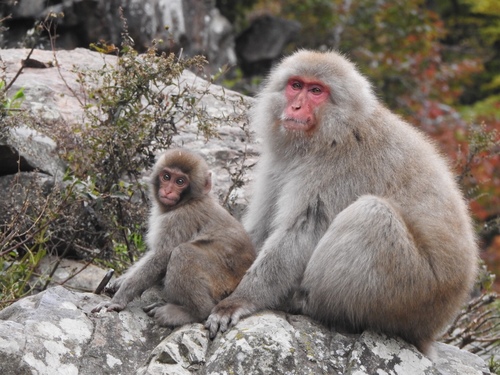
They have a pinkish face and posterior, while the rest of their body is covered in brown or greyish hair.
Cold Adaptation
Their coat is well-adapted to cold conditions, growing thicker as temperatures drop, and the species can survive temperatures as low as −20 °C (−4 °F).
Locomotion
Japanese macaques mostly move on all fours, and are semiterrestrial: females spend more time in trees, while males spend more time on the ground. They are known to leap, and are very strong swimmers, with records of individuals swimming distances over half a kilometer.
Lifespan
The maximum recorded lifespan for this species is 32 years for females and 28 years for males, which is longer than typical lifespans of other macaque species.
Range Classification
This is the northernmost-living non-human primate.
Native Distribution
Its native range covers three of the four main Japanese islands, all located south of Blakiston's Line: Honshu, Shikoku, and Kyushu. The northernmost native populations live on the Shimokita Peninsula, the northernmost point of Honshu. Japanese macaques also inhabit several smaller Japanese islands.
Subspecies
The southernmost population, on Yakushima Island, is classified as the subspecies M. fuscata yakui, separate from the mainland subspecies.
Population Estimate
A 1989 study estimated the total wild Japanese macaque population at 114,431 individuals.
Habitat Range
The species occupies a wide range of habitats. It lives in subtropical forests across the southern part of its native range, and subarctic forests in northern mountainous areas.
Specific Habitat Types
It occurs in both warm and cool forests, including the deciduous forests of central and northern Japan and the broadleaf evergreen forests of the Japanese islands' southwest. Warm temperate evergreen and broadleaf forests, and cool temperate deciduous broadleaf forests, are the species' most important habitats.
Relocation to Texas
In 1972, a troop of around 150 Japanese macaques was relocated from Kyoto to a primate observatory in southwest Texas, United States. The observatory is an enclosed ranch-style environment, where the macaques were allowed to roam with minimal human interference.
Adaptation to Texas Habitat
Many individuals died at first in the unfamiliar arid brushland habitat, but the surviving macaques eventually adapted: they learned to avoid local predators such as eagles, coyotes, and rattlesnakes, and began foraging for mesquite beans, cactus fruits, and other native foods.
Texas Troop Growth
The troop grew, and by 1995 numbered between 500 and 600 individuals.
Texas Sanctuary Establishment
In 1996, hunters maimed or killed four escaped macaques; as a result, legal restrictions were clarified publicly, and funds were raised to establish an 186-acre (75 ha) sanctuary near Dilley, Texas.
Sanctuary Management
In 1999, the Animal Protection Institute took over management of the sanctuary and began rescuing other primate species. As of 2017, the original relocated troop cohabits the site with six other macaque species.
Activity Pattern
Japanese macaques are diurnal.
Seasonal Feeding Patterns (Colder Areas)
In colder native areas, from autumn to early winter, macaques feed between other daily activities. In winter, they have two to four feeding periods per day, with fewer overall daily activities. In spring and summer, they have two or three daily feeding bouts.
Activity Patterns (Warmer Areas)
In warmer areas such as Yakushima, daily activity patterns are more varied.
Daily Time Budget
On average, a Japanese macaque's daily time is divided as: 20.9% inactive, 22.8% traveling, 23.5% feeding, 27.9% social grooming, 1.2% self-grooming, and 3.7% other activities.
Sleeping Behavior
Macaques usually sleep in trees, but they also sleep on the ground, as well as on or near rocks and fallen trees. During winter, macaques huddle together on sleeping grounds to stay warm.
Hot Spring Use
Macaques at Jigokudani Monkey Park are well known for visiting winter hot springs to warm up, a practice that started after they were encouraged to gather there in the 1960s as part of a plan to reduce crop damage from their foraging.