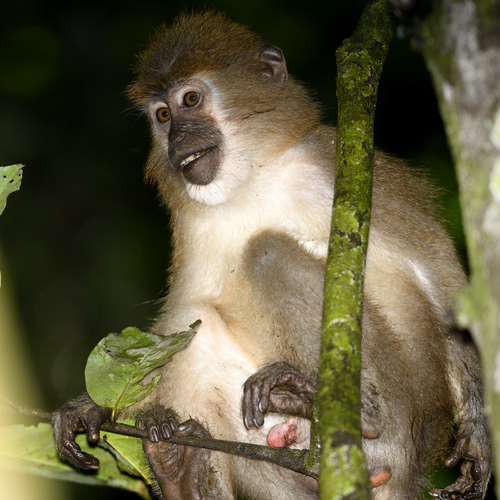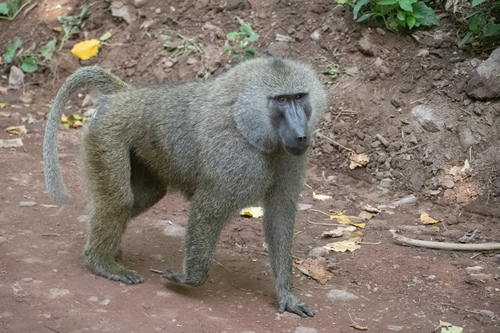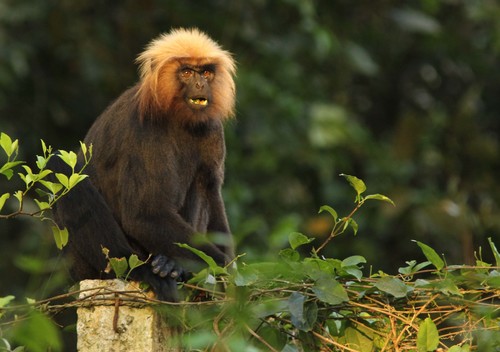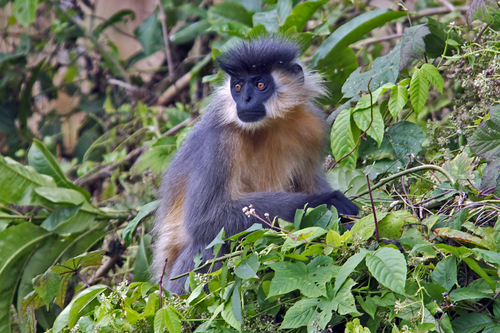
About Trachypithecus phayrei (Blyth, 1847)
Species Naming Origin
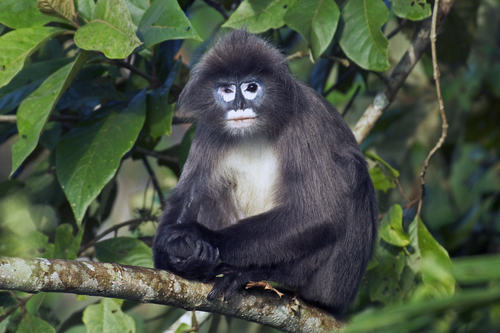
Phayre's langur (Trachypithecus phayrei) has distinctive white coloration around its ventral area, mouth, and eyes. The broad, ring-shaped white patches around its eyes resemble spectacles, which gives it the local Bengali name "Chasma bandor", meaning spectacled monkey.
Adult Body Fur Coloration
This white fur contrasts sharply with the species' overall deep bluish-brown body fur, which is darker on the head, below the elbows, and at the tip of the tail. Both adult males and adult females have a sagittal crest on the head, which gives the head a triangular shape.
Infant Coat Coloration
Infants are easily distinguishable from other members of their group by their straw-colored natal coat.
Head-Body Length
The average head-body length of this species ranges from 530–580 mm (21–23 in) for males, and 495–580 mm (19.5–22.8 in) for females.
Tail Length
The tail is usually longer than the head-body; average tail length is 700 mm (28 in) for males and 750 mm (30 in) for females. Compared to Trachypithecus melamera and Trachypithecus popa, Phayre's langur has a shorter tail.
Body Mass
The average body mass of Phayre's langur is around 7.9 kg (17 lb) for males and 6.9 kg (15 kg) for females.
Sexual Dimorphism in Eye Patches
In field studies, males and females can be differentiated by the shape of their eye-surrounding white patches: females have cone-shaped white patches that bend inward toward the nose, while males have rounder patches. This shape difference also creates a slightly wider gap between the patches in males than in females.
Dental Formula
Like most Old World monkeys, Phayre's langur has the dental formula 2.1.2.3 / 2.1.2.3.
Craniodental Adaptations
Unlike other colobines, Phayre's langur has specific craniodental adaptations suited for seed-eating, including medially positioned tooth rows and stronger masseter pterygoid muscles.
Geographic Range
Phayre's langur inhabits tropical, deciduous, and evergreen forests in Northeast India, eastern Bangladesh, and western Myanmar.
Habitat Types
It can also live in secondary forest habitats such as bamboo clusters and rubber plantations.
Bangladesh Resting Trees
In Bangladesh, the langurs rest in the shade of large-canopied tree species including Artocarpus chama, Artocarpus lacucha, Ficus racemosa, Trophis aspera, Mangifera indica, and Grewia nervosa.
India Roosting Trees
In India, particularly in Mizoram, the most common roosting trees are Ficus hispida and Triadica sebifera, which typically grow 6–15 m (20–49 ft) tall and have extensive canopies.
Recorded Population Sizes
Currently, recorded populations total 1200 individual langurs in India and 376 individuals in Bangladesh, 288 of which live in the northeastern forests of Bangladesh.
Female Reproductive Timing
Female Phayre's langurs reach their first pregnancy at an average age of 5.3 years, and have an average gestation period of 205 days.
Mating Behavior
Females exhibit promiscuous behavior, and studies show they prefer more experienced, usually higher-dominance males. Polygynous relationships are common, and males provide protection to females they have mated with.
Infant Care
Females nurse their infants for an average of 22 months, with weaning occurring between 19 and 21 months after birth. An infant's natal coat begins to darken 26 weeks after birth.