About Macaca silenus (Linnaeus, 1758)
Fur and Mane Characteristics
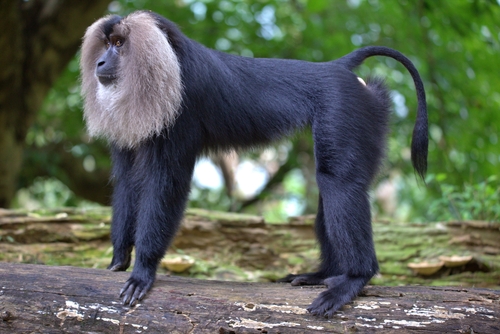
Lion-tailed macaques (Macaca silenus) are covered in black fur, and both sexes have a distinct gray or silver mane surrounding the face. The face is hairless and black in adults, but pinkish in infants under one year old. Infants are born without a mane, which begins to grow around two months after birth.
Tail Traits
They get their common name not from their mane, but from their tail: the tail is long, thin, and mostly hairless, ending in a lion-like black tuft. The tail is typically around 25 cm (9.8 in) long.
Facial and Oral Features
Their eyes are hazel, framed by contrasting black eyelids. Like other macaques, lion-tailed macaques have deep cheek pouches for storing food.
Locomotion and Digits
They are quadrupedal and have opposable digits.
Etymology
The mane surrounding the face gives the species its German name Bartaffe, meaning "beard ape".
Size and Weight
It has a head-body length of 42–61 cm (17–24 in) and weighs 2–10 kg (4.4–22.0 lb), making it one of the smaller macaque species.
Habitat
The lion-tailed macaque lives in rainforests, most often in the upper canopy of tropical moist evergreen forests or monsoon forests.
Activity Pattern
It is diurnal, active only during daylight hours.
Daily Activity Budget
When active, half of the day is spent foraging, and the other half is spent resting or moving to new foraging areas.
Human Interaction
This species avoids humans more than other macaques, but habitat loss has led to increased habituation to humans and more frequent conflict with people.
Social Group Structure
Like other macaques, lion-tailed macaques live in hierarchical social groups that usually contain 10 to 20 members, with 1–3 males (including a dominant alpha) and many females.
Mating System
They have a polygynous mating system with no fixed breeding season, though most breeding occurs in the wet season when resources are most abundant.
Intragroup Social Behavior
Group members spend little time grooming or playing together.
Territorial Defense
Lion-tailed macaques are territorial. They first defend their range against invading troops with loud calls and bared teeth; if this does not work, they fight aggressively, and large canines can cause severe laceration injuries.
Communication Displays
Other forms of communication include mounting to display strength, branch shaking to scare off intruders, lip-smacking as a friendly greeting, and yawning with a bared grimace to signal dominance.
Arboreal Behavior Patterns
Lion-tailed macaque behavior follows characteristic patterns of arboreal life. These patterns include selectively feeding from a wide variety of fruit trees, maintaining large spaces between individuals while foraging, and devoting a high proportion of their activity time to exploration and feeding.
Diet Classification
They are omnivores.
Undisturbed Forest Diet
In undisturbed virgin forest, they primarily eat native fruits, seeds, flowers, insects, snails, and small vertebrates.
Seed Dispersal Role
Lion-tailed macaques play an important role in seed dispersal, as they can carry seeds long distances by dropping them or excreting them after consumption.
Logged Habitat Adaptations
In areas that have undergone heavy selective logging, the species has adapted to rapid environmental change through behavioral shifts and expanded food choices. These changes include a large increase in ground foraging, and much higher consumption of non-native plants and insects.
Expanded Diet Components
Their expanded diet includes fruits, seeds, shoots, pith, flowers, cones, mesocarp, and other parts of many non-native and pioneer plants.
Regional Prey Observation
In the forests of Kerala, lion-tailed macaques have been observed preying on pigeon nestlings and eggs.
Reproduction and Development
Gestation lasts approximately six months. Offspring are nursed for one year. Females reach sexual maturity at four years old, while males reach sexual maturity at six years old.
Life Expectancy
Life expectancy is around 20 years in the wild, and up to 30 years in captivity.