About Rana latastei Boulenger, 1879
Size
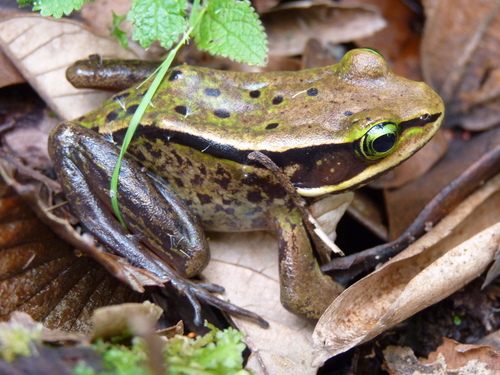
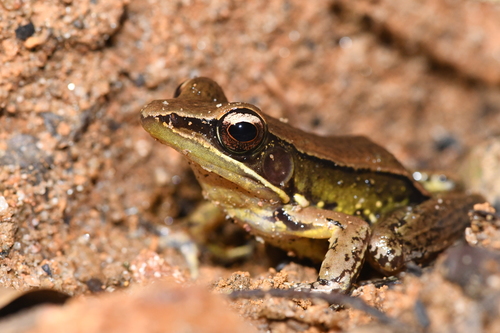
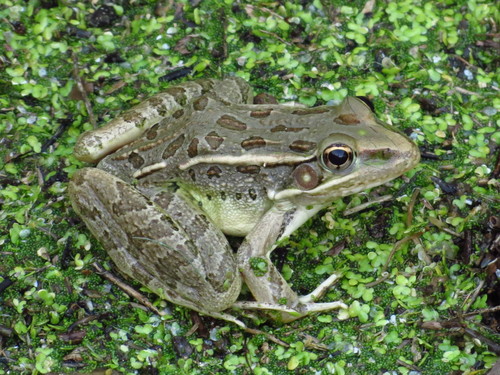
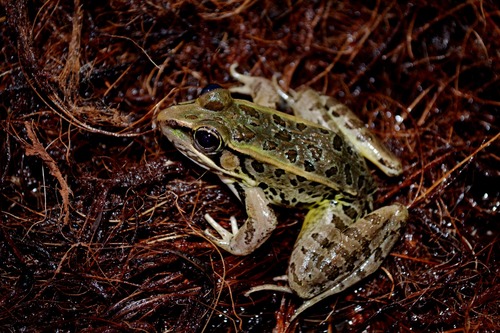
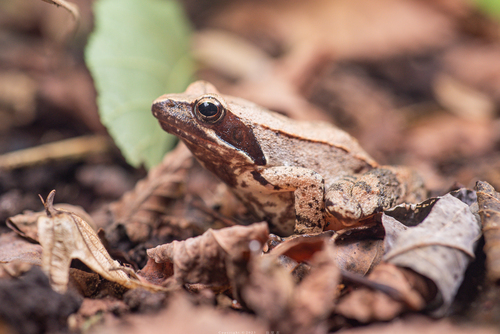
Rana latastei (Italian agile frog) can reach a head-body length of 7.5 cm (3.0 in). Females are typically slightly larger than males.
Snout Morphology
Most individuals have pointed snouts, though some frogs have rounded snouts.
Dorsal and Ventral Coloration
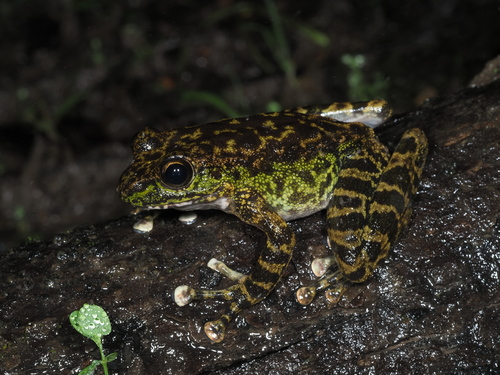
Like many European common frogs, R. latastei is primarily gray or brownish-red with a white belly, and there is almost no color variation across different geographic locations. It has a dark throat with a narrow light central stripe that extends down to the chest.
Breeding Male Traits
Some sexually active males have dark red or brown spots on the throat, orange-red coloration on the underside of the thighs, and thumb pads on the forelimbs.
Elevation Range
R. latastei is strictly a lowland species, and rarely occurs at elevations above 400 m above sea level, only reaching the lower foothills of mountains. Colder temperatures in higher elevations delay larval development and metamorphosis for the species.
Forest Habitat
The Italian agile frog lives in oak- and hornbeam-dominated plain woods, hygrophilous woods, and riparian woods dominated by white poplar and white willow. These types of woodlands are regularly flooded.
Open and Modified Habitats
It has also been recorded in open habitats including wet meadows and peat bogs, as well as cottonwood plantations and ditches in agricultural areas that have enough vegetation.
Cave Occurrence
There are records of R. latastei living in caves in Italy and Croatia, though these frogs move between caves and surrounding forests. Researchers have proposed two explanations for the presence of frogs in caves: either they were washed into caves by floods, which are common in most habitats the Italian agile frog prefers, or they entered caves intentionally to avoid predators, find food, or seek humidity. It is not known if the Italian agile frog breeds in these subterranean habitats.
Breeding Habitat Requirements
The Italian agile frog prefers humid regions with abundant rotting plant material, and stays close to rivers, streams, lakes, and other freshwater sources, which are required for the species' breeding and reproduction.
Activity Patterns
It is most active in the early morning and at dusk, and tends to avoid dry weather. During dry periods, the frogs stay closer to water sources and reduce activity until evening.
Seasonal Movement
Adults stay closer to bodies of water during the breeding season, which runs from February to April. They are more commonly found in forests when conditions become more humid in late spring and summer.
Annual Activity Cycle
Activity is highest in summer and early autumn after the spring breeding season ends. Hibernation on land starts in October, and frogs emerge in spring to breed.
Geographic Distribution
Rana latastei is endemic to the plains of northern Italy, the extreme southern tip of Switzerland, the Istrian region of Slovenia, and adjacent parts of Croatia.
Distribution in Italy
In Italy, populations are found in four regions: Lombardy, Venetia, Piedmont and Friuli-Venezia Giulia, and the species is most abundant in Lombardy and Venetia. Its distribution mainly follows the Po River plains and its tributaries.
Water Extraction Threat
Water pumping for crop irrigation has been particularly harmful to the species, as it makes habitats less suitable for breeding.
Habitat Fragmentation Effects
The Italian agile frog does not move long distances, and rarely strays far from its nearest breeding site. Because of this, forest habitat fragmentation has caused reduced genetic diversity in the species.
Pathogen Vulnerability
This reduced diversity is predicted to make R. latastei more vulnerable to infection by Ranaviruses and other pathogens. Genetic isolation is also thought to cause significant size variation between different populations of R. latastei.
Invasive Species Threat
The introduction of invasive predatory species including Percottuss glenii, the American bullfrog, and crayfish has further endangered the Italian agile frog.
Microplastic Threat
Rising microplastic deposition in the environment has also become a recent concern for the survival of the species. R. latastei tadpoles feed indiscriminately, which puts them at higher risk of ingesting small plastic particles.
Microplastic Effects on Tadpoles
Increased microplastic exposure has been linked to reduced growth, activity, and survival rates in R. latastei tadpoles. Smaller microplastic fragments have the strongest negative effects on the species. This may be because small plastic pieces and fibers can form blockages and tangled clumps in tadpoles' intestines. Some researchers have suggested that larger, more developed tadpoles are more resistant to the negative effects of microplastics on growth and activity.
Microplastic Effects on Adults
It is currently unknown how microplastics affect adult R. latastei.