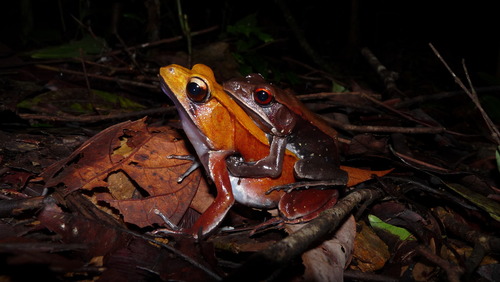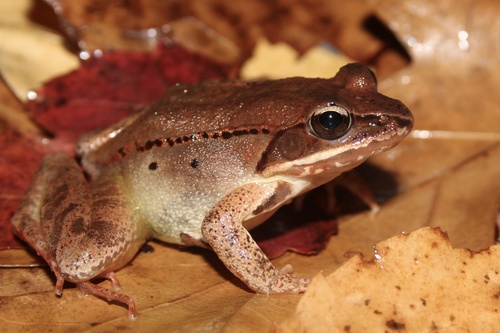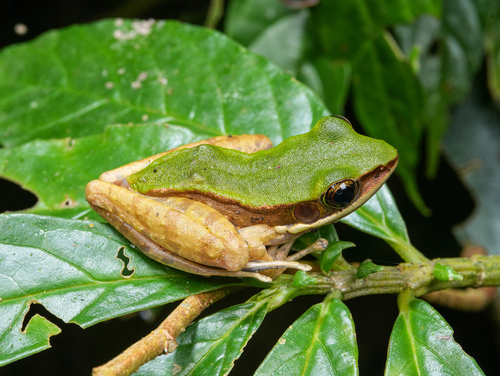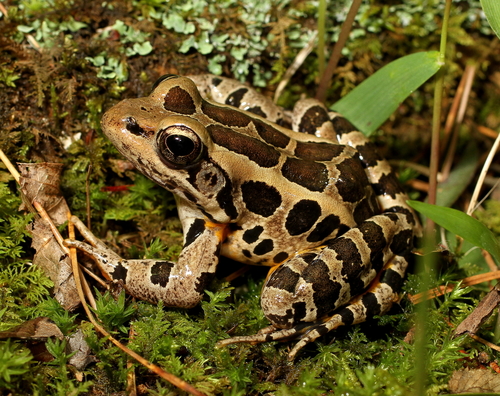
About Lithobates grylio (Stejneger, 1901)
Coloration and Markings
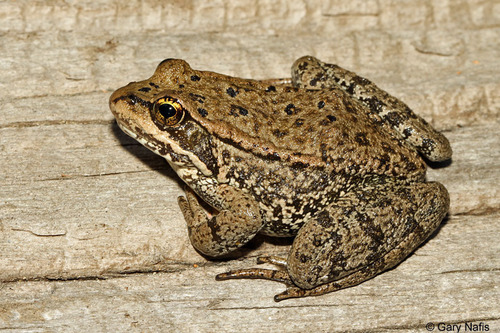
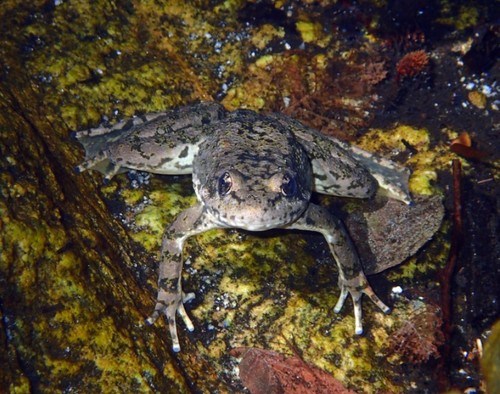
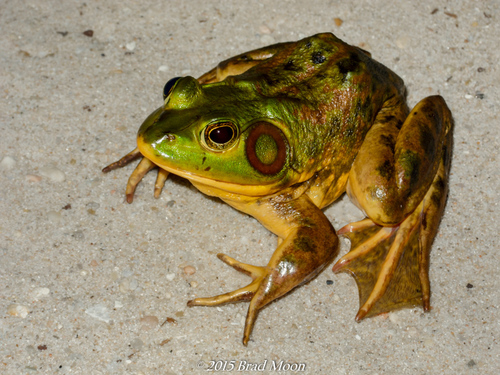
Lithobates grylio, commonly called the pig frog, is green or grey-green with brown or black blotches.
External Morphology
It has fully webbed feet, a sharply pointed nose, and large eardrums (tympana).
Sexual Dimorphism Traits
This species shows sexual dimorphism in size and coloration: males have larger tympana than females, and males also have a distinctive bright yellow throat that sets them apart from females.
Adult Size Range
Pig frogs grow to a snout to vent length (SVL) of 85 to 140 millimeters (3 1/4 to 5 1/2 inches).
Growth Rate Patterns
Males and females have similar growth rates until their snout-vent length reaches roughly 100mm; after this point, females grow faster and eventually reach a larger adult size than males.
Wild Population Demographics
Because adult females are larger, they generally have higher survival rates than males and are therefore likely more abundant in the wild.
Similar Congeneric Species
Pig frogs are easily confused with other species in the genus Lithobates that share their geographic range, including the American bullfrog (Lithobates catesbeiana).
Common Name Origin
The species gets its common name from the loud, deep grunting or snorting call males produce, which resembles the oinking sound of a pig.
Male Call Function
Males use this low grunting call during the breeding season to attract females and establish territory.
Habitat Preferences
Pig frogs are almost entirely aquatic, and are most often found along the edges of lakes, or in vegetation-heavy cypress swamps and marshes.
Activity Pattern
They are nocturnal, and their pig-like grunts can be heard during the warm months of the year.
Breeding Season Timing
Their breeding season runs from April to August.
Fertilization Method
Fertilization is external: males release sperm over eggs as the eggs are laid.
Egg Laying Characteristics
Females lay eggs in large surface masses of up to 10,000 eggs at a time, usually positioned over vegetation on the water surface.
Development Timeline
The eggs hatch within several days, and tadpoles may take a full year to complete metamorphosis into adult frogs.