About Potamochoerus porcus (Linnaeus, 1758)
Body Fur Coloration
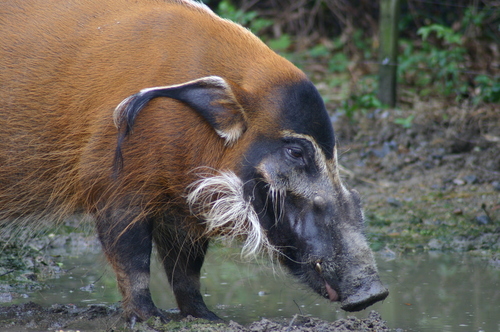
The red river hog, Potamochoerus porcus, has striking orange to reddish-brown fur, with black legs and a tufted white stripe running along its spine. Adult red river hogs have white markings around the eyes, cheeks, and jaws, while the rest of the muzzle and face is contrasting black.
Fur Length Variation
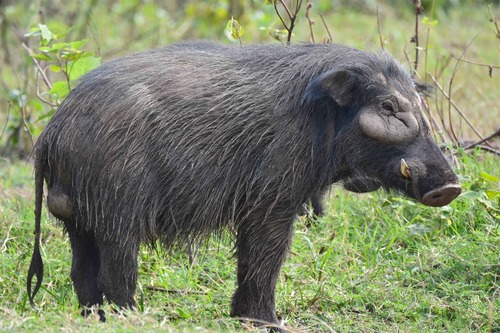
The fur on the jaw and flanks is longer than the fur on the body, and males have especially prominent facial whiskers. Unlike other pig species native to tropical Africa, the entire body of the red river hog is covered in hair, with no bare skin visible.
Adult Size Measurements
Adult red river hogs weigh 45 to 115 kg (99 to 254 lb), stand 55 to 80 cm (22 to 31 in) tall, and measure 100 to 145 cm (39 to 57 in) in total length. Their thin tail is 30 to 45 cm (12 to 18 in) long and ends in a tuft of black hair.
Ear Characteristics
Their ears are also long and thin, ending in tufts of white or black hair that can reach 12 cm (4.7 in) in length.
Male Morphological Features
Male boars are somewhat larger than female sows, and have distinct conical protuberances on either side of the snout along with small, sharp tusks. These facial protuberances are bony and likely protect the boar's facial tendons during head-to-head combat with other males.
Dental Formula
Red river hogs have a dental formula of 3.1.3–4.3/3.1.3–4.3, which is similar to that of wild boar.
Scent Gland Distribution
Individuals of both sexes have scent glands close to the eyes and on the feet; males have additional scent glands near the tusks on the upper jaw and on the penis.
Chin Gland Structure
There is also a distinctive glandular structure about 2 cm (0.79 in) in diameter on the chin, which likely has a tactile function.
Female Reproductive Anatomy
Females have six teats.
Habitat Preferences
Red river hogs live in rainforests, wet dense savannas, forested valleys, and areas near rivers, lakes and marshes.
Geographic Distribution
Their distribution ranges from the Congo area and Gambia to eastern Congo, extending south to the Kasai and the Congo River.
Range Overlap with Bushpigs
The exact boundary between the range of the red river hog and the closely related bushpig is unclear; in broad terms, red river hogs occupy western and central Africa, while bushpigs occupy eastern and southern Africa. Where the two species meet, they are sometimes reported to interbreed, though other authorities dispute this claim.
Taxonomic Subspecies Status
While many subspecies were identified in the past, none are currently recognized.
Breeding Seasonality
Red river hogs breed seasonally, so their young are born between the end of the dry season in February and the middle of the rainy season in July.
Female Oestrus Cycle
The oestrus cycle of females lasts 34 to 37 days.
Mating Behavior
Before mating, the male licks the female's genital region, and mating itself lasts approximately five to ten minutes.
Gestation Period
Gestation lasts 120 days.
Nesting and Litter Size
The mother builds a nest from dead leaves and dry grass before giving birth to a litter of up to six piglets, with three to four being the most common litter size.
Newborn Piglet Characteristics
Newborn piglets weigh 650 to 900 g (23 to 32 oz), and are initially dark brown with yellowish stripes and spots.
Piglet Development
Piglets are weaned after about four months, and develop the plain reddish adult coat by around six months of age; the dark facial markings do not appear until they reach adulthood at about two years of age.
Wild Lifespan
Red river hogs probably live for around fifteen years in the wild.