About Sus scrofa Linnaeus, 1758
Body Form
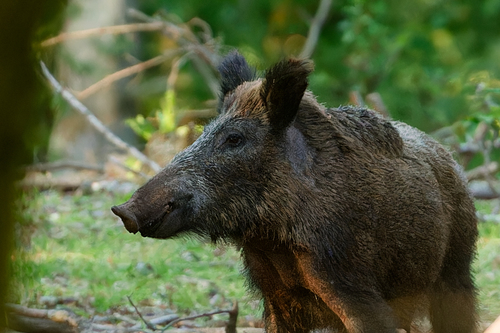
The wild boar (Sus scrofa Linnaeus, 1758) is a bulky, massively built suid with short, relatively thin legs. Its trunk is short and robust, and the hindquarters are underdeveloped. There is a hump behind the shoulder blades, and the neck is short, thick, and nearly immobile.
Head and Limbs
The head is large, taking up to one - third of the body length, and is well - suited for digging. It can dig 8–10 cm into frozen ground and upturn rocks weighing 40–50 kg. The eyes are small and deep - set, and the ears are long and broad.
Speed
Adult males have well - developed canine teeth that protrude from the mouth. The medial hooves are larger and more elongated than the lateral ones, enabling quick movements. The boar can run at a maximum speed of 40 km/h and jump 140–150 cm high.
Dimorphism
Sexual dimorphism is pronounced. Males are 5–10% larger and 20–30% heavier than females. Males have a mane on their back, especially in autumn and winter.
Male Traits
Their canine teeth are more prominent and grow throughout life. The upper canines are short and curve upwards, while the lower canines are sharp and 10–12 cm long. During the breeding period, males develop a 2–3 cm thick subcutaneous tissue from the shoulder blades to the rump. They also have a chicken - egg - sized sac near the penis opening that collects urine and emits a sharp odour.
Adult Size
Adult size and weight depend on environmental factors. In Europe, males in different regions weigh between 50–200 kg, and females between 45–120 kg.
Coat Features
In Northeastern Asia, large males can reach 270–350 kg. The winter coat consists of long, coarse bristles and short brown downy fur. The bristle length varies, with the longest on the back.
Colouration
Coat colour is variable, and piglets have light - coloured bands.
Vocalizations
The wild boar produces contact calls (grunts, purrs), alarm calls (huffing, screeches), and combat calls (high - pitched cries).
Senses
It has a well - developed sense of smell, acute hearing, and weak eyesight.
Venom Resistance
Pigs are one of four mammalian taxa with mutations in the nicotinic acetylcholine receptor that protect against snake venom.
Habitat
The wild boar inhabits diverse habitats, from boreal taigas to deserts, and can be found at high altitudes in mountains.
European Habitat
It needs heavily brushed areas for shelter, water, and an absence of regular snowfall. In Europe, it prefers deciduous and mixed forests.
Movement and Rest
It is a competent swimmer and can cover long distances. It rests in shelters with insulating material, often near streams.
Historical Range
Originally, the wild boar occurred in North Africa and much of Eurasia. In recent centuries, its range has changed due to hunting and captive escapes.
Population Change
Populations declined in many areas before the 20th century but have revived since the mid - 20th century.
Social Structure
Boars are social animals, living in female - dominated sounders. Males leave the sounder at 8–15 months.
Breeding Season
The breeding period is from November to January. Males develop subcutaneous armour before mating. The gestation period varies by the age of the sow.
Birth and Care
Farrowing is between March and May, with an average litter of 4–6 piglets. Piglets are born in a nest, and if the mother dies, they are adopted by other sows.
Human Use
Humans have hunted wild boar for millennia. It was a food source and a sporting challenge in ancient times. Hunting methods have changed over the years.
Captivity
Wild boar can be raised in captivity, and products derived from it include meat, hide, and bristles. Wild boar meat is leaner and healthier than pork.