About Babyrousa celebensis (Deninger, 1909)
Taxonomic Naming
The North Sulawesi babirusa, scientifically named Babyrousa celebensis, is a pig-like animal native to Sulawesi and the nearby Indonesian islands of Lembeh, Buton, and Muna. Both its common and scientific name come from transcriptions of the species' local name, which translates literally to "pig-deer".
Etymology
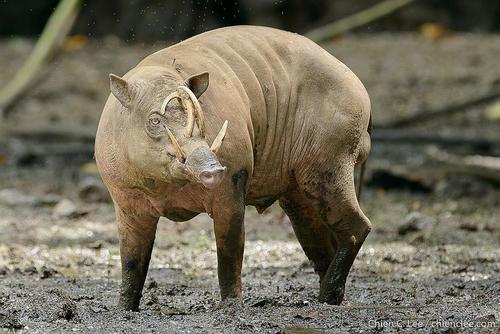
This name combines the Indonesian words babi (pig) and rusa (deer), chosen because the male's large tusks resemble a deer's antlers. This species has two pairs of large tusks formed from greatly enlarged canine teeth.
Tusk Structure
The lower and upper pairs of canines both curve up and back toward the head. In males, the upper canines are so enlarged and curved that they penetrate through the flesh and the top of the snout, then continue curving back toward the forehead.
Skin Characteristics
The North Sulawesi babirusa has mostly hairless mottled grey and brown skin that works as camouflage.
Habitat
It lives in the underbrush of tropical forests and canebrakes, as well as along the shores of rivers and lakes.
Conservation Status
Although the species is protected under Indonesian law, it is threatened by illegal hunting and deforestation.