About Platycercus icterotis (Temminck & Kuhl, 1820)
Taxonomy and Common Name
Platycercus icterotis, commonly known as the western rosella, is the smallest species in its genus.
Adult Size Measurements
Adult western rosellas weigh 60 to 70 g (2.1 to 2.5 oz), measure 25 to 30 cm (9.8 to 11.8 in) in total length, have a 35 to 41 cm (14 to 16 in) wingspan, and an average tail length of 13 cm (5.1 in) — equal to half of their total body length.
Sexual Dichromatism
This is the only species in the genus that shows strong sexual dichromatism in plumage.
Adult Male Head and Neck Plumage
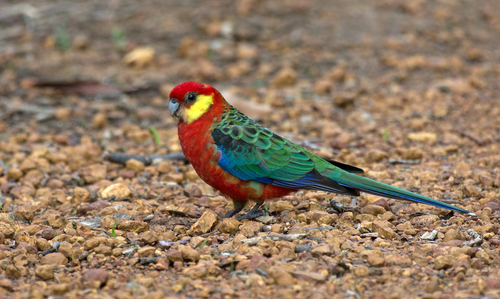
For adult males, the red plumage is a brighter scarlet; they have a mostly red head and neck, with a yellow cheek patch that is bright yellow in the nominate subspecies and pale cream in subspecies xanthogenys.
Adult Male Red Feather Fringing
Fresh red feathers have black fringes.
Adult Male Back Plumage
The back features indistinct black feathers mottled with red, green, and buff, with these colors forming scalloped edges along each feather.
Adult Male Folded Wing Plumage
When folded, the wing is green; the shoulder is black with green margins, plus a narrow dark blue shoulder patch and dark primary coverts edged with blue.
Adult Male Flight Underwing Plumage
The blue coloration of underwing flight feathers and coverts is visible when the bird is in flight.
Adult Male Rump and Upper Tail Coverts
The upper tail coverts and rump are green shifting to olive, and may have a red margin.
Adult Male Tail Plumage
Central tail feathers are blue and green, outer tail feathers are similar blue with white tips, undertail feathers are blue with white fringes.
Adult Male Underpart Plumage
Underparts are red with green flanks.
Adult Male Soft Part Coloration
The beak is pale blue-grey with a dark grey cere; legs and feet are slate grey, and the iris is dark brown.
Adult Female Head and Underpart Plumage
In adult females, most red plumage on the head, neck, and underparts is replaced with green, except for a solid red band across the forehead.
Adult Female Plumage Details
Females have more subdued red plumage flecked with green, a smaller dull yellow cheek patch, no red feathers on the back and scapulars, and a broad white or cream bar on the underwing.
Immature Plumage
Immature birds resemble adult females but have even more green plumage, red only on the crown, and no yellow cheek patch at all.
Immature Soft Part Coloration
Their bill and cere are light pink, changing to adult coloration by six months of age.
Intraspecific Color Variation
The species has an east-west cline of color variation, and variable levels of hybridisation have been reported east of the Darling Range, in southern Australia, and in the Stirling Range, with intergrading between forms recorded at locations including Albany.
Sympatric Similar Parrot Species
Southwest Australia is also home to larger similar parrots: the red-capped parrot (Purpureicephalus spurius), which is easily distinguished by its yellow rump, and Port Lincoln parrots (Barnardius zonarius), which have a blue cheek and black head that contrast with the green, red, and yellow plumage of the western rosella.
Endemic Range
The western rosella is endemic to southwestern Australia, isolated from congener species found in the north and east of the country.
General Movement and Habitat
It is moderately common and usually sedentary, frequenting forests, many other types of wooded country, or kwongan.
Occurrence in Altered Habitats
It also occurs in farmland or at other sites with feeding opportunities, and is most often observed at cleared sites.
Captive History
The species has been kept in captivity in Australia and on several other continents, starting before 1830 in England.
Subspecies Geographic Distribution
The two recognised subspecies are geographically adjacent: P. icterotis xanthogenys occurs in the wheatbelt region, inland to the north and east of the species' overall range, while P. icterotis icterotis occurs in coastal areas of the south and west.
Species Overall Range Boundary
The inland boundary of the species' range extends from the area between the lower Swan River and the Arrowsmith River on the western coast, then runs east and south before passing near Southern Cross, the Fraser Range, Esperance, the Stirling Ranges and Kojonup.
Subspecies Boundary
The boundary between the inland and coastal subspecies starts east of King George Sound and runs northwest through Mount Barker and the Kojonup region toward the Bannister River.
Regional Population Abundance
The species is less common on the Swan Coastal Plain than in southern areas of the wheatbelt, where it is observed more frequently around Narrogin and Katanning in remnant wandoo woodland, and occurs throughout the conservation area at Dryandra Woodland.
Subspecies Taxonomic Validity
Authors have expressed doubt about the validity of the two subspecies, and compiled observations show no clear geographic separation between them.
Historical Population Records
Historical records note the species was relatively uncommon, but reported more often in southern regions.
Northern Range Limit
The northernmost extent of its range is near Moora, with records extending east to around Norseman.
Post-Colonisation Population Decline
The species' population has declined significantly since European colonisation, especially for the inland P. icterotis xanthogenys after the 1970s.
Local Extinction Locations
It has become locally extinct in shires where it was previously recorded, including Coorow, Dandaragan, Moora, Dalwallinu, Merredin, Quairading, Serpentine-Jarrahdale and the Shire of Murray.
Additional Population Decline Areas
Population declines have also been recorded in the shires of Swan, Kalamunda, Northam, York, Armadale-Kelmscott, Capel and Dumbleyung.
Decline Cause and Trend
This disappearance from northern and eastern parts of the Wheatbelt is the result of habitat removal, and no shires have recorded an increase in observations of the species.
Crop Adaptation Limitation
Compared to other parrot species such as ringnecks (Barnardius zonarius) that harvest a wide range of seeds, the western rosella has comparatively limited adaptation to introduced agricultural crops.
Colonisation Limitation
This is likely to have restricted its ability to successfully migrate to or re-colonise heavily altered landscapes.
Seasonal Movement Evidence
The suggestion that birds move from northern parts of the range toward the coast after breeding during the austral summer has no supporting evidence of large-scale seasonal movement in occurrence data.
Coastal Subspecies Range
The distribution of P. icterotis icterotis is restricted to humid and subhumid regions, south of Dandaragan and the lower reaches of the Moore River, and west of Wannamal, Muchea, Mundaring, Jarrahdale, Marrinup, Collie, Boyup Brook, upper Hay River, and the Porongurup and Green Range.
Inland Subspecies Former Range
P. icterotis xanthogenys is recorded in the southern interior of Western Australia, in semiarid climatic zones; its former range included the Wongan Hills, with occurrences at Kununoppin, Moorine Rock, Parker Range, Yardina Rock and Ten Mile Rocks.
Inland Subspecies Current Range
Its range extends west to Toodyay, Dale River, Mt Saddleback and Kojonup, and north of the Stirling Range, lower Fitzgerald River, Ravensthorpe, Frank Hann National Park and Red Lake.
Casual Occurrence Locations
Occurrences farther north are considered casual, at locations including Mt Jackson, Karalee and Gnarlbine Rock.
Local Abundance Change Example
A significant change in abundance was noted at Grass Patch, where the species was common in the mid-20th century, then reappeared in later decades after a fifteen-year absence.
Erroneous Northern Location Records
Erroneous location records for Point Cloates and Shark Bay published by Mathews were later confirmed incorrect by the author.
Gould's Range Correction
Mathews also identified a clear error in Gould's 1837 protologue, which incorrectly extended the species' range from King George Sound to New South Wales.
Historical Swan River Colony Records
Gould later noted in 1848 that the species was only known from the Swan River Colony, a location where it is now uncommon.
Preferred Woodland Habitat
The western rosella favours woodland habitat with sheoak (Allocasuarina), salmon gum (Eucalyptus salmonophloia) and wandoo (Eucalyptus wandoo), but has sometimes thrived in areas cleared for introduced grain crops in the region's Wheatbelt.
Cleared Habitat Use
It also occurs in other cleared areas adjoining bushland, such as roadsides, golf courses and reserves, to feed on grasses or weeds.
Subspecies Vegetation Associations
The two subspecies occupy different vegetation types, associated with their specific woody upper-storey plant communities.
Coastal Subspecies Habitat Vegetation
The coastal subspecies P. icterotis icterotis is found among eucalypts and paperbarks in high rainfall areas from Jurien to Green Range, east of Manypeaks; these include marri (Corymbia calophylla), karri (Eucalyptus diversicolor), flood gum (E. rudis) and paperbark (Melaleuca).
Coastal Subspecies Diet
It is known to feed on the fruit of Bossiaea linophylla and Leucopogon obovatus, the flowers of marri, and the fleshy part of the seed of Macrozamia riedlei, and feeds both on the ground and in trees.
Inland Subspecies Habitat Vegetation
The lower rainfall inland region inhabited by P. icterotis xanthogenys is covered in wooded scrub generally made up of eucalypt and sheoak, including flood gum, wandoo, salmon gum, tall mallee country, and rock sheoak (Allocasuarina huegeliana).
Inland Subspecies Diet
This subspecies feeds on seeding wandoo, Acacia huegeliana, Glischrocaryon flavescens and Olearia revoluta, and flowering Eucalyptus eremophila and Melaleuca acuminata.