About Aratinga solstitialis (Linnaeus, 1758)
Size and Sexual Dimorphism
On average, sun conures (Aratinga solstitialis) weigh around 110 g (4 oz) and measure around 30 cm (12 in) long. Males and females have similar plumage, though females tend to be lighter and more slender, with shorter tails, smaller rounder heads, and smaller beaks.
Adult Plumage
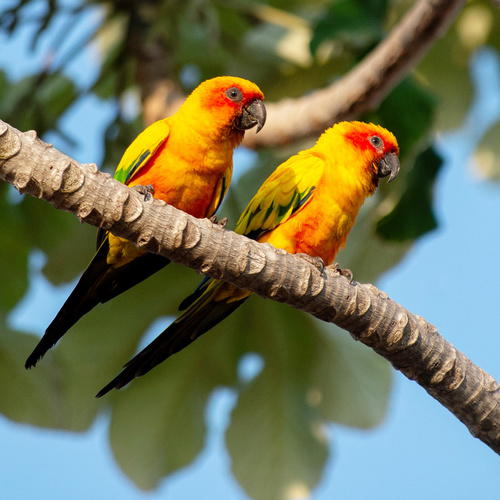
Adult sun conures have a rich yellow color on the crown, nape, mantle, lesser wing coverts, tips of the greater wing coverts, chest, and underwing coverts. Their face and belly are orange, with red coloring around the ears. The base of the greater wing coverts, tertials, and base of the primaries are green, while the secondaries, tips of the primaries, and most of the primary coverts are dark blue.
Soft Part Features
The tail is olive-green with a blue tip, and all flight feathers appear dark greyish when viewed from below. The bill is black, and the legs and bare eye ring are grey; in captive individuals, the grey eye ring often fades to white, so using eye ring color to judge an individual’s “purity” can be misleading.
Similar Species
Sun conures are easily confused with the closely related jandaya parakeet and sulphur-breasted parakeet. Jandaya parakeets have entirely green wing coverts, mantle, and vent, while sulphur-breasted parakeets have green mottling on the mantle and less orange on the underparts. Sun conures also look superficially similar to the pale-billed golden parakeet.
Juvenile Plumage
Juvenile sun conures have predominantly green plumage and resemble young sulphur-breasted parakeets. They develop their distinctive yellow, orange, and reddish coloration on the back, abdomen, and head as they reach maturity.
Geographical Range
Sun conures inhabit a relatively small region in northeastern South America: the north Brazilian state of Roraima, southern Guyana, extreme southern Suriname, and southern French Guiana. They also occur as vagrants in coastal French Guiana. Their presence and status in Venezuela is unclear, though recent sightings have been reported in the southeast near Santa Elena de Uairén.
Unconfirmed Range Areas
They may also occur in Amapá or far northern Pará, two regions with very poorly documented avifauna, but this has not yet been confirmed. Populations once thought to be sun conures along Brazil’s Amazon River are now known to be sulphur-breasted parakeets.
Preferred Habitats
Sun conures are mostly found in tropical habitats, but their exact ecological requirements remain relatively poorly understood. They have been widely reported in dry savanna woodlands and coastal forests, but recent sightings indicate they mainly live at altitudes below 1,200 m (3,900 ft), along the edges of humid foothill forests in the Guiana Shield. They only cross open savannah habitats when traveling between patches of forest.
Other Occurrence Habitats
They have also been observed in shrublands along the Amazon riverbank, forested valleys, and coastal seasonally flooded forests, and usually inhabit areas with fruiting trees and palm groves.
Pair Formation
Young sun conures form monogamous pairs when they are around 4 to 5 months old. Before breeding, pairs can be seen feeding and grooming each other. Mating can last up to three minutes, after which pairs become very affectionate toward each other.
Pre-Laying and Nesting
Before egg laying, the female’s abdomen noticeably swells. Sun conures are known to nest in trees or in cavities of Mauritia flexuosa palms. Active nests have been observed holding multiple adults, along with eggs and young birds of various ages, which suggests the species may engage in cooperative breeding.
Egg Characteristics
Eggs and chicks can be found in nests from January to October. The fertility rate of sun conures is relatively high. A typical clutch holds three or four white eggs, which may be laid at two- to three-day intervals.
Incubation Behavior
Pairs only destroy and eat their eggs when the female has calcium deficiency. Females handle the entire incubation period, which lasts 23 to 27 days, and only leave the nest for short periods to feed. Males aggressively protect the nest from potential predators.
Hatching Process
Eggs may fail to hatch if they are not kept warm, or if the hatchling cannot successfully break through the shell, a process that can take from a few hours to a few days. Newly hatched chicks are born blind, naked, and completely vulnerable. They begin opening their eyes and growing feather quills after 10 days.
Chick Rearing and Lifespan
Both parents participate in feeding the chicks. Young sun conures depend on their parents for 7 to 8 weeks after hatching, and become fully independent at 9 to 10 weeks old. Sun conures reach sexual maturity around 2 years of age, and have a lifespan of 25 to 30 years.