About Pionites melanocephalus (Linnaeus, 1758)
Description
Size and Dimorphism
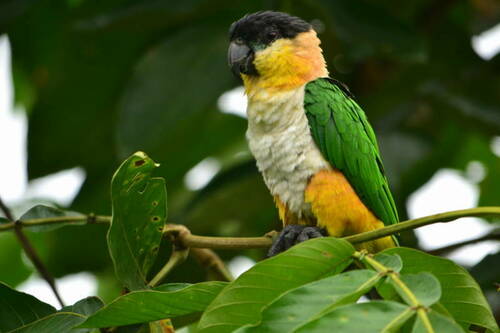
The black-headed parrot (Pionites melanocephalus) measures 21 to 25 cm (8.3 to 9.8 in) in length and weighs 130 to 170 g (4.6 to 6.0 oz), with no visible difference between males and females.
Nominate Adult Plumage
Adults of the nominate subspecies have a black cap covering the forehead to nape, with a rufous-orange band across the hindneck. The area from the lores to below the eye is green, while the lower face, sides of the neck, and upper breast are yellow. The back and wings are dull green, with dark blue primary feathers and reddish blue axillaries.
Underpart and Tail Plumage
The lower breast and belly are creamy white, and the flanks, thighs, and vent area are apricot yellow. The upper surface of the tail is green with yellow-tipped feathers, and the lower surface is olive-yellow.
Immature and Subspecies Plumage
Immature birds have pale yellow breasts and bellies. Subspecies P. m. pallidus is similar to the nominate subspecies, but has whiter breast and belly, and a paler rufous-orange band on the hindneck.
Distribution and Habitat
Nominate Subspecies Range
The nominate subspecies is distributed from southeastern Colombia east through Venezuela and the Guianas, and south into Brazil as far as the Amazon River.
P. m. pallidus Range
Subspecies P. m. pallidus occurs east of the Andes in southern Colombia, eastern Ecuador, and northeastern Peru.
Habitat Preferences
This species lives in the canopy, clearings, and edges of humid lowland tropical forest, including both terra firme and várzea types. It is also found in secondary forest.
Elevational Range
It occurs at elevations up to 1,000 m (3,300 ft), but only small numbers are found above 500 m (1,600 ft).