About Melopsittacus undulatus (Shaw, 1805)
Size Measurements
Melopsittacus undulatus, the wild budgerigar, averages 18 cm (7 in) long, weighs 30–40 grams (1.1–1.4 oz), and has a 30 cm (12 in) wingspan.
Wild Body Coloration
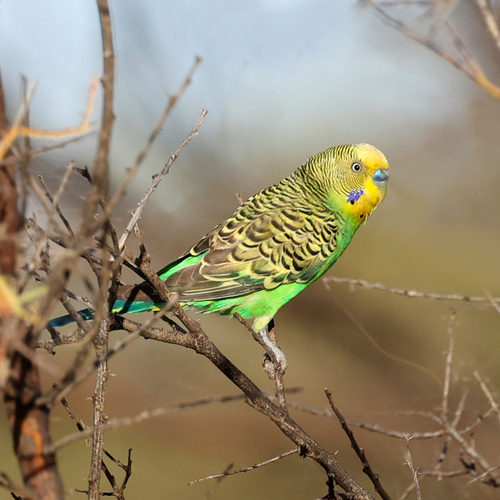
Wild individuals have a light green body, with pitch-black mantle markings (blackish in fledglings and immatures) edged in clear yellow undulations.
Adult Face Markings
Adult budgerigars have yellow foreheads and faces.
Juvenile Head Plumage
Before developing adult plumage, young birds have blackish stripes that extend down to the cere, until they reach around 3–4 months of age.
Cheek and Throat Markings
All individuals have small, iridescent blue-violet cheek patches, plus a series of three black spots on each side of the throat; the two outermost throat spots sit at the base of each cheek patch.
Tail Characteristics
The tail is cobalt, with central yellow flashes on the outer tail feathers.
Wing Features
Their wings have greenish-black flight feathers and black coverts with yellow fringes, plus central yellow flashes that are only visible when the bird is in flight or has its wings outstretched.
Bill and Limb Traits
Budgerigars have olive grey bills, blueish-grey legs, and zygodactyl toes.
Wild vs Captive Size
Wild budgerigars in their natural Australian habitat are noticeably smaller than captive-bred individuals.
Captive Color Morphs
This parrot species has been selectively bred in captivity to produce many other colors and shades, including blue, grey, grey-green, pieds, violet, white, and yellow-blue.
Common Pet Store Colors
Budgerigars sold in pet stores are most commonly blue, green, or yellow.
UV Fluorescence Function
Like most parrot species, budgerigar plumage fluoresces under ultraviolet light, a phenomenon that may be linked to courtship and mate selection.
Cere Color by Sex and Age
The color of the cere, the area that contains the nostrils, differs between sexes: it is lavender or baby blue in mature males, pale brownish or white (when not breeding) turning brown (when breeding) in mature females, and pink in immature birds of both sexes (young males usually have a more even purplish-pink cere color).
Female Cere Color Changes
Some female budgerigars only develop a brown cere during breeding season, which later returns to their normal non-breeding color.
Juvenile Female Cere Identification
Young females can often be identified by a subtle, chalky whiteness that begins around the nostrils.
Male Morph Permanent Cere Color
Males of certain color morphs – albino, lutino, dark-eyed clear, or recessive pied (also called Danish pied or harlequin) – retain the immature purplish-pink cere color for their entire lives.
Male Cere Color Mutations
Mature males usually have a light to dark blue cere, but some color mutations result in periwinkle, lavender, purplish, or pink ceres.
Additional Morph Head Traits
This includes dark-eyed clears, Danish recessive pieds, and inos, which also usually have much rounder heads.
Female Behavioral Traits
Female budgerigars are more behaviorally dominant than males of the species, and may act aggressively toward males.
Color Vision Capabilities
Budgerigars have tetrachromatic color vision, though all four classes of their cone cells do not operate simultaneously unless the bird is under sunlight or a UV lamp.
UV Role in Mate Attraction
The ultraviolet spectrum makes their feathers appear brighter to other budgerigars, to help attract mates.
Throat Spot UV Reflection
The throat spots of budgerigars reflect UV light, and this can be used to distinguish individual birds.
Captive UV Requirements
Ultraviolet light is essential for the good health of caged and pet budgerigars, but inadequate darkness or rest leads to overstimulation.
Nomadic Movement Pattern
Budgerigars are nomadic birds, and flocks leave a site when local environmental conditions change.
Native Australian Habitat
They live in open habitats, primarily the scrublands, open woodlands, and grasslands of Australia.
Flock Size Variation
They normally form small flocks, but can gather into very large flocks when conditions are favorable.
Movement Driver
The nomadic movement of their flocks is tied to the availability of food and water.
Flight Speed Flexibility
Budgerigars are capable of switching between two distinct flight speeds depending on the situation.
Large Swarm Behavior
They will sometimes swarm in groups of thousands of individuals.
Drought Habitat Shifts
Drought can push flocks into more wooded habitats or coastal areas.
Primary Diet Components
They feed primarily on grass seeds, and also eat the seeds of spinifex, and sometimes ripening wheat.
Opportunistic Feeding
They also opportunistically feed on growing cereal crops and lawn grass seeds.
Water Requirements
Because the seeds they eat have low water content, budgerigars rely on access to fresh surface water.
Florida Feral Population History
Outside of Australia, a naturalized feral population of budgerigars lived near St. Petersburg, Florida for over 50 years.
Florida Population Decline and Extinction
Increased competition for nesting sites from European starlings and house sparrows is thought to be the main cause of this population’s decline starting in the 1980s, and the entire Florida population went extinct in 2014.