About Agapornis lilianae Shelley, 1894
Common Name and Length
Agapornis lilianae, commonly known as Lilian's lovebird, measures 13 cm (5 inches) in total length.
Plumage Characteristics
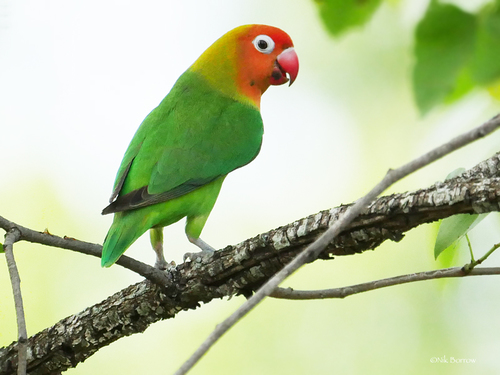
Its plumage is primarily green, with distinct white eyerings, orange coloring on the head, neck, and upper chest, and a green rump.
Sexual Dimorphism
Males and females have identical external appearance.
Similar Species Comparison (Fischer's Lovebird)
Lilian's lovebird is frequently confused with the slightly larger Fischer's lovebird, which differs by having an olive-green hood and a blue rump.
Similar Species Comparison (Rosy-faced Lovebird)
It is also generally similar in appearance to the rosy-faced lovebird, which has more clearly defined orange coloring and does not have a white eyering.
Geographic Range
This species is endemic to Malawi, Mozambique, Tanzania, Zambia, and Zimbabwe.
2004 Population Estimate
In 2004, the total wild population of Lilian's lovebird was estimated to be fewer than 20,000 individuals.
Current Core Habitat
Currently, the species inhabits Liwonde National Park (LNP), with a small number of clustered groups found in surrounding forests outside LNP.
Distribution Restriction Cause
Its distribution is rapidly becoming restricted to Liwonde National Park because feeding and breeding habitat outside the park is being overexploited for agricultural use.
Remaining Outside Habitat Status
While the full extent of habitat loss outside LNP has not been scientifically assessed, the remaining habitat outside the park consists of fragmented Miombo Forest Reserves.
Diet
Lilian's lovebird feeds on grass seeds, millet, wild rice, flowers, and the seeds and fruit of other plant species.