About Pionites leucogaster (Kuhl, 1820)
Size and Build
The white-bellied parrot (Pionites leucogaster (Kuhl, 1820)) is 23 to 25 cm (9.1 to 9.8 in) long and weighs about 155 g (5.5 oz). It is a chunky, short-tailed parrot, and males and females have identical plumage.
Nominate Subspecies Head and Upperparts
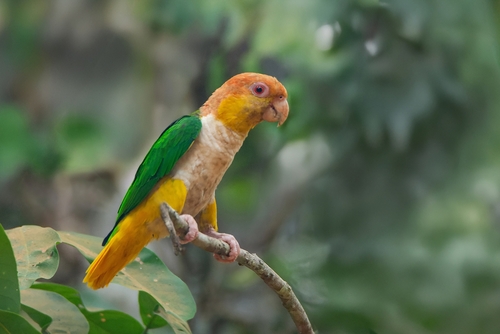
Adults of the nominate subspecies P. l. leucogaster have mostly yellow heads with orange crowns and napes. Their upperparts are mostly dull green with a bright green rump.
Nominate Subspecies Underparts
Their throat, the sides of their neck, their breast, and their vent are yellow. Their lower breast and belly are white, with bright green thigh feathers.
Nominate Subspecies Wings, Tail and Bare Parts
Their wing is mostly dull green with reddish-orange axillaries and dark blue primaries. Their tail is bright green. Their bill is pale horn colored with a bright pinkish cere, their iris is reddish brown, and their legs and feet are bright pink.
Immature Plumage
Immature birds are similar to adults, but have brownish crowns and napes.
Subspecies P. l. xanthomerius Features
Subspecies P. l. xanthomerius has an apricot-orange crown and nape, yellow thigh feathers, and blackish legs and feet.
Subspecies P. l. xanthurus Features
Subspecies P. l. xanthurus also has an apricot-orange crown and nape and yellow thigh feathers. Its tail is yellow, and it has the same pinkish legs and feet as the nominate subspecies.
Subspecies Intergradation
Both of these subspecies intergrade with each other and with the nominate subspecies.
Breast Feather Staining
The white breast feathers of the white-bellied parrot are often stained a chestnut brown (or "isobel") color. This staining is thought to be caused by tannins, resulting from the species' habit of bathing by rubbing its bodies against wet leaves and other plant matter.
Plumage Fluorescence
The head and nape plumage of the white-bellied parrot has been observed to fluoresce strongly under ultraviolet light.
P. l. xanthomerius Distribution
The three subspecies have distinct recorded distributions: P. l. xanthomerius occurs in Peru east of the Ucayali River, eastern Bolivia, western Brazil south of the Amazon as far as the Juruá River, and has been recorded in extreme southeastern Colombia since 2011.
P. l. xanthurus Distribution
P. l. xanthurus is found in Brazil south of the Amazon between the Juruá and Purús rivers, and south to the upper Madeira River basin.
P. l. leucogaster Distribution
P. l. leucogaster occurs in northern Brazil south of the Amazon between the Madeira River and the Atlantic coast in Maranhão.
Habitat Types
All three subspecies of the white-bellied parrot live in humid tropical forests, including both terra firme and várzea forest types.
Habitat Preferences
They seem to prefer forest edges and forest openings over closed forest interior. Small numbers of the nominate subspecies are also found in drier forests at the southern reaches of its range.