About Phigys solitarius (Suckow, 1800)
Adult Length & Dimorphism
Adult Phigys solitarius birds measure approximately 20 centimeters (7.9 inches) in length, and the species shows slight sexual dimorphism.
Male Plumage (Head & Torso)
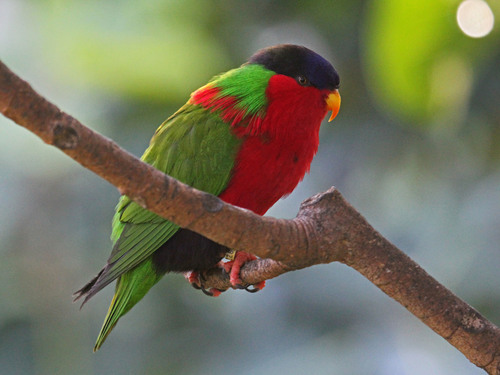
Males have bright scarlet coloring on their cheeks, throat, breast, and upper abdomen. The male crown is dark purple, while the nape combines lime green and red with some elongated feathers.
Male Plumage (Appendages & Lower Body)
The wings, back, and tail are greenish, and the lower abdomen is purple.
Male Soft Part Coloration
Males have a yellow-orange bill, pink-orange feet, and orange-red irises.
Female Plumage Differences
Females are similar in appearance to males, but their crown is paler and has a greenish hue on the posterior part.
Juvenile Characteristics
Juveniles have duller overall coloration, with vague purple transverse striations on the upper abdomen and breast; they also have a brown beak and pale brown irises.
Natural Habitat
This species' natural habitat is subtropical or tropical moist lowland forests.
Anthropogenic Adaptation & Urban Occurrence
It has adapted to live alongside humans and can be found in Suva.
Current Fijian Distribution
It occurs on Fiji's larger islands, and across the Lau Islands as far out as Lakeba and Oneata.
Historical Range & Extirpation
Though the species is currently restricted only to Fiji, fossil evidence confirms it once also lived in Tonga, where it was extirpated by early human settlers.