About Aratinga leucophthalma (Statius Muller, 1776)
Size and Weight
The white-eyed parakeet, Aratinga leucophthalma, is 32 to 35 cm (13 to 14 inches) long, with a 37 to 40 cm (15 to 16 inch) wingspan, and weighs 100 to 218 g (3.5 to 7.7 oz). Males and females have identical plumage.
Adult Plumage Base
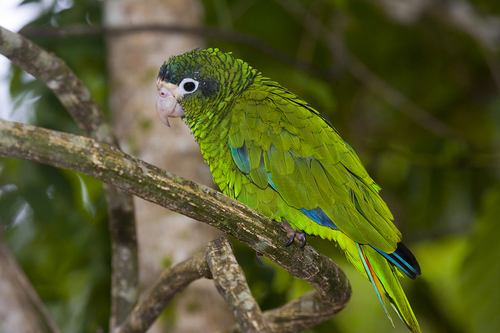
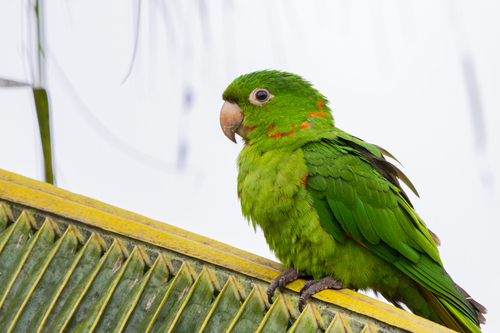
Adults of all subspecies are mostly green, with paler green underparts. They have red flecks on the head and neck.
Wing Markings
The bend and edge of the wing, plus the outermost lesser underwing coverts, are also red. The outermost greater underwing coverts are yellow.
Underside Plumage
The undersides of the flight feathers and tail are olive.
Soft Part Coloration
Their eye is orange, surrounded by bare white to yellowish white skin, and the bill is horn colored.
Subspecies P. l. callogenys Traits
Subspecies P. l. callogenys is larger and darker green than the nominate P. l. leucophthalmus.
Subspecies P. l. nicefori Traits
Subspecies P. l. nicefori has a red band on its forehead.
Juvenile Plumage
Juveniles look similar to adults, but have little to no red on the head and wings.
Nominate Subspecies Range
The nominate subspecies of white-eyed parakeet has the widest distribution. It occurs in Trinidad, eastern Venezuela extending east through the Guianas, and south through Brazil into Bolivia, Paraguay, northern Argentina, and Uruguay.
Nominate Subspecies Brazil Range Exclusions
Its range in Brazil excludes the upper Amazon Basin and the dry northeastern region of the country.
P. l. callogenys Distribution
Subspecies P. l. callogenys occurs in southeastern Colombia, extending south through eastern Ecuador into northwestern Peru, and east into the upper and central Amazon Basin south of the Amazon River.
P. l. nicefori Distribution
P. l. nicefori is only known from the type specimen collected in central Colombia.
Habitat Types
The white-eyed parakeet lives in a wide range of landscapes, most of which are somewhat open. These landscapes include dense forest edges and nearby savannahs, secondary forests, gallery forests, várzea forests (especially in Ecuador), palm groves, mangroves, and clearings in rainforests.
Elevation Range
It generally inhabits lowlands, reaching an elevation of 700 m (2,300 ft) in Colombia, 1,100 m (3,600 ft) in Ecuador, and up to 2,500 m (8,200 ft) in Bolivia.