About Pilherodius pileatus (Boddaert, 1783)
Species Identification
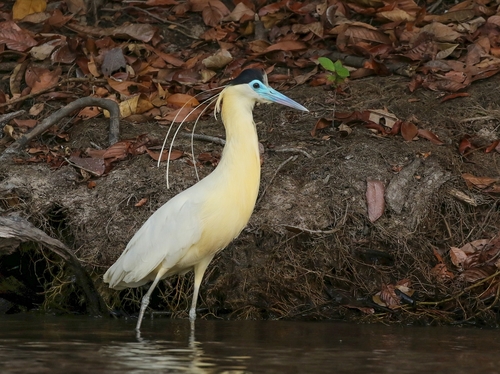
Pilherodius pileatus, commonly called the capped heron, is easily distinguished from all other heron species. It is the only heron with a blue beak and blue face, paired with a black crown.
Crown Feathers
Three to four long white feathers extend from its black crown.
Body Plumage
The neck, chest, and belly are covered in yellowish-white or light cream-colored feathers, while the back and wings are covered in white feathers. No sexual dimorphism in feather color or brightness has been recorded for this species.
Adult Body Measurements
Adult body length ranges from 510 to 590 mm, wing chord length ranges from 263 to 280 mm, tail length ranges from 95 to 103 mm, and tarsus length ranges from 92 to 99 mm. Adult body weight ranges from 444 to 632 g.
Juvenile Appearance
Juvenile capped herons are very similar in appearance to adults, differing only in smaller body size and having a slight grey tinge to their white feathers.
Species Range
The capped heron is endemic to the Neotropics, and is almost exclusively found in rainforest. It occurs in Bolivia, Brazil, Colombia, Ecuador, French Guiana, Panama, Paraguay, Peru, Suriname, and Venezuela.
Elevation Range
It generally inhabits low elevation areas up to 900 m above sea level; it is restricted to areas below 500 m in Venezuela, and below 400 m in Ecuador.
Movement Patterns
No long-distance migrations have been recorded for this species, and it is thought to be generally sedentary, though seasonal local movements may occur in Darien, Panama.
Habitat Types
It most often lives in swamps and ditches within wet grasslands or rainforest, and can sometimes be found in deeper ponds and rivers.
Foraging Locations
It prefers to forage along shorelines or on floating vegetation, but has also been observed foraging in trenches on coffee plantations and in flooded rice fields.
Diet Composition
Capped herons hunt primarily for fish, and also eat aquatic insects, insect larvae, tadpoles, and frogs. Most fish prey caught by this species are between 1 and 5 cm long.
Prey Capture Contexts
They hunt insects in vegetation near rivers or ponds, and hunt fish in shallow water.
Standard Hunting Sequence
A typical capped heron hunting sequence begins with the heron standing upright to search for prey. Once prey is located, the heron slowly crouches and extends its neck, then quickly stabs its beak into the water to catch the prey. The observed hunting success rate for this sequence is 23%.
Hunting While Walking
Capped herons can also use this same hunting sequence while walking through shallow water. They usually walk slowly, repeatedly covering the same area, pausing for a few seconds before slowly moving one foot to take a new step.
Alternative Hunting Behaviors
There are recorded observations of individual capped herons using other hunting behaviors including aerial hunting, peaking, gleaning, foot paddling, dipping, swimming feeding, and bill-vibrating.
Between-Site Movement
Capped herons move often between feeding sites, and sometimes fly up to 100 m between sites.
Foraging Period
They may be crepuscular, but have also been observed foraging in full daylight, unlike night-herons.
Social Foraging
They most often hunt alone.