About Egretta garzetta (Linnaeus, 1766)
Adult Size
The adult little egret (Egretta garzetta) measures 55–65 cm (22–26 in) in length, has a wingspan of 88–106 cm (35–42 in), and weighs 350–550 g (12–19 oz).
Plumage Morphs
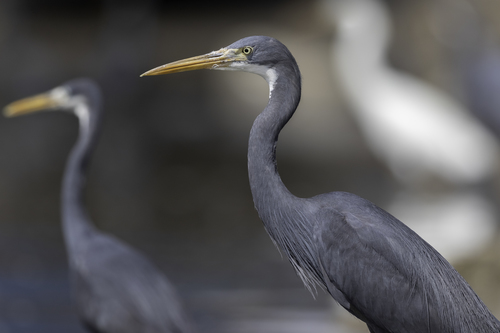
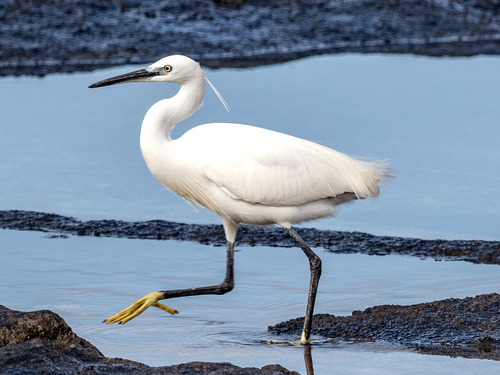
Its plumage is normally entirely white, though dark morphs exist with mostly bluish-grey plumage.
Breeding Nape Plumes
In the breeding season, adults grow two long, pointed, very narrow plumes around 150 mm (6 in) long on the nape that form a crest.
Breeding Breast Feathers
Similar feathers grow on the breast, but their barbs are more widely spaced.
Breeding Scapular Feathers
Several elongated scapular feathers with long loose barbs, which may reach 200 mm (8 in) in length, are also present.
Non-breeding Winter Plumage
In winter, the plumage is similar, but the scapular feathers are shorter and have a more typical appearance.
Bill and Lores Coloration
The little egret has a long slender bill; both the bill and lores are black.
Facial Skin and Iris
There is an area of bare greenish-grey skin at the base of the lower mandible and around the eye, which has a yellow iris.
Adult Leg and Foot Coloration
The legs are black and the feet are yellow.
Juvenile Appearance
Juveniles resemble non-breeding adults, but have greenish-black legs, duller yellow feet, and may have some greyish or brownish feathers.
E. g. nigripes Subspecies Traits
The subspecies E. g. nigripes differs by having yellow skin between the bill and eye, and blackish feet.
Courtship Color Changes
At the peak of courtship, the lores turn red, and the feet of yellow-footed races turn red.
Vocalization Contexts
Little egrets are mostly silent, but produce a range of croaking and bubbling calls at their breeding colonies and a harsh alarm call when disturbed.
Call Similarity to Other Herons
To human hearing, these sounds cannot be distinguished from those of the black-crowned night heron (Nycticorax nycticorax) and the western cattle egret (Ardea ibis), species that the little egret sometimes associates with.
E. g. garzetta Breeding Range
The breeding range of the western race E. g. garzetta covers southern Europe, the Middle East, most of Africa, and southern Asia.
E. g. garzetta Migration Patterns
Northern European populations are migratory, mostly traveling to Africa, though some stay in southern Europe; some Asian populations migrate to the Philippines.
Eastern Subspecies Ranges
The eastern race E. g. nigripes is non-migratory and lives in Indonesia and New Guinea, while E. g. immaculata lives in Australia and New Zealand, but does not breed in New Zealand.
20th Century Range Expansion
In the late 20th century, the little egret's range expanded northward in Europe and into the New World, where a breeding population was established on Barbados in 1994.
New World Range Spread
The species has since spread to other parts of the Caribbean and to the Atlantic coast of the United States.
South American Vagrancy Records
Little egrets have been recorded in South America, with most out-of-range records from Brazil and French Guiana, and there is also one recorded sighting from Colombia.
Inland Habitat Preferences
The little egret occupies a wide variety of habitats, including lake shores, rivers, canals, ponds, lagoons, marshes, and flooded land, and it prefers open locations over dense cover.
Coastal Habitat Preferences
On the coast, it lives in mangrove areas, swamps, mudflats, sandy beaches, and reefs.
Regional Important Habitats
Rice fields are an important habitat for the species in Italy, and coastal and mangrove areas are important habitats in Africa.
Association with Hoofed Mammals
Little egrets often move among cattle and other hoofed mammals.
Aquatic Feeding Behaviors
Little egrets use multiple methods to get food: they stalk prey in shallow water, often running with raised wings or shuffling their feet to disturb small fish, or may stand still and wait to ambush prey.
Opportunistic Feeding Associations
They take advantage of opportunities created by cormorants disturbing fish or humans attracting fish by throwing bread into water.
Terrestrial Feeding Behaviors
On land, they walk or run while chasing prey, feed on animals disturbed by grazing livestock and feed on ticks living on livestock, and even scavenge.
Diet Composition
Their diet is mostly made up of fish, but they also eat amphibians, small reptiles, mammals, birds, crustaceans, molluscs, insects, spiders, and worms.