About Botaurus lentiginosus (Rackett, 1813)
Taxonomy and Morphological Comparison
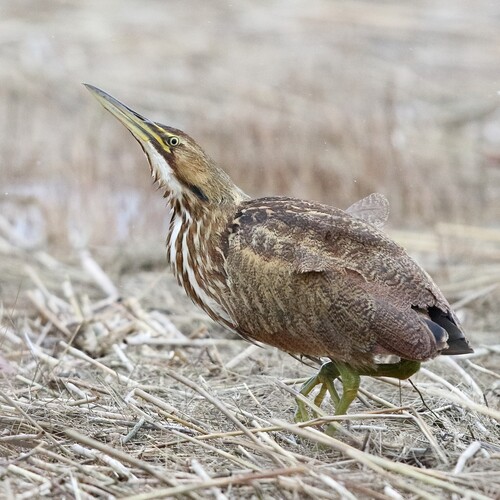
The American bittern, scientifically named Botaurus lentiginosus (Rackett, 1813), is a large, chunky brown bird. It is very similar to the Eurasian bittern (Botaurus stellaris), though it is slightly smaller, and its plumage is speckled rather than barred.
Size Measurements
It measures 58–85 cm (23–33 in) in length, has a 92–115 cm (36–45 in) wingspan, and has a body mass of 370–1,072 g (0.816–2.363 lb).
Crown and Neck Plumage
Its crown is chestnut brown, with black feather centers. The side of the neck has a bluish-black elongated patch that is larger in males than in females. The hind neck is olive, while the mantle and scapulars are dark chestnut-brown, barred and speckled with black, and some feathers have buff edges.
Back and Rump Plumage
The back, rump, and upper tail-coverts share a similar color, but are more finely speckled with black and have grey feather bases.
Wing and Tail Plumage
The tail feathers are chestnut brown with speckled edges, and the primaries and secondaries are blackish-brown with buff or chestnut tips.
Facial Plumage
The cheeks are brown, with a buff superciliary stripe and a similarly colored mustachial stripe.
Underpart Plumage
The chin is creamy-white with a chestnut central stripe, and the feathers of the throat, breast, and upper belly are buff and rust-colored, finely outlined with black, which creates a striped effect on the underparts.
Soft Part Coloration
The eyes are surrounded by yellowish skin, and the iris is pale yellow. Its long, robust bill is yellowish-green, with the upper mandible darker than the lower, and the legs and feet are also yellowish-green.
Juvenile Morphology
Juveniles look similar to adults, but the sides of their necks are less olive.
Overall Range
This species has a range that covers most of North America.
Breeding Distribution
It breeds in southern Canada as far north as British Columbia, Great Slave Lake, and Hudson Bay, across much of the United States, and possibly in central Mexico.
Wintering Distribution
It migrates south in autumn, and overwinters in the southern United States along the Gulf Coast, most notably in the marshy Everglades of Florida, as well as in Mexico and the Caribbean Islands; past records also exist from Panama and Costa Rica.
Vagrant Occurrence
As a long-distance migrant, it is a very rare vagrant in Europe, including Great Britain and Ireland.
Core Habitat
It is an aquatic bird that lives in bogs, marshes, and the thickly-vegetated verges of shallow-water lakes and ponds; these water bodies can be fresh, brackish, or saline.
Feeding Habitat
It sometimes feeds in open areas in wet meadows and pastures.